Showing posts with label discussion. Show all posts

Thursday, January 31, 2019

Philosophical Chairs- Let's Debate! Part 2...


Philosophical Chairs is similar to a debate. Students are given a central topic or question that they must choose to agree, disagree or be neutral regarding the answer. A great Philosophical Chairs discussion starts with a great topic or question, and is centered around text(s).

See my original blog post about Philosophical chairs to gain and understanding of the structure:  Philosophical Chairs

I really do think that implementing this structure into your classroom is VERY powerful for student learning.  It really does force them to think critically and at a higher level.  Also, the kids REALLY LOVE the debates!  It's engaging, fun, and develops higher level thinking skills! What reason is there to not try it out??


Here are my students doing Philosophical Chairs on the topic of Social Media.  The focus question was, "Are social media networks more harmful or helpful to our society?"
The Essential Question in our ELA Wonders curriculum for this week was "How do technology and inventions affect your life?" (4th grade, Unit 4 Week 3).  I found the connecting articles they're using for the debate on Newsela, and printed them at different Lexile levels to meet the  differing needs of my students.


To briefly summarize the process from my previous post:

I use Newsela.com as  GREAT resource to find news articles written for kids on topics that will interest them.  You can also print them at about 4 - 5 different Lexile levels to differentiate and meet the needs of your students.  Generally I try to find a topic that ties into either the Essential Question in Wonders, or topics we're studying in science or Social studies.  Also, the texts or articles chosen must insight a debate! The more the kids are interested the better and more exciting the Philosophical Chairs will be.

When I first introduce the topic of a "debate," or Philosophical Chairs, my kids will initially do this within their table groups (groups of 6).  This is to teach them the structure of the debate and to allow them to practice in this small group setting where they are more comfortable and likely to speak up.  Once we've done this a few times, I then have the kids move into the actual whole group Philosophical Chairs lesson.

As I've explained in the previous blog(see link above), the students take notes on each article/text and then develop higher level questions.  They bring their notes/questions with them to the debate and choose their side/stance for the debate.  Any students who are unsure or haven't chosen a side will hang out in the middle, and as they listen to the debate they will move to a side when they agree.  Likewise, students may switch sides during the debate at any time.  

Once the debate is finished, students then respond to the prompt, or debate question, as a written constructed response, using the RACES process (see my previous blogs for more info on RACES).
Here's another video of my kids debating an article related to technology discussing whether or not cars should be replaced with ONLY public transportation in large city centers.

For additional information, videos, and resources the Learnzillion website is a GREAT resource that will help you understand how to implement Philosophical Chairs: 
 LearnZillion- Philosophical Chairs

Collaboratively Learning,

Megan Brown

Copy of pic- Megan Brown.jpg

Sunday, January 27, 2019

Got S - t - r - e - t - c - h Text? (PART 2)


Thank you for returning to my 3-part blog regarding stretch text.  Last month, I introduced this idea of what stretch text means in the classroom.  I highlighted some frequently asked questions and this month I want to continue sharing some of these insights and questions with you!


FAQ's:

Why stretch text?  http://www.corestandards.org/assets/Appendix_A.pdf  Read pages 1 - 11


What essential questions can I use during stretch text lessons?  The one essential question that I use during ALL stretch text lessons: “What makes this text difficult?”  This simple yet powerful essential question is what I want my students to think about throughout the lesson.  By “deconstructing” the text, my students can dissect, explore, investigate, and “reassemble” the text like a puzzle.  If they can succeed with stretch text, they will certainly succeed with grade level text. Ultimately, I want my students to think about their thinking.

Where do I find stretch text?  NOT on Teachers Pay Teachers!  Instead, I have found that famous speeches or Ted Talks are ideal to use as stretch text (they are also free).  Try to select speeches that are relevant, engaging, and meaningful or that tie into Wonders anthologies in some manner.  For example, in fourth grade Wonders unit 4, week 3 includes the anthology selection The Moon Over Star.  This historic fiction selection focuses on the night of the moon landing.  You could tie the famous Moon Speech by JFK to this particular selection (which I actually have done).  Another example in fourth grade Wonders is unit 4, week 1 leveled reader “A Day in the Senate.” Last year, we deconstructed part of the Constitution using it as a stretch text in order to extend the understanding of the leveled reader.  The possibilities are endless. I try to make sure that my students understand that my selected stretch text is either part of an article, document or a transcript of a speech. This is why I try to avoid TPT worksheets or TPT articles. It is no secret that Common Core has made the understanding of technical texts a cornerstone of these new standards.  Stretch text lessons allow the teacher to at least begin to encourage and build self-efficacy within students in order to challenge them to continue “reaching and stretching” their reading abilities. My "look for" when I am searching text is mainly vocabulary. Does the text include a fair amount of academic vocabulary for students to grapple with? Be careful though! Too much may become too frustrating.

Note:  If you find a video on youtube, it usually offers the option to view the transcript.  Copy and paste the transcript onto your desktop in order to print the text for students.

How long do stretch text lessons take?  If you decide to do stretch text lessons during a 30-minute time block of UA, you can expect to take approximately three to five days to grapple with the passage.  It really depends on how deep you want students to go into the text. It is up to you and your learning outcomes.

Are there any resources that I can use?  Yes, I have included below some links that you can view at your leisure to see some examples of stretch text lessons.  Be warned, you will not find much resources by googling “stretch text.” You will usually find resources about accessing complex text (which may in itself be helpful as well):

1.  READ pages 1 - 11 in Appendix A of the common core initiative document (yes, I know it may be a struggle but, hey, if you want your students to do this, then we need to do this as well):

2.  Teaching Channel videos:
https://www.teachingchannel.org/video/teaching-declaration-of-independence


Happy Writing!
             Gustavo Macuil

Thursday, February 22, 2018

Fishbowl Discussion

Fishbowl Discussion

Image result for fishbowl discussion clipart
Would you agree that holding classroom discussions on a given topic are easier said than done?  This year in particular, I have found it quite difficult to ensure that students participate in classroom discussions.  The first few months into the school year I realized that it was always the SAME students eager to participate.  Similarly, it was always the SAME students that would choose to stay quiet during discussion.  I knew I had to come up with a solution.


“The single biggest problem in communication is the illusion that it has taken place.”  George Bernard Shaw


The quote above really resonated with me and helped me to realize that I really wasn't including everyone in discussion. It was an illusion that communication was taking place but in reality it wasn't happening with everyone. And let’s be realistic, you’re not ALWAYS going to be able to hear from EVERY single student.  However, it was always the same students participating.  I at least knew that something had to be done about that.  What about the rest?  When would I hear from them?

Do you also find that certain students dominate classroom discussions?  How do you modify classroom discussions to ensure that the shy ones also get their voices heard?  Or maybe they’re not necessarily shy but perhaps their reasons for not participating as much is that that they need more time to process their thoughts into words.  

As educators, it is always our goal to create conditions that enable students with various learning preferences and personalities to contribute their thoughts and ideas.  But this isn’t easy!  Check out the link below to see how you can start implementing a discussion strategy that my students and I have learned to love!  It’s called Fishbowl Discussion.

If you click on the following link you will see a fishbowl discussion on why it is important to work in teams. Fishbowl Discussion

Let’s ensure that all students engage and participate in class discussion.  As a step into this direction why not try the fishbowl discussion strategy?


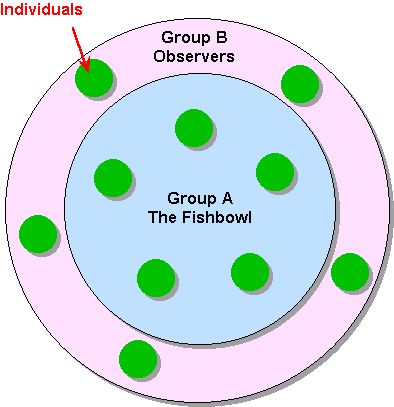
A fishbowl conversation is a form of dialogue that can be used when discussing topics within large groups.  Although many might use it for the purpose of discussing dilemmas/debates, I have found it useful to utilize this strategy in various ways.  We have used it to discuss the essential questions in Wonders, application problems in Eureka, and even to help gather more ideas in writing.  The advantage of fishbowl discussion is that it allows the entire group to participate in conversation.  Several people can join the discussion while others listen.


What does it look like?  Students are separated into an inner and outer circle. In the inner circle, or fishbowl, students have a discussion.  Students in the outer circle listen to the discussion and take notes.  You can preselect those who you want to discuss or you can also just select using equity sticks.  Keep track of those who have been in the inner circle so that next time a different group of students holds the discussion. Or even better, rotate the students around during the discussion so that everyone has an opportunity to talk and to listen on a given topic.


I have found it quite interesting to see that the more quiet students finally discuss.  Even if it’s a little bit, at least they’re voice is now being heard.  They feel more accountable and so this pushes them to participate in discussion. You will also start to see that the more you practice this strategy the less you will have to intervene to facilitate discussion.  Before you know it students will be having a conversation right before your eyes and without much scaffolding.  


I found the following website quite helpful when it came time for me to plan my discussion: Teaching Strategy: Fishbowl. It explains the process of how to hold a fishbowl discussion in more detail. I hope you find it useful too!  

What strategies do you use to help involve all your students in discussion? I'd love to find out!


Inspiring Minds,
Melissa Hernandez

Thursday, January 25, 2018

Mathematically Speaking!

Mathematically Speaking!


Getting our students to use and clearly comprehend academic language in math (and any other subject area for that matter) is not an easy task.  We know how difficult the Lexile level is for most standardized tests and understand how imperative it is that students can read and take in the terminology.  What if you could address these academic vocabulary words daily without taking a lot of time out of your busy day?


In this blog post, you’ll read about some different ways to turn your students into mathematical speakers!

Asking my students again and again what the word “sum” means always gets quite irritating.  “Boys and girls, I know you’ve heard this word ever since ___(insert grade level here).”  I don’t want to make my students feel bad, but I also want to hold them accountable for knowing their academic language especially when the word is not new to them!  How can I get my students to proficiency on a test if they can’t understand the language provided?  After thinking logically about ways to increase comprehension and vocabulary in math, I realized that a good old point system with rewards always seemed to do the trick.  However, I also knew that I couldn’t stop there.

Using some of these strategies will not solve all of your students’ academic language needs, but they’ll at least get kids motivated to participate and try harder to use more mathematical words.  Here are some of the things I do:

  1.   Write “Mathematical Speakers” on the board.  I write this on my white board because it needs to be seen the entire week.  Every time students use math vocabulary, I reward a tally mark next to their name.  The board starts off blank and each name only makes it onto the board once they earn a point (see picture at the top of the blog).  I use sticker charts in my class, so for each point received, a sticker is earned.  Once students fill up their sticker charts, they get to choose a prize from the prize box.  Each time a student receives a point, the class cheers for him or her.  I’ve even heard one of my boys say, “Alright!  You’re a mathematical speaker now!  Woo hoo!” :)
  2. When a student shares a response and does not use academic language, I simply say, "Can you restate that like a mathematician would?" The student then has to reach into his or her academic tool bag to come up with the proper vocabulary.
  3. Include important academic language/math vocabulary in your room where kids can access it.  Underneath my mathematical speakers area, I have “Math Words of the Week”.  Some of your words might stay up the whole year, and others you’ll need to update weekly.  When my students find a word during the lesson that is not on the board, they share it out loud and receive a Mathematical Speaker point.
  4. Box, underline or highlight important vocabulary words within your lessons.  When we read directions together and/or word problems, we always box the verbs so that we are aware of the action that needs to be taken.  For every verb, we number the steps.  If a problem has three verbs, then the students have three steps to complete.  We also identify and annotate other key words.  For example, if we come across the word product, we’ll highlight it and draw a multiplication sign or annotate “the answer to a x problem” above the word.
  5. During cooperative learning structures, I walk around to listen to my students' conversations.  I let them know that I'm looking for students to use their math vocabulary like mathematicians.  When I hear students using these words, they receive more stickers.  I also might stop the class to bring attention to an awesome word or conversation that I heard.
  6. Create diagrams for students to copy or paste into their math journals.  Ask students to help you label each part of the diagram. See example below:
  7. Design a Kahoot or some other formative assessment to continuously spiral through math vocabulary words. The more they practice and have access to this language, the better.

These are just some of the things we like to use during math time.  I’m sure you have many creative and helpful ideas, and I’d love to hear about them!  Please comment below about some of the things that work well for you!

Educating together,
Kimberly Smith Loya


Monday, December 11, 2017

Philosophical Chairs- Let’s debate!


Philosophical Chairs- Let’s debate!
Learning takes place when critical thinking is happening.  Being able to think critically about an issue to solve a problem is a skill that students need not only to be successful in school, but throughout life.  Teaching students how to discuss and debate an issue (rather than argue) based on facts and information is not only a great, but powerful way to enhance students critical thinking skills. Philosophical Chairs allows students to think and discuss on a critical thinking level, and then allows them to apply their ideas or opinions to writing.


As seen here, my students recently participated in their second Philosophical Chairs debate on the "Christopher Columbus Day issue."  You see each of the opposing sides lined up across the room from each other, as well as the "neutral" kiddos seated in the middle.

The Power is in the discussion! Get your kids thinking deeply and critically about texts and issues, and watch their learning soar.

When you hear students develop their own opinions about a topic based on what they’ve read, researched, and discussed, that’s when you know all your efforts as a teacher are worth it!  Over the past couple of years where I have really started incorporating a lot more collaborative conversations, philosophical chairs, and socratic seminars, I have noticed that my kids will start researching topics on their own.  Often they come into class and tell me how they researched a topic that we had learned/discussed in class and what they learned about it.  To me that’s extremely powerful because not only are they learning what I taught them to do, they are making those connections and applying them to their everyday lives.  They're starting to think critically all on their own! #TeacherGoals

“For good ideas and true innovations, you need human interaction, conflict, argument, and debate” -Margaret Heffernan

Here are my student's engaging in their first Philosophical Chairs debate this school year (read below for more details). Although not perfect they're off to a great start!

You can get started right away preparing your students for Philosophical Chairs! Here are some simple steps to take:


Often times you can simply use the Essential Question for the week in our Wonders adoption to focus your debate around. If not the exact question, you can use it as your focus area of study, and then reword it appropriately for the debate.  In the video just above, my students are debating the weekly Essential Question from Wonders that stated “What are the positive and negative effects of new technology?” With this being the basis of study for that week and also the week before having had a similar theme, students had opportunities to read many texts and gather information within our Wonders curriculum.  Additionally I found 3 articles on Newsela.com (a GREAT site that has current news articles for kids) that also discussed pros/cons of new technology. The students read and took notes on these as well. The question I posed for the Philosophical Chairs debate was “Are advancements in technology more helpful or harmful to our society?”

  1. If using the Essential Question in Wonders (or something closely relating to) then majority of your reading and information gathering is already presented in the Wonders texts and curriculum.  Guide students through note-taking and discussion on the topic.  I always find additional sources for them to read and take notes on such as Newsela articles and even short video clips from Discovery Education or YouTube.
  2. Once all research and notes have been gathered, I have students write a couple of Level 2 and Level 3 questions (Costa’s) about their learning. This is so they have some ideas/questions of their own prepared to discuss. I will display the prompt(question) that will open the debate and then have them gather their notes and move to the side of the room they most agree with.  In this case they were choosing between whether new technology is more helpful, or that it is more harmful to our society.  Students who are “neutral” or unsure stay in the middle of the room.  
  3. Students may only speak one at a time.  The person speaking will step forward and present his/her idea, thought, or question.  Then a student from the opposing side will step forward, summarize (or restate) what the previous person just said, and then add his/her rebuttal.  Students in the middle may also stand up and ask questions at any time.
  4. Students need to wait until 2 other people on their team have spoken before they can speak again (so 4 turns back and forth).  You want to remind the students not to attack the “person” and that they are just discussing the “ideas.”
  5. Any student from any side may move to another side at any time they’ve heard information that has persuaded them to feel differently.
  6. Once the debate is over, I have the students respond to the prompt (the original debate question) through a constructed response writing process (I use the RACES Writing format).  Sometimes they will write their RACES response on paper, and other times I have them complete their writing through a Google Classroom assignment.

Philosophical Chairs is an ongoing work in progress.  The video you see above is the first time my students attempted the process this year (about a month ago).  As you can see, it is not perfect, but overall they did well! It helps if you have been conducting text-based collaborative conversations already, as the kids are experienced in discussing with one another and using text evidence to support their opinions.  One thing I will be working on with my students as we progress in this activity throughout the year, is an emphasis on restating what the person before them has said. I hope I have inspired you to try this out in your classroom, it's fun and easy to implement, and the kids LOVE doing it!


Collaboratively Learning,
Megan Brown
Copy of pic- Megan Brown.jpg
OMSD.jpg


Most Viewed Posts