Showing posts with label student talk. Show all posts

Tuesday, December 10, 2019

Collaborative Conversations with Kagan

Collaborative conversations when done though the proper cooperative learning structures (aka Kagan), can be soooo incredibly powerful for student learning! Powerful AND engaging! My students absolutely love doing collaborative discussions. And you may be thinking, "How is this effective? How is letting the kids talk in groups not a waste of time?" Well I'm gonna show you just how effective it is!

To start, you want to make sure you've constructed appropriate collaborative learning groups.  Meaning you want to have an even mix of High, Low, Medium, GATE, EL, EO students, etc.  This keeps the groups well balanced and supports differentiation of instruction for students at all levels.  They are all able to contribute and learn at their own level, while accessing the same content classroom wide.  This is very important to maximize learning. (To learn more about Cooperative Learning structures, see my previous blog posts here: Cooperative Learning Structures  and also here: More on Cooperative Learning Structures/Kagan)

Once you've  created these evenly balanced groups, you want facilitate team building activities.  These are non-academic activities that help students to get to know each other, and to understand the importance of working together as a team, establishing each of their strength's etc.  These activities could be something like building something, creating something, building words out of letters, etc.  This piece is extremely important to help foster student's sense of belonging, and comfort-ability working with each other.  If you skip this essential step, you will probably not get full participation from ALL of your students within their table groups. (see my previous blog for more info in Team Building here: Team Building with Kagan)

Now you're ready to start collaborative, higher level academic discussions! I also teach the students "accountable talk" sentence frames, so that they know how to have a discussion.  Often times I use the Essential Question from the Wonders ELA curriculum that week as the focus point of the discussion, as well as the reading comprehension skills taught that week.  Or, I have students annotate the text before the discussion and have them use their annotations to guide their discussions.  Often times, I will incorporate all of the above into one lesson/discussion.  I also use the Kagan Software with the random selector tools, to choose students at random to share out after each discussion any random selector software, or even just equity sticks will work!).  The students are taught that they can share their idea or one discussed at their table.  I find that my students are VERY  excited to share their peers' ideas just as much as they are their own.  Through establishing these cooperative learning groups and academic talk, my students are VERY VERY good at complimenting each other, giving each other positive feedback, helping out their peers when in need.  Its really endearing and super cute to watch them.

I  have seen my students year after year, make huge gains and growth in their reading comprehension skills as well as test scores.  Structuring these academic discussions in the correct manner helps facilitate students reading, writing, and research skills, in addition to helping strengthen their speaking and listening skills.  These types of discussions also help students develop a strong understanding of being able to site the text in order to support an original thought or idea of their own.  I encourage you to start using these collaborative discussions in your classroom right away! 

Collaboratively Learning,

Megan Brown
Copy of pic- Megan Brown.jpg

Thursday, February 22, 2018

Fishbowl Discussion

Fishbowl Discussion

Image result for fishbowl discussion clipart
Would you agree that holding classroom discussions on a given topic are easier said than done?  This year in particular, I have found it quite difficult to ensure that students participate in classroom discussions.  The first few months into the school year I realized that it was always the SAME students eager to participate.  Similarly, it was always the SAME students that would choose to stay quiet during discussion.  I knew I had to come up with a solution.


“The single biggest problem in communication is the illusion that it has taken place.”  George Bernard Shaw


The quote above really resonated with me and helped me to realize that I really wasn't including everyone in discussion. It was an illusion that communication was taking place but in reality it wasn't happening with everyone. And let’s be realistic, you’re not ALWAYS going to be able to hear from EVERY single student.  However, it was always the same students participating.  I at least knew that something had to be done about that.  What about the rest?  When would I hear from them?

Do you also find that certain students dominate classroom discussions?  How do you modify classroom discussions to ensure that the shy ones also get their voices heard?  Or maybe they’re not necessarily shy but perhaps their reasons for not participating as much is that that they need more time to process their thoughts into words.  

As educators, it is always our goal to create conditions that enable students with various learning preferences and personalities to contribute their thoughts and ideas.  But this isn’t easy!  Check out the link below to see how you can start implementing a discussion strategy that my students and I have learned to love!  It’s called Fishbowl Discussion.

If you click on the following link you will see a fishbowl discussion on why it is important to work in teams. Fishbowl Discussion

Let’s ensure that all students engage and participate in class discussion.  As a step into this direction why not try the fishbowl discussion strategy?


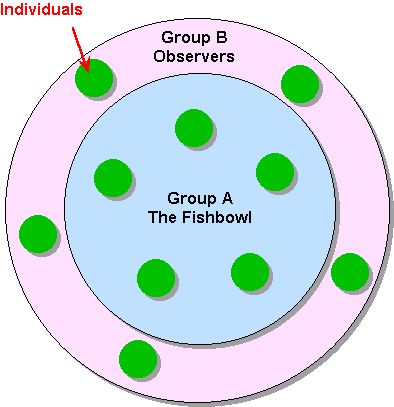
A fishbowl conversation is a form of dialogue that can be used when discussing topics within large groups.  Although many might use it for the purpose of discussing dilemmas/debates, I have found it useful to utilize this strategy in various ways.  We have used it to discuss the essential questions in Wonders, application problems in Eureka, and even to help gather more ideas in writing.  The advantage of fishbowl discussion is that it allows the entire group to participate in conversation.  Several people can join the discussion while others listen.


What does it look like?  Students are separated into an inner and outer circle. In the inner circle, or fishbowl, students have a discussion.  Students in the outer circle listen to the discussion and take notes.  You can preselect those who you want to discuss or you can also just select using equity sticks.  Keep track of those who have been in the inner circle so that next time a different group of students holds the discussion. Or even better, rotate the students around during the discussion so that everyone has an opportunity to talk and to listen on a given topic.


I have found it quite interesting to see that the more quiet students finally discuss.  Even if it’s a little bit, at least they’re voice is now being heard.  They feel more accountable and so this pushes them to participate in discussion. You will also start to see that the more you practice this strategy the less you will have to intervene to facilitate discussion.  Before you know it students will be having a conversation right before your eyes and without much scaffolding.  


I found the following website quite helpful when it came time for me to plan my discussion: Teaching Strategy: Fishbowl. It explains the process of how to hold a fishbowl discussion in more detail. I hope you find it useful too!  

What strategies do you use to help involve all your students in discussion? I'd love to find out!


Inspiring Minds,
Melissa Hernandez

Most Viewed Posts