Showing posts with label AVID. Show all posts

Tuesday, October 26, 2021

Digging Deeper Into Learning Strategies: Close Reading for Exceptional Learners

 By Heather Pfrunder, M.A.Ed.   SDC Teacher and Education Specialist

October 25, 2021


The written word...oh how I love thee!  I could wax poetic for at least 5 pages on how much I LOVE reading, and even writing!  However, teaching this all encompassing and vital subject had me shaking in my boots as a new teacher.  There is just sooo much to cover.  In fact, my first several years of teaching I merely tested the waters of what I might explore versus really developing deeper strategies.  Upon my third school year teaching, and my first at OMSD, I really began to grow in this area.  However, implementing strategies which include writing to learn seemed daunting to students that barely acquired phonics skills and were challenged to learn vocabulary.   So I went down checklists: What do my students need to learn?  What is required that they have exposure and learn to use strategies comparable to their typical peers -- particularly AVID?  How do I select texts?  So hang tight - because this post has every resource I’ve ever created (and 2 I gathered) for ELA -- all downloadable!


What do my students need to learn? 


  1. A-typical/autistic students require visuals (i.e. pictures) to help them relate the written word to a concept.  This strategy is also helpful for students with cognitive delays or are Language Learners (that covers 100% of my students and probably a few of your students, too).

  2. Repetitive practice to understand the task demand so that they can focus on the actual learning/application of learning.

  3. Simplicity - while a concept can be complex to a degree, the format needs to be not too visually busy.


What Strategies Do I Need to Teach?


From a fundamental standpoint I need to address the following skills, as all reading comprehension rests on the following (and note - I usually teach them in this order):

  1. Wh- Questions

  2. Story Sequence

  3. Story Retelling

  4. Citing Text Evidence

  5. Identifying Themes

  6. Metacognition While Reading


Added to that are specific expectations of how learning should occur: AVID (i.e. column notes/WICOR, RACES, Thinking Maps, Costa’s Levels of Thinking), and of course, our district appointed curriculum: Wonders.


Starting with Wh- Questions, try using a mat to reference Wh- Mat Free Resource

Then break it down: Using a graphic organizer


This one I created. It has the blue shading because most of my students

are also challenged with their handwriting skills.


Story Sequence: For this one I typically start with taking pictures of the story.  Students can reference the book to match the order.  Notice the difference between the two sets of visuals: the one I used earlier in the year also includes the text for students to cite.  As they become more proficient, they are expected to find the words in the actual text:


Notice the Select Your Theme at the bottom? After a passage/story
review, they are given options to identify the type of story and the
change or significance of the story.
                                                                  

Story Telling: I created several versions of this graphic organizer, each version addressing Costa’s Levels of Thinking.  Below is the simple level one thinking.

Yup… I love the “Someone, Wanted, But, So, Then, Finally” format of story retelling.  You pretty much can’t go wrong with simple stories.  For added challenge, students really have to pay attention to time frames in a story if it starts with a “flash-forward.”


Citing Text Evidence:  Joint-attention is challenging enough when you are looking at a book and then worksheet to complete your work.  Add a graphic organizer on the wall to this, and well… who’s lost?  Everyone! Sigh… Solution?  Imbed the expectations right into the worksheet.  Make the worksheet a template and apply, and reapply… over time the concept is learned! Not only are we citing text evidence, but we are also reflecting on the Essential Question that is posed within the Wonders Curriculum.
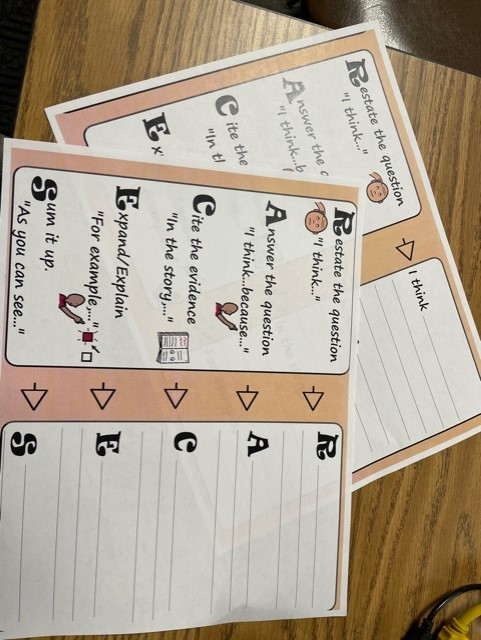


Note: there are two different versions of this RACE and RACES - 

Start with RACE for beginning learners.


Identifying Themes: This always has me near tears.  Abstract concepts are so hard for my students to connect with!  But then I realized that the solution could be as simple as basic story themes themselves!  Aren’t common themes recycled in most literature?  Especially simple literature?  I started with Thinking Maps about story problems/solutions, and then after this reflection, the Thinking Map for Story themes became a matter of visual connect-the-dots.
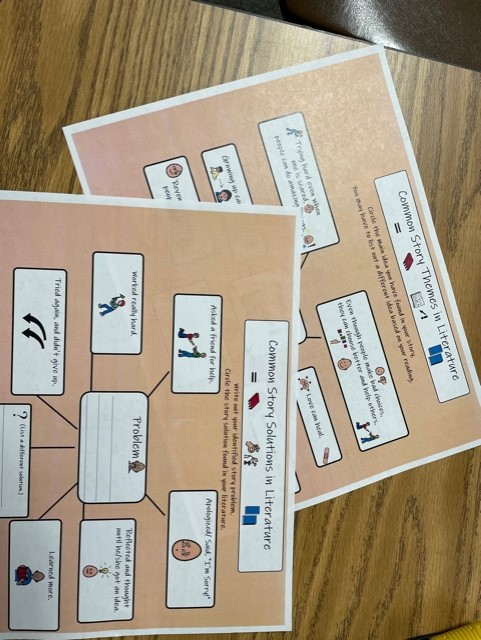

Story Problems and Story Themes are laid out into Thinking Maps. 

While Thinking Maps are meant to help students organize their own thoughts,

Modeling with them also has benefits.


Metacognition While Reading: While all of the previous graphic organizers can address metacognition with additional visuals and check in’s, there is one strategy that made an amazing difference for my more advanced learners, and that is the CSR Learning Model. Of note that the CSR model is not only a reflection of reading comprehension, but done correctly, it is also done in collaboration with a peer.  So think about Kagan strategies in conjunction with this.  CSR stands for: “The Collaborative Strategic Reading (CSR) strategy incorporates cooperative learning, vocabulary development, questioning techniques, opportunities to practice, and students’ use of prior knowledge” (Per: nysrti.org/intervention-tools/reading-tools/tool:csr/).

In its simplest of explanations, students reflect on what they “get” or the “GIST” of a passage/story and what they “don’t get” or the “CLUNK” of the passage/story.  Often, this boils down to vocabulary or word usage.  And for this I like to use the Frayer Model to do a deep dig dive on a per student vocabulary.  What I love about this is that vocabulary learning now becomes not based on teacher assigned work, but student identified need.  By the end of the process/last multiple read students really have looked deeply into what the passage says.  (Of note: while this works for all texts, I really like to begin with non-fiction texts of interest, especially those with more academic words.)
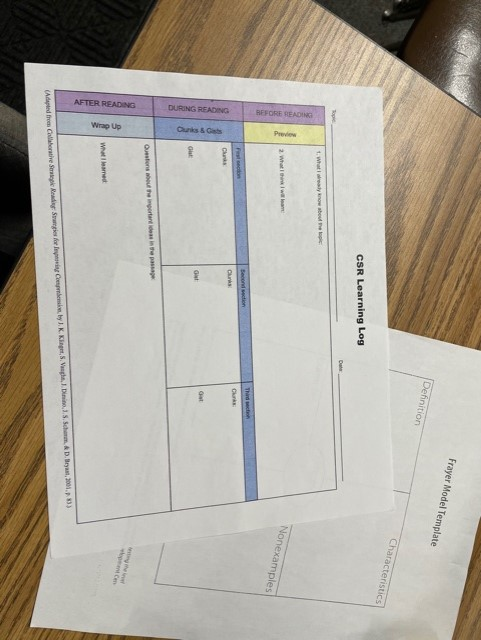

This is a simple graphic organizer with the before, during, and after reflections. 


For more on the CSR model you can explore: https://iris.peabody.vanderbilt.edu/module/csr/cresource/q1/p01/#content


Everything I have shared and More can be downloaded here:

Close Reading Strategies for Diverse Learners


So at this point I have shared a lot of resources and strategies.  Hopefully one or more will help you and your students on the very long road to English proficiency.  While all of these resources are created to exist in conjunction with the texts, often the question lies in which text to pick -- after all the provided resources of Mc-Graw Hill’s Wonders program can seem like an ocean when prep time demands that you select from a more pond-sized selection.


How Do I Select Texts?


For this I am suggesting that selection is either for UA/ELD support or if you are in an SDC setting like myself - you are adjusting based on IEP goals. So here goes the short version at the end of a long blog post!


  1. I actually like the Phonics Readers to begin teaching how to use strategies.  The simple text helps students focus on the main points.

  2. From there I go to the Anthology texts using the above shared graphic organizers.  I focus on main events and new vocabulary. I typically begin each story with a short video clip to introduce the topic and/or vocabulary slides.

  3. From there I go into using the Close Reading Companion (Grade 1-2) or Wonderworks (Grades 2- and beyond): story selections are vocabulary rich, with visuals, and tend to be slightly shorter than the Anthology.  I shift to this resource because the embedded questions on the page are much easier to navigate but are also complex enough to challenge and expand their understanding beyond the initial graphic organizers I have shared. Additionally, students can underline not only the work cited, but the key words in the questions being asked.


Over the years I have used supplemental resources (as found on teacherspayteachers.com) or programs like “Read Naturally,” but the idea is that students have access to high quality texts and are commensurate to their typically developing peers.  In this, adapting strategies to work in conjunction with the Wonders curriculum not only meets the unique needs of the students, but allows them access to the general education curriculum.


Like what you read?  Join me in upcoming blog posts where I continue to put these strategies into place and share resources!


Tuesday, August 24, 2021

Growth Mindset: Successful Students with Jot Thoughts


During the first few weeks back to school, it's so important to build a sense of community and belonging amongst your students.  You want them to feel that your classrom is a safe place to learn and share.  Through all the team building and classroom building activities that I engage my students in the first few weeks, I think it's equally important to place an emphasis on Growth Mindset.  We know that your mindset can change or determine your outcome and success, and that's so very true for our students as well!

Being as though we are an AVID school for many years now, one of the first activities we do at the start of the year is something called the "Successful Student." For this activity, students will brainstorm words that show what it means to be a successful student.  I copy the outline of a person onto cardstock and here they decorate the person to look like themselves and fill the poster with words that describe being a successful student.


I incorporated Growth Mindset into this activity by asing them to think of things they feel they're not good at "yet" or things they want to become better at as a studnet this year.


I used a collaboratve learning Kagan strategy called "Jot Thoughts" to help guide and facilitate discussions about growth mindset and what it means to be a successful student.  You can see the pictures I've included of this Jot Thoughts strategy as my students engaging in these discussions the first week of school!  You can also see the photos of the finished product of the "Successful Students."

This "Successful Student" activity is just one example of a very simple way to use collaborate learning (Kagan- Jot Thoughts), and Growth Mindset to help students engage in positive thinking. It's also a super fun activity, helps them to learn how to work together, and not to mention they look super cute up on the wall!

Collaboratively Learning,

Copy of pic- Megan Brown.jpg

Thursday, April 25, 2019

One Pager - I am excited . . .

A couple months ago I wrote about doing a One-Pager with my math students and that I would give
an update on how it went.  My 8th graders have completed one of these activities and my 7th graders just completed their second one.

Well, I cannot contain my excitement about what I received from my students and the possibilities I see happening for next year.

Why am I so excited?  The products I received were all student created with very little direction from me.  I handed out the expectations and then let the students self-create their own product.  The students were able to capture the important facts for the unit of study, draw diagrams for the unit, list key vocabulary words, and ask two questions that they had about the topic of study.  While some of the final products lacked the eye appeal you might expect, there were so many the showed a huge effort to make them professional looking by adding color and setting them up in a easy to read fashion.


I wonder to myself what would have happened if I had actually shown examples of high quality work to the students as what I am expecting?  Without any guidance from me (besides the one page expectation handout), students were given free reign to design the One-Pager however they wanted.

Another small detail that I enjoyed was that students laminated their One-Pager on the day it was due.    This small detail seemed to show students that I felt this was an important document that I wanted them to keep for a long period of time.  While there is an expense on my part for doing this, I will continue with this practice as it ups the ante and allows students to keep something from being destroyed.

Next steps . . .

First, the 7th grade math team has agreed to prepare students for 8th grade by reviewing integer operations and solving equations after SBAC and before the end of the school year.  To that end, math 8 teachers will be visiting each of the math 7 classes and asking the students to complete a One-Pager for each of the topics.  Students will be shown examples of One-Pagers completed by 8th graders so that all students have a visual of what is expected.  The final documents will be put back-to-back and laminated, collected and saved for students to use next year.  The hope is that students will create documents that will be usable next year and give math 8 teachers some initial insight into students personal understanding of two key topics.

Second, next year, every 8th grader will create a One-Pager for each of the topics taught throughout the year.  These One-Pagers will then be used during our sprint to SBAC review and any common assessments given throughout the year.  The hope is that students will take pride in their work since they will be allowed to use them throughout the year and that they will become meaningful for every student.

I am thankful to our site's AVID team for presenting this type of student understanding conceptual.  I firmly believe, that as educators we hear different strategies throughout our teaching career, and many times we hear the same ones from time to time.  Yet, sometimes we are not at a place to use the strategy or it does not ring true for us at that time - but then at a later time, the same strategy is presented and we find so much value and meaning in it.  Continue to be open to strategies that are presented by your colleagues and value the time that they have put into the presentation.


Kevin Stott

Tuesday, April 9, 2019

Poetry Madness


Every year it is a challenge to bring in some great examples of interesting and thought provoking poetry which connects to our unit of study.  Each time I am usually met with groans of frustration at "hating poetry."  I even hear the same responses from other teachers and I get it...poetry IS hard because it is often not straightforward, but it doesn't have to be groan-inducing.

An amazing reversal poem
written by an inspired student..
Read each line top to bottom
then bottom to top.
This year I wanted to try a different approach.  I had seen mention online of an approach other teachers take and I decided that what my students really needed was to find enjoyment in reading poetry, not to understand structures and analyze difficult texts. Poetry March Madness was the key to my struggles!

Honestly, I was not expecting this to be as exciting as it ended up being for my classes but it ended up being what they looked forward to every day.  I went from hearing, "Ugh. A poem." to "Are we going to read poems today?" and in the end I even had kids voluntarily writing poems emulating the structures of some that we looked at.  Amazing, right??

Really this was a pretty simple thing once I had it all set up.  Here is what I did.

Five Steps for Poetry Madness Success
1. Select 16 poems. I used lists I found online, poems recommended by other teachers, and poems that connected to our current novel unit. I tried to pair each set of poems by subject or style.  Then I placed them in the brackets.  Poetry March Madness Brackets
2. Read two poems with your students every single day. 
3. Briefly discuss the poem ("What did you like about the poem? What do you think the point of it is?")  Keep the discussion brief and positive. This took no more than 10 minutes each day. I printed both poems side by side and also projected them onto the board.
4. Allow students to vote for their favorite of the two poems. I used Plickers and Google Forms but also sometimes had them get up and move to the right or left side of the room according to their votes.
5. Repeat the process for all eight pairs/16 poems.  Round 2, 3 and the finals will be quick. (See the video for how the bracket works). The whole process takes 15 days.

Things I learned in the process
1. Choose equally amazing poetry so that it is difficult for students to decide.  I was able to turn some of the discussions into an impromptu Philosophical Chairs discussion because they were struggling to decide.  When we read "Nothing Gold Can Stay" and "We Real Cool," I only had a few votes for "Nothing Gold Can Stay." I knew if they talked it through, the votes would change. I let them debate a few minutes and the final vote ended up being really close in all groups.
2. Reflect on the discussions from students and make adjustments. Next year I'll probably adjust the first four poems.  They were great for round one but didn't really stand a chance in rounds 2 or 3 because there wasn't a lot of depth to them. I also ended up changing two poems near the end because of the timing we would have read them. It would have given away a big plot point in the novel we were reading if I had kept them.
3. Don't tell them that "The Rose That Grew From Concrete" was written by Tupac until after they discuss and vote.  I learned this one quickly and changed my approach for the second class!

Our School-wide Read unit after testing focuses on poetry and I know that getting my students excited to read, analyze, and then write poems will not be hard this year!

Comment below with something that you tried out and found that it worked better than you expected it to.  I can't wait to see what you share!

Keep the magic alive,


Kandyce Valverde
Follow me on Twitter for more classroom updates! @valverderules 

Thursday, January 31, 2019

Philosophical Chairs- Let's Debate! Part 2...


Philosophical Chairs is similar to a debate. Students are given a central topic or question that they must choose to agree, disagree or be neutral regarding the answer. A great Philosophical Chairs discussion starts with a great topic or question, and is centered around text(s).

See my original blog post about Philosophical chairs to gain and understanding of the structure:  Philosophical Chairs

I really do think that implementing this structure into your classroom is VERY powerful for student learning.  It really does force them to think critically and at a higher level.  Also, the kids REALLY LOVE the debates!  It's engaging, fun, and develops higher level thinking skills! What reason is there to not try it out??


Here are my students doing Philosophical Chairs on the topic of Social Media.  The focus question was, "Are social media networks more harmful or helpful to our society?"
The Essential Question in our ELA Wonders curriculum for this week was "How do technology and inventions affect your life?" (4th grade, Unit 4 Week 3).  I found the connecting articles they're using for the debate on Newsela, and printed them at different Lexile levels to meet the  differing needs of my students.


To briefly summarize the process from my previous post:

I use Newsela.com as  GREAT resource to find news articles written for kids on topics that will interest them.  You can also print them at about 4 - 5 different Lexile levels to differentiate and meet the needs of your students.  Generally I try to find a topic that ties into either the Essential Question in Wonders, or topics we're studying in science or Social studies.  Also, the texts or articles chosen must insight a debate! The more the kids are interested the better and more exciting the Philosophical Chairs will be.

When I first introduce the topic of a "debate," or Philosophical Chairs, my kids will initially do this within their table groups (groups of 6).  This is to teach them the structure of the debate and to allow them to practice in this small group setting where they are more comfortable and likely to speak up.  Once we've done this a few times, I then have the kids move into the actual whole group Philosophical Chairs lesson.

As I've explained in the previous blog(see link above), the students take notes on each article/text and then develop higher level questions.  They bring their notes/questions with them to the debate and choose their side/stance for the debate.  Any students who are unsure or haven't chosen a side will hang out in the middle, and as they listen to the debate they will move to a side when they agree.  Likewise, students may switch sides during the debate at any time.  

Once the debate is finished, students then respond to the prompt, or debate question, as a written constructed response, using the RACES process (see my previous blogs for more info on RACES).
Here's another video of my kids debating an article related to technology discussing whether or not cars should be replaced with ONLY public transportation in large city centers.

For additional information, videos, and resources the Learnzillion website is a GREAT resource that will help you understand how to implement Philosophical Chairs: 
 LearnZillion- Philosophical Chairs

Collaboratively Learning,
Megan Brown

Copy of pic- Megan Brown.jpg

Tuesday, January 29, 2019

ONE PAGER AND FLIPGRID IN A MATH CLASSROOM


Have you gone to a training and had a takeaway that makes you excited?

This past week in our site's PD there was an AVID presentation by our AVID site team.  One aspect of it was a round table learning about ONE PAGERS.  I got excited about the prospects of this student generated activity.  Students take a topic and create their own final product about their learning.  The activity allows students to respond with their own imagination while consolidating their learning into a brief one page product - that makes connections between words and pictures.  What a great way to end a unit of study in math - students create their own One-Pager that captures their essential learnings for the unit of study.  I went home and googled one pager examples and came up with the above image.  I am just finishing up a unit on system of equations with my 8th graders - and what a great way for them to capture what they learned during our study.  I believe in rubrics so I also researched rubrics for One-Pagers and found several that I could modify for my class.  I will share examples of next month of my students' work.  But I wanted to share something that was exciting for me this past week and let you know where it ends up.


In addition to this new idea, I also took a tentative step into the world of Flipgrid.  This resource
allows students to verbalize their learning.  I learned about it from my grade level science teacher that I partner up with to do our cross-curricular projects with.  We decided that our current Crayon Project would be a good place to see how this works with our students.  I did my first Flipgrid video with the students last week - where they had to verbalize their rationale for choosing the number of crayon boxes that OMSD needs in order to replace all the boxes in the District.  Students were hesitant at first to have themselves videotaped but after getting them to really focus on their writing it was much easier for them.  One of the mathematical practices is Communicating Reasoning so this resource offers a different way to capture this practice.  I also feel that this is a good 21st Century Skill to develop in that students need to communicate clearly and effectively their reasoning so that others can understand.  For those of you who missed it, Jennifer Merry on January 17 posted a well written description of useful tips for using Flipgrid in your classroom - she has done a great job of giving a sequence of tips to make it easier for you.


This month was sharing two ideas that I have not completed in my classroom but have come across in the past month as something that I am willing to try and see where it goes.  For me, this is one aspect of teaching that I really enjoy - trying something new.  If the end result is something better for my students then it is well worth the time and energy.  If it fails, then I pick myself up and see what else I can learn to make a positive impact with my students that is meaningful and relevant.


Will return next month with an update of both of these new ideas that I am trying.


Teaching and still loving it,


Kevin Stott
De Anza Middle School

Tuesday, August 28, 2018

Buckle Up Friends! It’s Going to be a Bumpy Ride.


Buckle Up, Friends!

It's Going to be a Bumpy Ride

You know that tingly feeling of anticipation that you get when
you buckle yourself into a roller coaster ride? Well, that’s the
feeling I get at the beginning of every school year. I love the
sense of infinite hope and expectation that distinguish those
first few weeks of school from the rest of the year. There’s a palpable sense of expectation in the air.


The pencils are sharp and inviting.

Minds are open and eager to learn.


Don't get me wrong. You're scared,
If you want to make the ride fun for you and your students,


but in a good way. And even though you know how "the ride" is going to end,
it always feels different.
You may have new students. Perhaps you're working with a
new grade level and learning a new curriculum.

Keep your eyes wide open and be present in the
moment. Embrace everything that our district has to offer.
We are fortunate to have coaches to support us with technology, Wonders, Eureka Math, and E.L.D. Spend some time investigating Symbaloo.

There are a multitude
of varied resources for
you and your students.

As classroom educators, there is a lot that is outside of our control. That being said, we have TREMENDOUS impact on our students when they are in our classrooms. So how can we make the most of the time that we do have. Prepare by planning, plan by preparing, and take advantage of every teachable moment.

“Place your hand over your heart. Feel that? That’s
called a purpose. You’re alive for a reason.
Don’t give up.”  Anonymous


Still Enjoying the Ride,

Lola Jollie


Monday, March 12, 2018

Socratic Seminar


Socratic Seminar!          
Involving your students in a Socratic Seminar is one of the best ways to encourage a higher level of thinking and a deeper understanding of important texts and topics. Socratic Seminars also teach kids to establish how to discuss and build ideas off of one another. "This type of student-led discussion (based on Socrates’ method of student inquiry rather than teacher lecture) elicits student ownership, deep thinking, critical questioning,academic vocabulary usage, and a rooted sense of community. Although the teacher is seemingly offstage, a meaningful and effective Socratic seminar only occurs through intentional planning." -Edutopia

Teaching your students to conduct a Socratic Seminar is one of the most powerful teaching tools you can implement as a teacher!

"Socratic Seminar focuses on deep discussion around a central text, so it is important that complex, rich texts are chosen that invite multiple interpretations and negotiation to arrive at meaning." -AVID

For this Socratic Seminar the students are focusing on “positive change” and “taking action.” This was based on the 5th grade ELA Wonders Curriculum Unit 4, Week, 3 Essential Question “What can people do to bring about a positive change?” This was a big topic and we spent several weeks even after this one reading articles in addition to the Wonders curriculum texts that connected to this theme/idea. Texts/topics we covered included: Rosa Parks, Frederick Douglass, Abbigail Addams, as well as some current event articles such as the Athletes taking a kneel, a boy with cancer who started a foundation, a girl in Florida who created an invention to help those in need, etc. It’s extremely heart-melting to hear the passion in the kids’ voices as they share and develop their own opinions about the world. Throughout the length of this unit you could see their little light bulbs going off as they read stories about people in our history who have made positive changes by standing up for what’s right, and also about the power that even children can have in making a positive change, such as raising money, building awareness, and developing inventions to help those in need. It was a really powerful topic and one that was time well spent! We do A LOT of collaborative discussions in here, and we've done TONS of small circle Socratic Seminars so they have had practice with this type of discussion, but this was our first whole group Inside/Outside Circle Socratic Seminar this year and they did an AWESOME JOB!!


Effectively conducting a Socratic Seminar unit will enhance your students’ learning across all areas. It will strengthen their reading comprehension skills, writing skills, higher level thinking skills, and their ability to communicate and develop ideas with their peers.


Here’s how to get started!:
1) You first want to introduce the topic, or question that students will be focusing on (I often times use the weekly Essential Question in our ELA Wonders curriculum as our discussion point). 2) You want to make sure you provide students with a variety of complex texts and resources to thoroughly gather information on the topic. If using the weekly Essential Question in Wonders, you already have 3 different texts built in. I then often times further enhance their knowledge on the topic by finding a couple of current event news articles that align with the topic in their reading curriculum. I use the Newsela.com site (This site is AMAZING if you don’t know about it, go there IMMEDIATELY! You can create a teacher/class account for free). This site creates current news articles for children. You can choose them by grade level, content, topic, and also Lexile level. It’s a great resource! The students need to read closely and interact with each text/resource provided. I generally have the students annotate the texts as we read/discuss them. I walk them through note-taking (either 2 or 3 column notes) on each text as we read, annotate, and discuss. This process ensures they are reading, understanding the text, and have notes with important details laid out in an organized manner. 3) After all sources have been read and discussed, the students need to prepare for the discussion. To do this I have students write Costa's Leveled Questions (Level 1, 2, and 3) for one or two texts of their choosing (I did not have them write questions for ALL texts/sources we have read as we read about 7 sources for this particular unit). These questions are meant to guide their discussion and facilitate a deeper level of thinking. 4) Last, you decide which method(setup) of Socratic Seminar you would like you use: One Large Circle, Inside/Outside Circle (or Fishbowl), Simultaneous Seminars (multiple small circles), or Triad Circle (“pilots” and “co-pilots). For the lesson you see above in my video, I chose to do the Inside/Outside "Fishbowl" Circle. The inside circle are the speakers- these students will engage in the discussion for the first round. In the outer circle the students are observing, listening, and writing down notes. Once done, the outside circle students give their feedback to the inside circle student they were focusing on, and then they switch places- the inner circle becomes the outer circle and visa versa. In order for a Socratic Seminar to flow successfully, it's important to assign a student “facilitator” who can help guide the discussion/group if they get off track. You can see this in my video above where this student guides the group by posing a new question, and calling out students who may not be participating. 5)After the seminar is over, the students then complete a constructed response writing prompt (which is generally the initial question posed as we started the unit and the Socratic seminar). I always have the focus question/writing prompt posted on the board so they can see it throughout their discussion- helps keep them on track. In doing all this, by the time the Socratic Seminar is finished, they have not only their own ideas, but now new ideas generated from their peers through the power of discussion, in addition to their notes and text evidence. For the this lesson, the constructed response prompt was developed into the format of a 5 paragraph essay via Google Docs- following the RACES format/process (just in essay form rather than a single paragraph).

Collaboratively Learning,
Megan Brown
megan.brown@omsd.net

Copy of pic- Megan Brown.jpg


Friday, February 23, 2018

We Are AVID Learners!

We Are AVID Learners!

AVID: Advancement Via Individual Determination.  AVID is a school-wide program that helps students be better prepared and ready for college, thus providing them with tools to be successful in school throughout their journey.  However, you do not need to be an AVID school to provide your students with some of these successful strategies. AVID teaches students how to take and use notes, how to ask and answer questions about a text, and includes many strategies that teach students how to think and interact with one another at a higher level such as through a Socratic Seminar and Philosophical chairs (see my previous blog post).  Today, however, I am going to share a few simple strategies with you that you can start implementing in your classroom right away!

Using AVID’s instructional tools will help your students succeed not only by becoming more organized and responsible, but their reading comprehension and ability to think about a text will also increase across subjects. Every teacher and student will benefit from implementing these strategies!


At this point in the year, my students are completely able to read a text and take notes on their own without me telling them how to set up their notes or what to put in them.  They also are able to write levels of questions completely independently and often do so without even being prompted when reading a text.  It’s such an awesome feeling to see them doing these things all on their own!❤

Below you will see my students sharing in partners the leveled questions they created,(here they are doing this through the Kagan Stand-Up-Hand-Up-Pair-Up strategy).  Next you will see they are discussing and answering their leveled questions in their collaborative conversation groups.  At the end of the video, I have included some samples of student work and also some of my anchor charts on Note-Taking and Levels of Questions.


Teaching students how to ask and answer different levels of questions, and take notes in an organized and useful manner is the first place to start in order to aid in student success and achievement! 

Note-taking is based on the Cornell Note-taking system, where your notes are divided into 2 or 3 columns.  2 and 3 column notes are being done even with TK and Kindergartners at my school! I generally structure the “heading” titles for the notes based on the Reading Comprehension skills we are focusing on for that story or text (ie: main idea/details, details/author’s viewpoint, etc). In the video above you can see numerous examples of the different ways I have done 2 and 3 column notes with my 4th and 5th graders this year.  In the beginning, it’s a slow process to teach them how to structure and set up the notes, but once they get it down it becomes like a second nature for them!

Costa’s Levels of questioning and thinking includes 3 different levels. This is how I teach it to the kids:

Level 1: This is a “right there answer.” You have to be able to put your finger on the answer in the text.  For example, “What is the boy’s name?” 

Level 2: These are harder questions both to ask and answer.  Level 2 questions are generally inference based, drawing conclusions, the author’s viewpoint types of questions.  They generally ask to compare or contrast characters, ideas or events.  They can also ask to “explain how” or “ explain why” something occurred in the story.  The students are taught that they will need to find clues in the text in order to answer the question, but they will not be able to explicitly find the answer.

Copy of pic- Megan Brown.jpgLevel 3: I teach the kids that this is the “selfish question” because it’s all about “me.” Level 3 questions often have the reader imagining themselves in the situation, or the character’s shoes and thinking about what they would do, how they would feel, etc.  Level 3 questions often start like “imagine if you were…..” or “predict what would happen if you…” Level 3 questions can also include summarizing a text and making predictions.
Collaboratively Learning,
Megan Brown


Most Viewed Posts