Showing posts with label art of teaching. Show all posts

Wednesday, April 15, 2020

Integrating Annotating & Screenrecording Simultaneously in Distance Learning

If Only. These words seem to pass my mind more and more each day as we continue down the path of distance learning. If only I had grabbed my document camera and ten other things from my classroom.  If only that student didn't miss that Zoom lesson when I explained that question in depth.  If only I could adequately explain these steps clearly to the student when they can't see what I am referring to on their page at that moment.  If only I could get the right angle or keep the camera straight while trying to record something for my kids. If only I could write neater and meet the time limit when I screen record my computer. If only there were a way to deal with all of these problems that continue to arise. Well, lucky for you- there is! The solution is on the tips of our fingers-literally! With the pairing of screen recording, digital documents (photos, pdfs, internet), and your unique teaching style on your apple device- you have just created your smartboard on the go. I loved screen recording my laptop screen, but hated how my writing was so awful you couldn't tell what I was doing. Now you can annotate and create mini-lessons/ explanations to support your students straight from your phone. Trust me its easier than it seems!

Reclaiming Your Teacher Voice in Remote learning
One lesson that distance learning has taught me is how much I genuinely miss getting in front of the class each day and teaching. I loved being able to put my unique spin on how I would teach kids or what I want them to understand. In a sense, I feel like I have lost a bit of that- sure everything I assign shows who I am but usually its other videos or links that are teaching the concept-not me. I can't tell you how many times I have searched for videos and can't find one that has EVERYTHING I wanted to say, or I can't find one at all that I think would help my students with a specific problem. These are the moments that I wish that I could be teaching them- without any time constraints or fear that my writing wouldn't look nice. Learn how to change that by watching the video to start. 


Annotate? Screenrecord? or BOTH! 
As you can see you have the option of doing one of the other or both. If you would just like to annotate- simply just take a picture or share your document afterwards. A few ways to incorporate these skills during distance learning is:

  • Using a students written response as a mentor text
  • In detail explain the steps of a math problem
  • Deeply explain the rubric that you have attached on your assignments
  • Provide feedback on an exit ticket 
  • Add a post to Class Dojo to better explains to parents and students how to navigate new information (I do this all the time-this is difficult if you do a screen recording on your laptop - works like a charm and helps parents who don't want to read a long post)
  • Add feedback for a student on Class Dojo Portfolios
  • Create your own mini lesson for whatever subject  you would like
  • Record an already published video you want students to watch - and pause to clarify what students just watched in the video you may have linked
  • Create a series of mini video recordings to form an iMovie and/or slideshow
  • Teach students how to do this for more complicated problems that exceeds the Flipgrid time slot

This list exceeds far more than what I have written. So try it out- you won't be sorry! 


Lively Teaching

Jessica Magana

Monday, February 24, 2020

Read like a Writer: Argumentative Writing Edition Part 1

We all have that "friend" on social media who likes to repost a source with bias information or unreliable sources (especially during campaign season). Each time I see this, I cringe and think how important it is for our students to be knowledgeable about credible sources and bias in the media, which is even more difficult with all the media our students have access to daily. Therefore, teaching students the skill of identifying the components of argumentative writing will be an essential skill for high school and college-level writing and thinking, and being a responsible global citizen (who doesn't spread false information from unreliable sources).  

"Students love discussing and debating their point of view, and it has the capacity to pull in reluctant writers because most students don't have trouble writing about their position on controversial issues." Ryan McCarty

From kindergarten to 5th grade, our students practice with opinion writing. They start in kindergarten with statements like "My favorite food is…" and build upon those skills to 5th grade when they need to "Write their opinion on topics or texts, supporting a point of view with reasons and information." (CCSS 5th grade standards) Throughout these years, students practice writing their opinions on topics, so they wind up writing things like, "I like how the main character solved his problem in the story because I would solve it the same way." This is an adequate answer because it's their opinion; however, in 6th grade, when the standards change it up on them and take away their "I think…" "I feel…" "I like…" it can be somewhat challenging for them. 

With the roll-out of Learning Targets on my site and my focus on Read Like a Writer, I decided to reflect on how I've introduced argumentative writing in the past. I was particularly interested in why it seemed to be so challenging to my former students. As I backward planned and looked at all the skills needed to be successful at argumentative writing, I began to see why students struggled. Take this substandard, for example: "W.6.1.A Introduce claim(s) and organize the reasons and evidence clearly." First, students need to know what a claim is and how it is different than an opinion. Then they need to understand the purpose of reasons and where they "find" these reasons. Next, they need to know how to use "evidence clearly." Wow, this is a lot to tackle for the 12-year-old brain. I looked at how I would implement this unit in teachable 30 minutes (or so) chunks and wrote out each of my learning targets. This process helped to focus my instruction. 

So we started slowly and purposely.

  1. We created common definitions of the vocabulary they'd be hearing me use repeatedly: claim, reasons, clear evidence (here we also defined types of evidence- see #3 below), counterclaim (not a 6th-grade standard), commentary, thesis statement. Learning Target: I can define the vocabulary words needed for argumentative writing. 
  2. The next day, we merged reading and writing instruction. I asked my students to identify the author's claim using a mentor text. Then, we built on that using probing questions like how do you know that is the author's claim? That moved us forward to identifying the author's reasons (more on developing reasons in my next blog post). Learning Target: I can identify the author's clear and reasons when reading a mentor text. 
  3. The following day we looked at evidence, evidence, and more evidence- Most of my students can identify evidence because they are well versed in pulling evidence from a text when writing a constructive response. To practice with identifying the author's evidence, we used the same mentor text we had been analyzing. I had my students write each piece of evidence on a different post-it. Then with their table groups, they looked for similarities and differences. Next, as a group, they compared the evidence they all found to our notes on evidence and added each post-it to our evidence tree map (chart above). From here, we had a class discussion on how each piece of the author's evidence was relevant and factual. We had a compelling discussion on how we know the evidence is factual (look for reliable sources and experts in that field). Learning Target: I can identify and evaluate an author's use of evidence. 
  4. We repeated this process once more with a new mentor text before I assessed their understanding using a completely new text. I was so happy to see that between my two classes, the average was 85% proficient. Learning Target: I can identify and evaluate the author's claim, reasons, and evidence when using a mentor text. 

Next month, I'll explain how we used our work with a mentor text to help my students create their own claims and research evidence on world issues that they are concerned about and want to see changed. Some big things are coming out of these 12-year-old brains, and I'm so proud of them for beginning responsible global citizens.

 Follow along to see how our reading and writing transforms, 

  • Jenni Merry 


Wednesday, January 29, 2020

What Might GATE Look Like for Our Students? Andrea Thune

What Might Gifted and Talented Education Look Like?

Photo by Noah Näf on Unsplash


While classrooms with gifted students share many best practices and powerful learning environments that should be in every school, there are some characteristics specific to Ontario-Montclair GATE classrooms.


"There's no time in teaching when "just telling" is enough. The key to quality teaching is explaining." ~Douglas Fisher & Nancy Frey

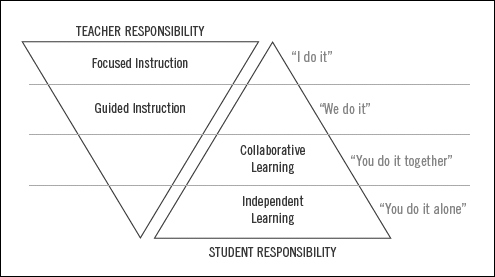
As a teacher with gifted students in my classroom, one of my main concerns was providing them with an environment challenging enough to keep all of us focused and engaged in our learning. Through experience, I quickly learned if I was engaged and challenged in our learning, then so were my students. I really had to let go of being the one in the classroom with all the answers. Amazing things happened when I did not have the answers. If we were going to get to the learning we all wanted to occur; then students had to take ownership. I later learned about Stiggins' evidenced-based strategy and the value of Gradual Release. We shared responsibility.

"Our job is to create rooms filled with students' voices. Not be the main voice." ~Pernille Ripp

There are strategies in theory and strategies in practice.

The balance we must maintain as practitioners is between theory and strategy. Merely copying a strategy I saw used in my friends' classroom isn't going to honestly give me the impact I hope to have on the learning in my class, and neither is only reading about it. An excellent place to start is with Dr. Sandra Kaplan's Thinking Prompts. I would encourage you to watch this brief video to understand the theory behind this strategy.  Click here for additional videos.
A second area to focus upon is Universal Themes and Generalizations. To hear about this theory and see the strategy in action, watch this 10-minute video.

Want to learn more? We've created a one-page document of strategies to look for in our GATE classrooms. To connect theory to practice, how about joining our team on a Spotlight visit to explore what instruction looks like for our OMSD GATE students?

I would encourage you to connect with other educators and continue learning about best practices for differentiation for our GATE students.

Happy Learning,
Andrea Thune


Friday, May 24, 2019

Accommodations in the Classroom by Ashley Ewert

Accommodations in the Classroom

by Ashley Ewert

Having students who need accommodations is nothing new to many Special Education teachers. Daily, Special Education teachers are faced with adapting curriculum to help meet the needs of each student. Students with disabilities require planned supports to participate meaningfully in classroom activities and lessons with their peers in general education. I teach in a classroom that students require accommodations daily. My students have physical and health impairments. They are learning from a grade level curriculum. When teachers are given curriculum and materials, they are often faced with difficulties in implement the curriculum with accommodations. Adapting the curriculum can help students succeed with grade level expectations.  

What is an Accommodation?


An accommodation is an adjustment to the instruction or method of student performance that does not substantially change the curriculum level or performance criteria. Accommodations in the classrooms enable students to access curriculum content or demonstrate learning without changing curriculum goals. Accommodations can be made by the classroom general education teacher or a special educator. They help improve how the student is learning, so the student is successful in accessing grade level curriculum. Accommodations can be made in all shapes and sizes. They not only help children with physical impairment, but they can also help students with learning and/or attention needs. Standard accommodations include presentation, response, settings, timing, scheduling, and organization.
"Every student can learn, just not on the same day, or in the same way." John Evans
Examples of Accommodations in the classroom:
*Listen to audio recordings instead of reading text
*Work with fewer items per page and/or materials in a larger print size
*Recording a lesson instead of taking notes
*Use of visual content (bubble maps, visual organizers)
*Dictate answers
*Use of a spelling dictionary or an electric speller
*Use of a calculator
*Take a test in a different setting (quiet room)
*Use of sensory tools
*Allowing more time to complete assignments
*Take frequent breaks
*Use of special seating (such as in the picture below)

"Fairness does not mean everyone gets the same. Fairness means everyone gets what they need." ― Rick Riordan
"To teach is to touch a life forever." -Anonymous
Ashley Ewert

Thursday, May 23, 2019

What is Co-Teaching Part 2- by Ashley Ewert


What is Co-Teaching? Part 2-


by Ashley Ewert
In my last blog, I discussed the benefits students and teachers had in an inclusive co-teaching classroom. Co-teaching exist with a variety of approaches or models. Some of the more popular used models of co-teaching include one teach, one support; parallel reaching; station teaching; alternative teaching; and teaming. Refer to the image for a visual example of the various models. Each co-teaching classroom will utilize multiple styles in their classrooms and may even use a different form during each academic lesson throughout the day.


Common Models of Co-Teaching - 


One Teach-One Support

When teachers use a style of one teach one support, many students in the classroom can receive individual attention however if the supporting teacher always is in the same role then he/she begins to be perceived as an aide and not a teacher. The best time to utilize one teach, one support model is during whole group instruction.

Station Teaching
Station teaching is similar to what we know as centers. Students are divided between two to four groups and either work independently or with the teacher's support. Using station teaching makes it easier for instruction to be differentiated levels. Teachers instruct one station while other students at other stations work independently. The student to teacher ratio is decreased when implementing station teaching into the classroom. The best time to use station teaching is during a center time activity when students are rotating to different groups.

Alternate Teaching
In the alternative teaching model, one teacher is responsible for the large group of students while the other teacher instructs a small group of students. This provides unique opportunities to deliver intensive instruction and individualized instruction to all students. Alternative teaching can be utilized anytime there is a need for small group instruction. A suggested subject to use alternative teaching is during a math lesson.

"Alone we can do so little. Together we can do so much." 
-Helen Keller
Additional Models of Co-Teaching-

Teaming
When both teachers are teaching and supporting each other at the same time, the teachers are participating in the co-teaching model of teaming.  Teachers are equally contributing to the delivery of the lesson. Teaming promotes respect between teachers as they also serve as a model for students respecting one another. The best way to use this model is when the presentation of differing views and perspective is appropriate. 

Parallel Teaching
When the class is divided into two heterogeneous groups, parallel teaching can be utilized. Each teacher directly instructs the same content to half the group. The student to teacher ratio is decreased by half using this model. Some teachers have a difficult time adjusting to multiple people speaking at the same time, and it can be distracting for students as well. The best time to utilize parallel teaching is when the whole group would benefit from smaller group instruction when being taught the same curriculum. 

"We may have all come on different ships, but we're all in the same boat now." 
                                                                          -Martin Luther King Jr.


"To teach is to touch a life forever." Anonymous
Ashley Ewert
             

Wednesday, May 22, 2019

What is Co-Teaching- Part 1 by Ashley Ewert


What is Co-Teaching? Part 1-

by Ashley Ewert

 As I sat at a staff meeting listening to information about MTSS models of instruction, the word "inclusion" came up more and more. A few days went by, and a colleague approached me and asked what I thought about the idea of an inclusion classroom with the opportunity to co-teach with my grade level peer. This school year, my general education grade level peer, and I was able to work closely to mainstream and reverse mainstream our students. The results have shown form the students' social-emotional and academic achievements because of our established system of supports. My grade level peer remembered inclusion information presented at previous OMTA meetings, the idea of inclusion seemed like an excellent way for us to take our collaboration to the next level of student support.  My potential co-teacher and I researched the opportunity by writing down all the questions we had and investing time into reading a book Teaching in Tandem by Gloria Lodato Wilson. After we were content with the information gathered, we wrote a proposal letter up and proposed this option to our administrator. We were able to visit other models of inclusion classrooms in the district to grasp an idea of what inclusion looks like in structure.
  

How does it benefit students?
Co-teaching in an inclusion classroom is a benefit not only for the staff involved but also for the students involved. Every student in the classroom, both typically achieving and those with disabilities is provided different educational options. Students with limited vocabulary show an increase in expressive language when working with good student models who are already using developmentally appropriate communication skills which will continue to improve with additional time together. General education students have more opportunities to teach, and model learned skills to other students, which increased mastery. A strong friendship and bond between general and special education students are developed as well as increased empathy for diverse students. All students learn tolerance and respect for diversity. General education students have an increased amount of teacher/paraprofessional support that would not be available to them in a non-inclusion class. Students in special education tend to rise to the challenge of the classroom's expectations.  In an inclusion classroom, it can be nearly impossible to identify the special education students in the inclusion class. The achievement and social gaps between typically achieving students and students with disabilities are reduced. 

"Co-Teaching does not exist solely to bring two teachers together, co-teaching exist to serve students." - Potts & Howard


How does it benefit the teachers involved?

Co-teachers have a unique experience to reflect on students' needs daily and strategically plan lessons and teaching configurations that will benefit each lesson. Co-teaching is a partnership with a Special Education teacher and a General Education teacher who have equal roles and responsibilities. An inclusion program that models the stages of MTSS would be ideal in both social and academic developments of all students and staff involved. The visit to the district's already existing and succeeding inclusion programs identified that a true partnership will utilize all the benefits of a co-teaching classroom and emphasizes effective instructional practices in which all students learn and achieve success. Teaching together is much more powerful than teaching alone. Co-teaching models emphasize students to rise to the challenges of the classroom expectations while understanding and respecting diversity around them. With social and academic standards relating closely, an inclusion program is ideal in the districts next steps of the MTSS models.

"When everyone is  included, everyone wins." - Jesse Jackson


"To teach is to touch a life forever." - Anonymous 

Ashley Ewert


Most Viewed Posts