Showing posts with label Think-Pair-Share. Show all posts

Sunday, January 27, 2019

Got S - t - r - e - t - c - h Text? (PART 2)


Thank you for returning to my 3-part blog regarding stretch text.  Last month, I introduced this idea of what stretch text means in the classroom.  I highlighted some frequently asked questions and this month I want to continue sharing some of these insights and questions with you!


FAQ's:

Why stretch text?  http://www.corestandards.org/assets/Appendix_A.pdf  Read pages 1 - 11


What essential questions can I use during stretch text lessons?  The one essential question that I use during ALL stretch text lessons: “What makes this text difficult?”  This simple yet powerful essential question is what I want my students to think about throughout the lesson.  By “deconstructing” the text, my students can dissect, explore, investigate, and “reassemble” the text like a puzzle.  If they can succeed with stretch text, they will certainly succeed with grade level text. Ultimately, I want my students to think about their thinking.

Where do I find stretch text?  NOT on Teachers Pay Teachers!  Instead, I have found that famous speeches or Ted Talks are ideal to use as stretch text (they are also free).  Try to select speeches that are relevant, engaging, and meaningful or that tie into Wonders anthologies in some manner.  For example, in fourth grade Wonders unit 4, week 3 includes the anthology selection The Moon Over Star.  This historic fiction selection focuses on the night of the moon landing.  You could tie the famous Moon Speech by JFK to this particular selection (which I actually have done).  Another example in fourth grade Wonders is unit 4, week 1 leveled reader “A Day in the Senate.” Last year, we deconstructed part of the Constitution using it as a stretch text in order to extend the understanding of the leveled reader.  The possibilities are endless. I try to make sure that my students understand that my selected stretch text is either part of an article, document or a transcript of a speech. This is why I try to avoid TPT worksheets or TPT articles. It is no secret that Common Core has made the understanding of technical texts a cornerstone of these new standards.  Stretch text lessons allow the teacher to at least begin to encourage and build self-efficacy within students in order to challenge them to continue “reaching and stretching” their reading abilities. My "look for" when I am searching text is mainly vocabulary. Does the text include a fair amount of academic vocabulary for students to grapple with? Be careful though! Too much may become too frustrating.

Note:  If you find a video on youtube, it usually offers the option to view the transcript.  Copy and paste the transcript onto your desktop in order to print the text for students.

How long do stretch text lessons take?  If you decide to do stretch text lessons during a 30-minute time block of UA, you can expect to take approximately three to five days to grapple with the passage.  It really depends on how deep you want students to go into the text. It is up to you and your learning outcomes.

Are there any resources that I can use?  Yes, I have included below some links that you can view at your leisure to see some examples of stretch text lessons.  Be warned, you will not find much resources by googling “stretch text.” You will usually find resources about accessing complex text (which may in itself be helpful as well):

1.  READ pages 1 - 11 in Appendix A of the common core initiative document (yes, I know it may be a struggle but, hey, if you want your students to do this, then we need to do this as well):

2.  Teaching Channel videos:
https://www.teachingchannel.org/video/teaching-declaration-of-independence


Happy Writing!
             Gustavo Macuil

Monday, October 9, 2017

Mixing it up with Cooperative Learning!


Mixing it up with Cooperative Learning!
Cooperative Learning is a LOT more than simply telling your students to share with their partners or table groups.  Where this has its value, the students need to be provided with a multitude of different cooperative learning/grouping structures in order to keep them engaged and deepen their level of thinking and learning. Novelty and variety plays a HUGE part in student engagement and learning.  The Kagan Cooperative Learning strategies (alongside countless others) are a great way to maximize student learning within your classroom!


20170911_084844.jpg
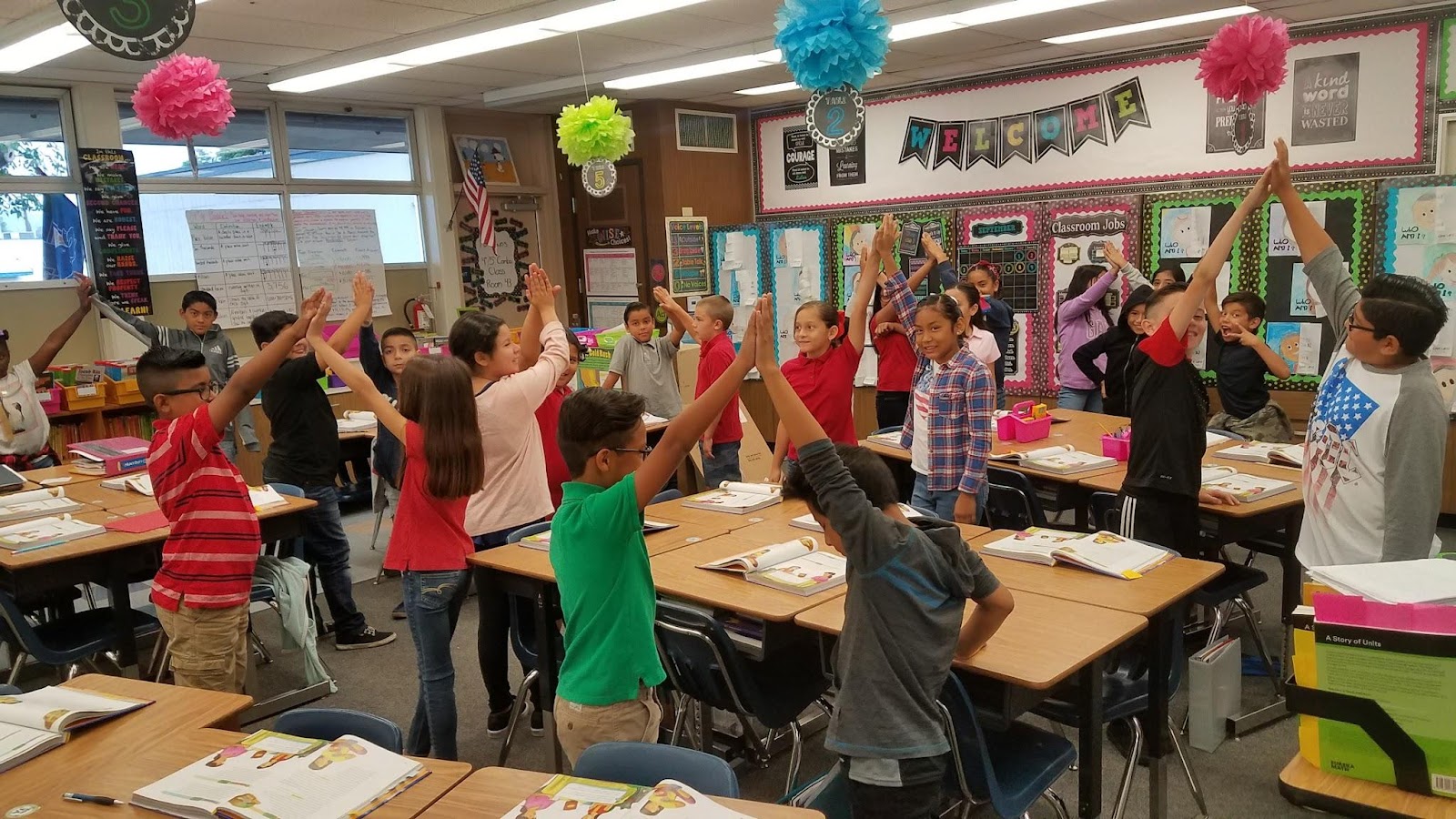
Students engaging in the “Stand Up Hand Up Pair Up” Kagan strategy (or Mix-Pair-Share) during a Wonders lesson.  Teacher poses a question, gives students think time (often times they will write a short answer), then teacher plays music set on a timer for 30 seconds while students wander around the room.  When the music stops, the students put their hand in the air and high five the closest person to them, thus forming their new TPS partner.  Teacher then has them discuss the question or idea that was originally proposed..  Shuffling students a few more times gives them more exposure to different levels of thinking.  Often times, I even build on the original question, and have the kids rethink before they shuffle to new partners.

This month’s blog is going to focus on student talk through a variety of Kagan/cooperative learning techniques.  As you read on, you will read about and see pictures and videos of my students successfully engaging in these different techniques and the level of learning that’s taking place.  Throughout this blog, I will show you examples of how easy it is to implement these structures into your daily routines with Wonders, Eureka Math, and any other subject for that matter!.  Once you see the power behind the kids’ learning and their level of engagement, you too will be convinced that student talk via cooperative learning structures is essential to help your students succeed!


Listening to the students insightful comments and conversations during collaborative conversations can be extremely heart-warming.  Once you have built that sense of security amongst your classroom climate, the students will share their thoughts, feelings, and emotions honestly as they make connections to the content being taught.  Its extremely powerful and endearing as a teacher to hear this in their conversations, and also powerful to know that they are learning from each other, connecting with each other, and thinking on a much higher/deeper level.
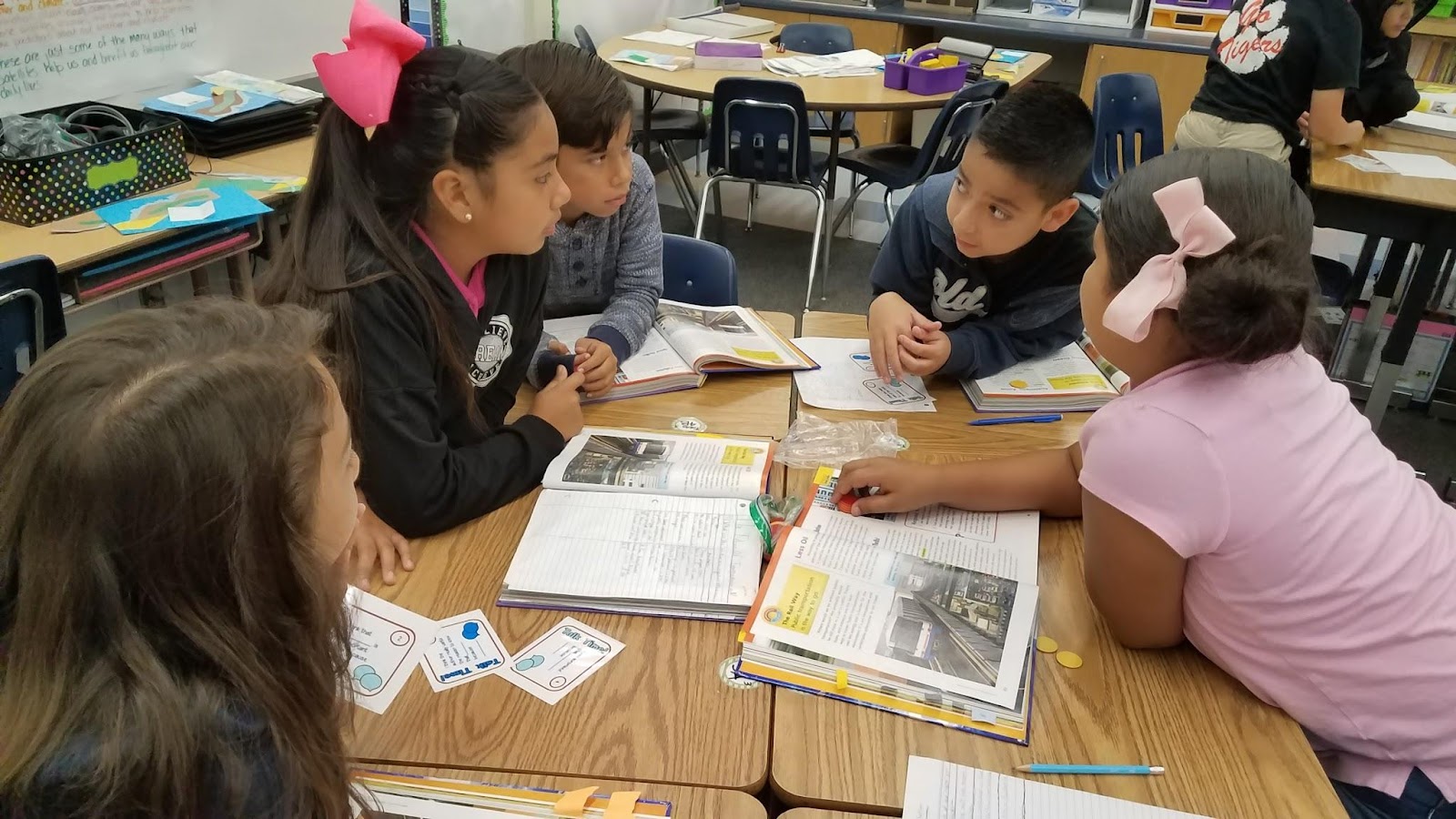
Here my students are participating in the Kagan “Talking Chips” strategy through the use of a collaborative conversation.  The students are given a bag of chips (counters) and each take one (or more).  After I have posed the questions, or ideas for discussion, and given them ample think time (and/or write time depending on the level of question and discussion) they take turns sharing their answers/ideas by placing their chip in the bag when they’d like to share.  This is what I use in the early stages of collaborative conversations to help teach them how to participate.  This strategy ensures that ALL students will have a chance to contribute their thoughts to the conversation.

20170915_092109.jpg

“Practice does not make perfect.  Only perfect practice makes perfect.” - Vince Lombardi

Here are some video clips of my kiddos participating in Collaborative Conversations with Talking Chips.  As the year progresses their conversations will grow and deepen, but they’re off to a great start!


Despite what some may fear, implementing cooperative learning structures does NOT require a ton of planning/prepping time on the teacher’s part.  In fact, most structures require minimal amount of teacher prep and the more you use them, you will LOVE them and your ideas of how/when to utilize them will start flowing freely!


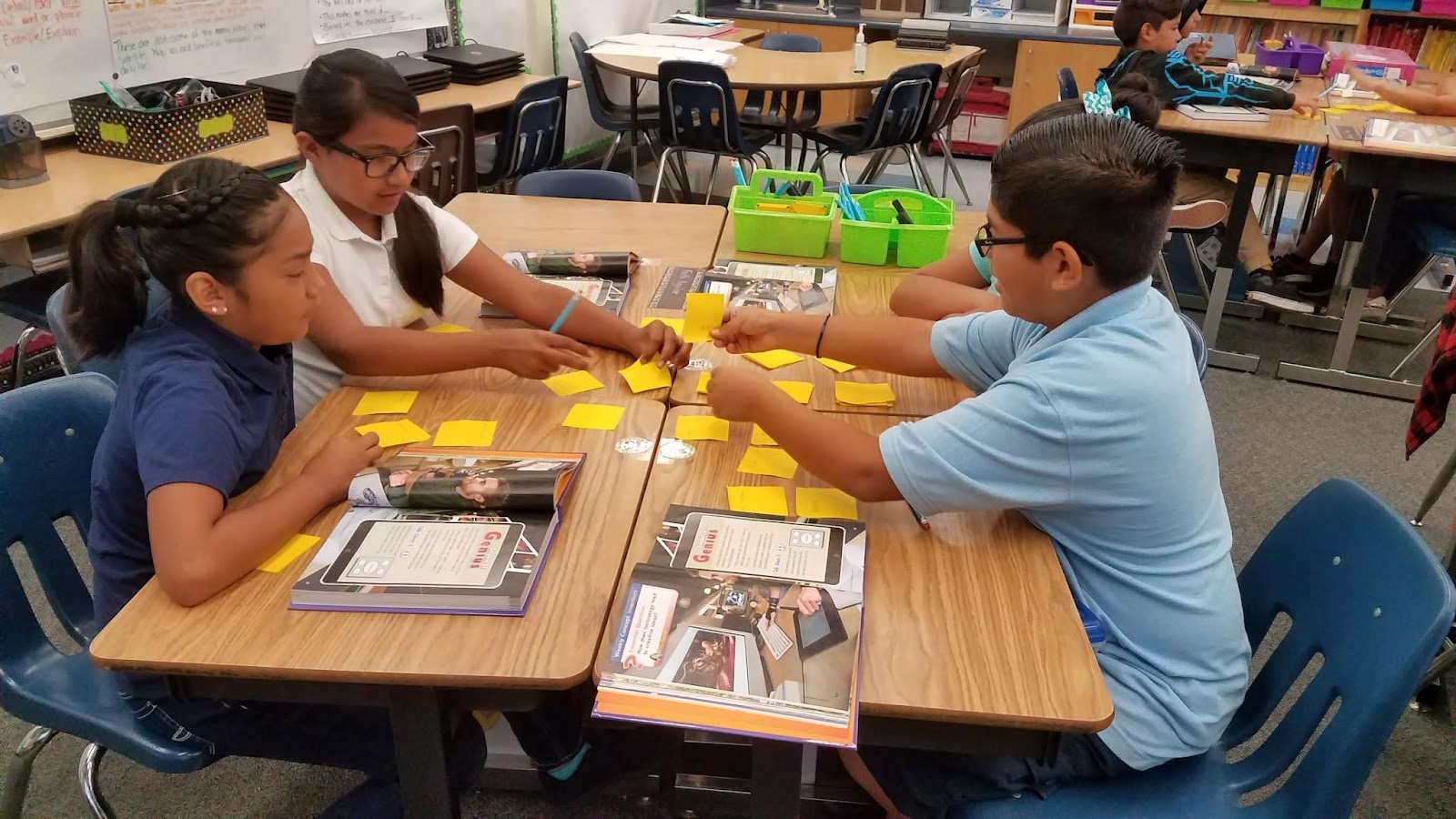
For instance with Wonders, I will look ahead at the lessons for the upcoming day/week and simply sticky- note in the TM where I want to incorporate certain Kagan/cooperative learning structures, and label which structure I want to use.  For example, on Day 1 of Wonders where you teach the “Introduce the Concept” lesson provides a GREAT opportunity to implement the Kagan “Jot Thoughts” strategy.  This is where students write as many different ideas/words/concepts etc on sticky notes until the teacher says time's up.  The table group has all their sticky notes in the center of the table and can then read and sort their ideas, group like ideas, and share out their thoughts.  Here is a picture of my kiddos utilizing this strategy last week!  


20170905_081854.jpgI constantly cycle through the different Kagan/cooperative learning structures throughout each week, so as to keep the kids engaged with novelty and variety as I mentioned above.  When teaching becomes monotonous and repetitive, the students tend to become less engaged and thus the level of learning is not a high as it should be.  Something to keep in mind!


Collaboratively Learning,
Megan Brown

pic- Megan Brown.jpg


OMSD.jpg

Most Viewed Posts