Off to the RACES with Writing!
| |||||
I know as teachers we often feel that teaching writing can be absolutely painful at times, but it doesn’t have to be! When given a structure, students are not only successful in writing but have fun doing it! The RACES structure is intended to teach students how to write a constructed response paragraph by analyzing texts, making connections, and citing text evidence to support their reasoning. Not only is this an essential skill for students to be successful on SBAC (as they have many constructed response questions), it goes deeper than a test! Being able to respond successfully to a constructed response prompt is also a necessary skill that focuses on student’s reasoning skills and helps them to develop and implement their own thoughts and opinions through research. It’s a life skill!
|  | ||||
Teaching students the RACES Writing format will not ONLY improve Writing skills but will simultaneously strengthen their reading comprehension skills as well as their ability to rationalize. The best part: The structure is simple enough that you can implement this process TOMORROW!
When implemented correctly, the RACES format transfers across subjects successfully. This form of Writing is not an isolated skill. Students start to become more aware of what they’re reading and spend more time annotating the text when they know they will be writing about it. Thus, increasing their reading comprehension skills in the process. I also integrate many different Kagan/cooperative learning strategies throughout the writing process which really helps the students to gain a deeper understanding of the text through the power of discussion. I have personally seen student’s constructed responses to test questions VASTLY improve after implementing this process in just over a matter of a couple of months. I love when the students finally make the crossover from KNOWING the steps and going through the motions, to actually making connections and UNDERSTANDING the process!❤ At this point in the year when I introduce a new prompt and tell the students we will be doing a RACES writing today, I hear “YESSSSS!” throughout the classroom. My students have come to love writing through this process because they know they are successful and enjoy doing it!
In this video, you can see my students completing a RACES Writing constructed response through collaborative conversations.
Modeling the RACES process AND giving students the opportunity to interact with each other along the way, is a crucial contributor to seeing success with this structure.
Structuring the RACES writing process in this step-by-step manner ensures that students will be able to complete these steps to their own success when in a testing situation. The consistent practice and support through collaborative discussions with their peers, myself, and the class as a whole really builds on so many different skills, and allows them to be successful!
Collaboratively Learning,
Megan Brown
megan.brown@omsd.net  | |||||
Showing posts with label citing text evidence. Show all posts
Showing posts with label citing text evidence. Show all posts
Monday, January 22, 2018
Off to the RACES with Writing!
Monday, December 11, 2017
Philosophical Chairs- Let’s debate!
Philosophical Chairs- Let’s debate!
| |||||
Learning takes place when critical thinking is happening. Being able to think critically about an issue to solve a problem is a skill that students need not only to be successful in school, but throughout life. Teaching students how to discuss and debate an issue (rather than argue) based on facts and information is not only a great, but powerful way to enhance students critical thinking skills. Philosophical Chairs allows students to think and discuss on a critical thinking level, and then allows them to apply their ideas or opinions to writing.
|  | ||||
The Power is in the discussion! Get your kids thinking deeply and critically about texts and issues, and watch their learning soar.
| |||||
When you hear students develop their own opinions about a topic based on what they’ve read, researched, and discussed, that’s when you know all your efforts as a teacher are worth it! Over the past couple of years where I have really started incorporating a lot more collaborative conversations, philosophical chairs, and socratic seminars, I have noticed that my kids will start researching topics on their own. Often they come into class and tell me how they researched a topic that we had learned/discussed in class and what they learned about it. To me that’s extremely powerful because not only are they learning what I taught them to do, they are making those connections and applying them to their everyday lives. They're starting to think critically all on their own! #TeacherGoals
| |||||
“For good ideas and true innovations, you need human interaction, conflict, argument, and debate” -Margaret Heffernan
Here are my student's engaging in their first Philosophical Chairs debate this school year (read below for more details). Although not perfect they're off to a great start!
| |||||
You can get started right away preparing your students for Philosophical Chairs! Here are some simple steps to take: | |||||
Often times you can simply use the Essential Question for the week in our Wonders adoption to focus your debate around. If not the exact question, you can use it as your focus area of study, and then reword it appropriately for the debate. In the video just above, my students are debating the weekly Essential Question from Wonders that stated “What are the positive and negative effects of new technology?” With this being the basis of study for that week and also the week before having had a similar theme, students had opportunities to read many texts and gather information within our Wonders curriculum. Additionally I found 3 articles on Newsela.com (a GREAT site that has current news articles for kids) that also discussed pros/cons of new technology. The students read and took notes on these as well. The question I posed for the Philosophical Chairs debate was “Are advancements in technology more helpful or harmful to our society?”
Philosophical Chairs is an ongoing work in progress. The video you see above is the first time my students attempted the process this year (about a month ago). As you can see, it is not perfect, but overall they did well! It helps if you have been conducting text-based collaborative conversations already, as the kids are experienced in discussing with one another and using text evidence to support their opinions. One thing I will be working on with my students as we progress in this activity throughout the year, is an emphasis on restating what the person before them has said. I hope I have inspired you to try this out in your classroom, it's fun and easy to implement, and the kids LOVE doing it!
Collaboratively Learning,
Megan Brown
  | |||||
Monday, October 9, 2017
Mixing it up with Cooperative Learning!
Mixing it up with Cooperative Learning!
| |||||
Cooperative Learning is a LOT more than simply telling your students to share with their partners or table groups. Where this has its value, the students need to be provided with a multitude of different cooperative learning/grouping structures in order to keep them engaged and deepen their level of thinking and learning. Novelty and variety plays a HUGE part in student engagement and learning. The Kagan Cooperative Learning strategies (alongside countless others) are a great way to maximize student learning within your classroom!
| 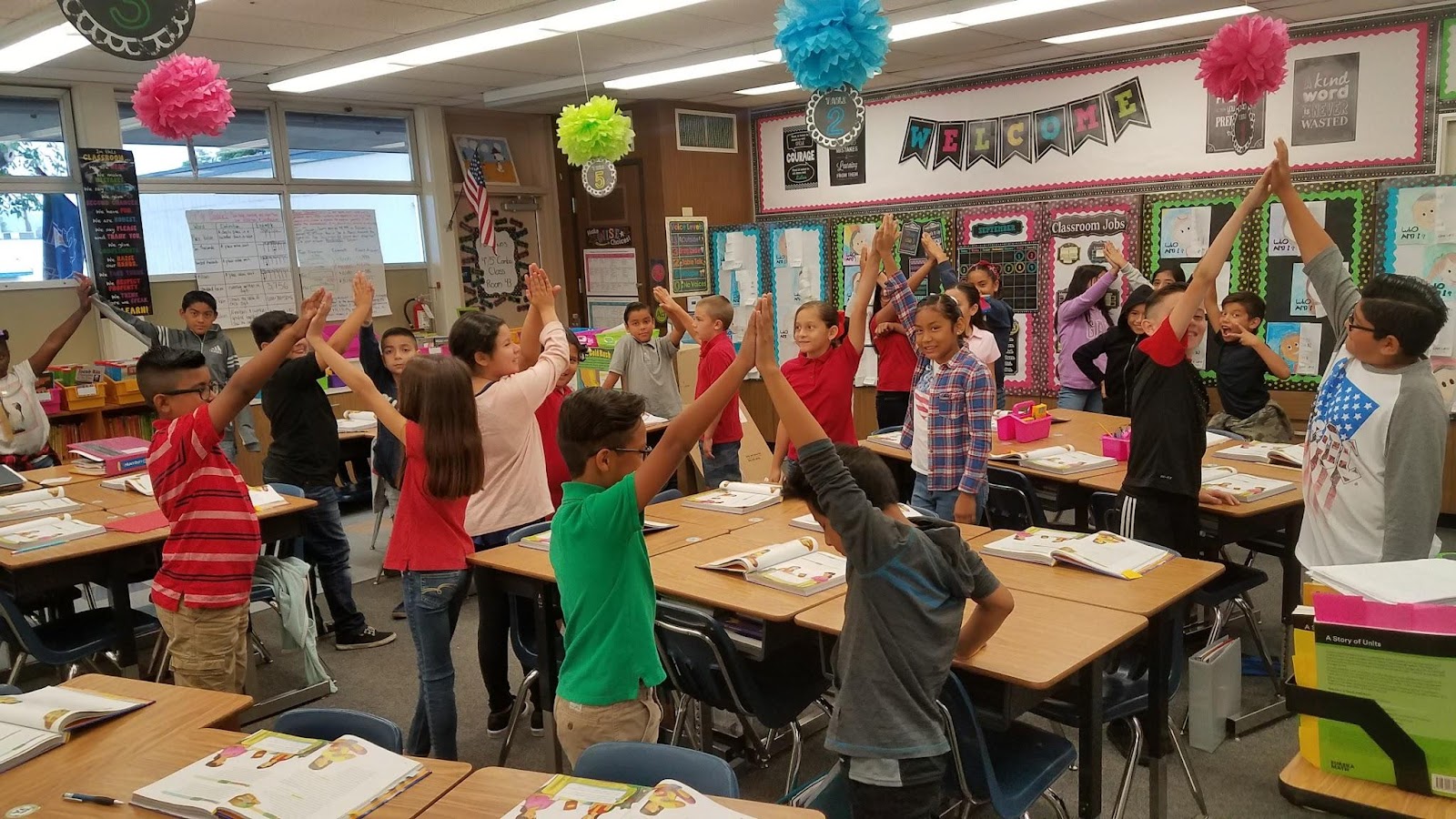
Students engaging in the “Stand Up Hand Up Pair Up” Kagan strategy (or Mix-Pair-Share) during a Wonders lesson. Teacher poses a question, gives students think time (often times they will write a short answer), then teacher plays music set on a timer for 30 seconds while students wander around the room. When the music stops, the students put their hand in the air and high five the closest person to them, thus forming their new TPS partner. Teacher then has them discuss the question or idea that was originally proposed.. Shuffling students a few more times gives them more exposure to different levels of thinking. Often times, I even build on the original question, and have the kids rethink before they shuffle to new partners.
| ||||
This month’s blog is going to focus on student talk through a variety of Kagan/cooperative learning techniques. As you read on, you will read about and see pictures and videos of my students successfully engaging in these different techniques and the level of learning that’s taking place. Throughout this blog, I will show you examples of how easy it is to implement these structures into your daily routines with Wonders, Eureka Math, and any other subject for that matter!. Once you see the power behind the kids’ learning and their level of engagement, you too will be convinced that student talk via cooperative learning structures is essential to help your students succeed! | |||||
Listening to the students insightful comments and conversations during collaborative conversations can be extremely heart-warming. Once you have built that sense of security amongst your classroom climate, the students will share their thoughts, feelings, and emotions honestly as they make connections to the content being taught. Its extremely powerful and endearing as a teacher to hear this in their conversations, and also powerful to know that they are learning from each other, connecting with each other, and thinking on a much higher/deeper level.
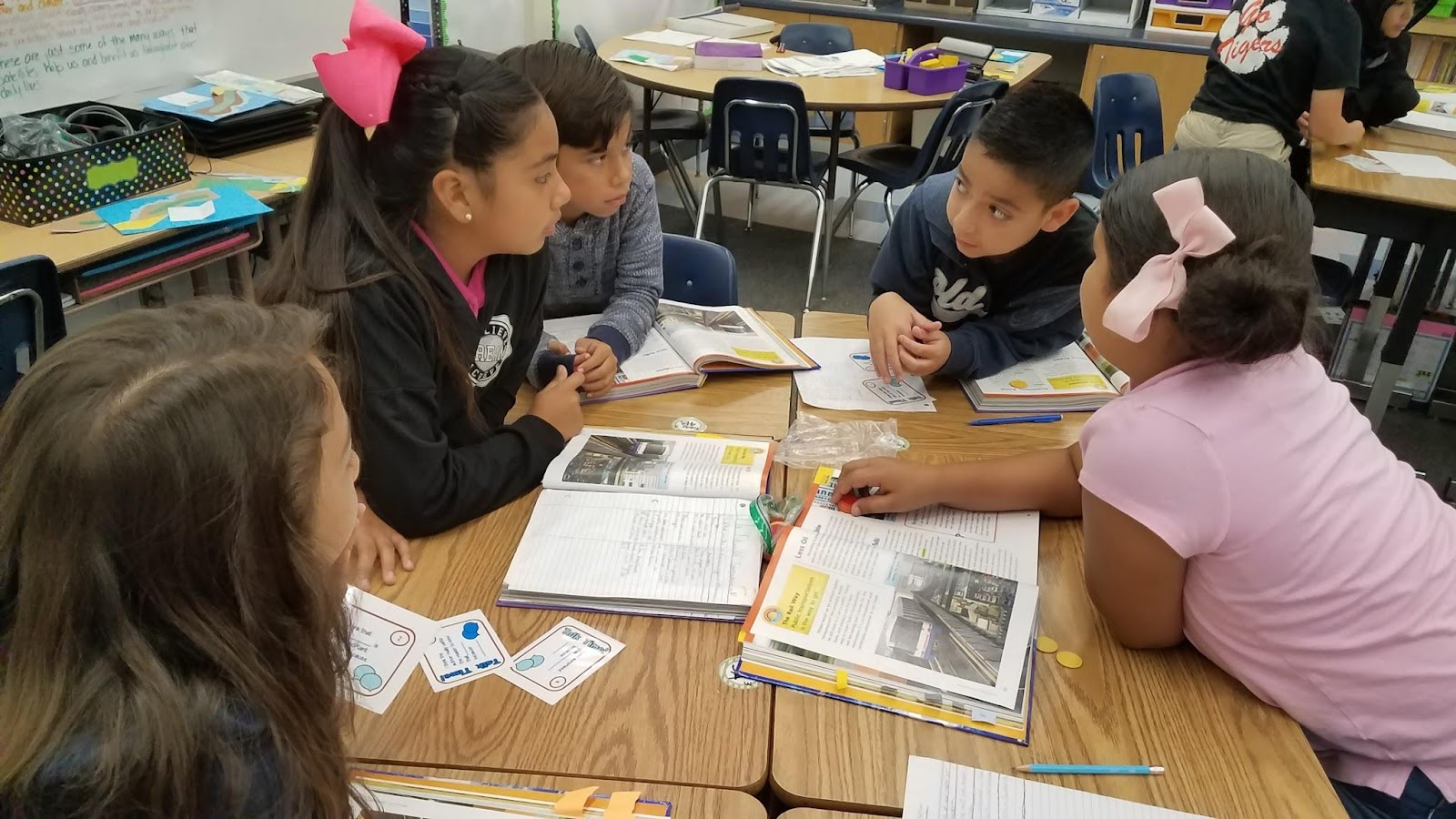
Here my students are participating in the Kagan “Talking Chips” strategy through the use of a collaborative conversation. The students are given a bag of chips (counters) and each take one (or more). After I have posed the questions, or ideas for discussion, and given them ample think time (and/or write time depending on the level of question and discussion) they take turns sharing their answers/ideas by placing their chip in the bag when they’d like to share. This is what I use in the early stages of collaborative conversations to help teach them how to participate. This strategy ensures that ALL students will have a chance to contribute their thoughts to the conversation.
 | |||||
“Practice does not make perfect. Only perfect practice makes perfect.” - Vince Lombardi
Here are some video clips of my kiddos participating in Collaborative Conversations with Talking Chips. As the year progresses their conversations will grow and deepen, but they’re off to a great start!Despite what some may fear, implementing cooperative learning structures does NOT require a ton of planning/prepping time on the teacher’s part. In fact, most structures require minimal amount of teacher prep and the more you use them, you will LOVE them and your ideas of how/when to utilize them will start flowing freely! | |||||
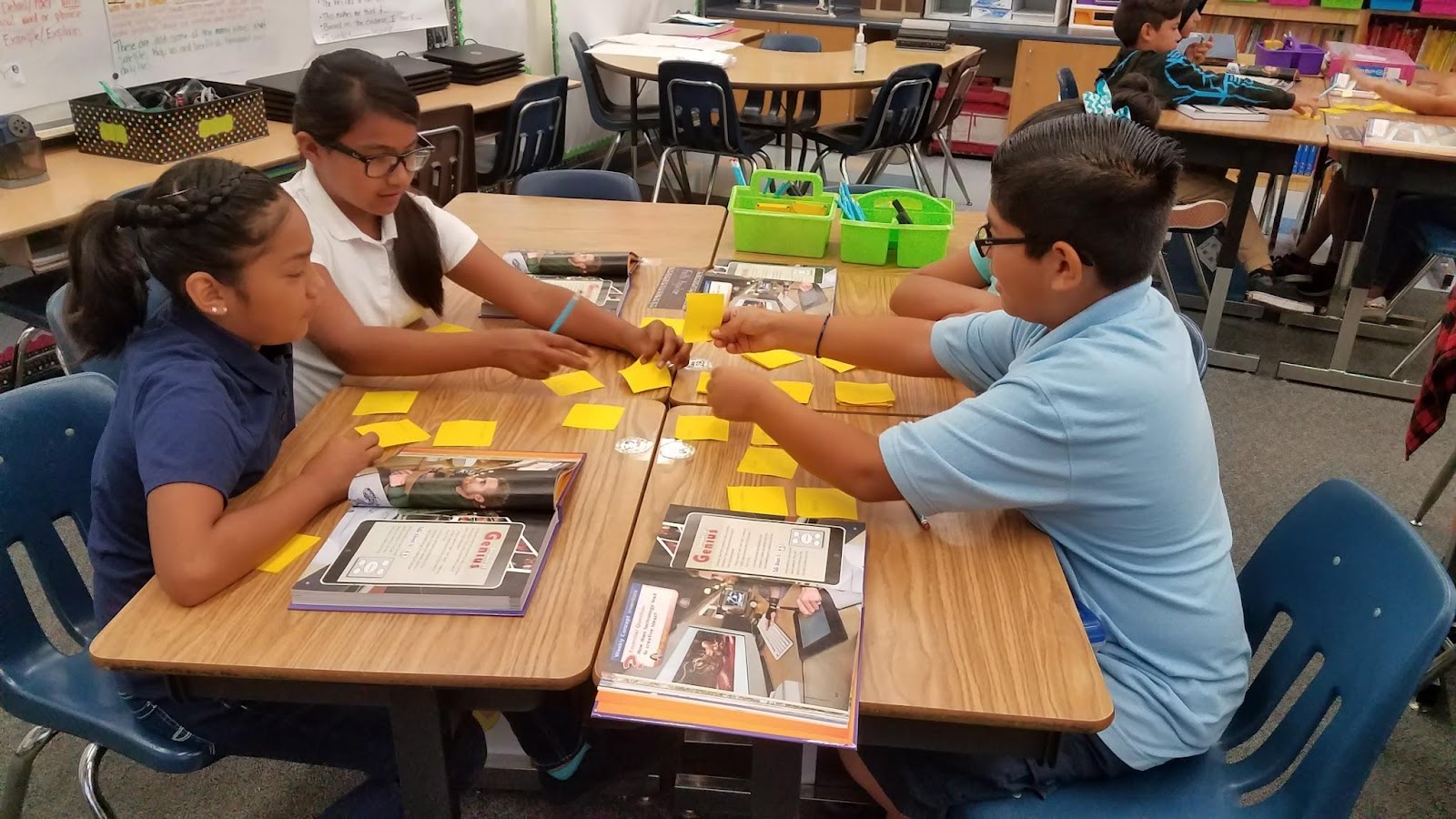
For instance with Wonders, I will look ahead at the lessons for the upcoming day/week and simply sticky- note in the TM where I want to incorporate certain Kagan/cooperative learning structures, and label which structure I want to use. For example, on Day 1 of Wonders where you teach the “Introduce the Concept” lesson provides a GREAT opportunity to implement the Kagan “Jot Thoughts” strategy. This is where students write as many different ideas/words/concepts etc on sticky notes until the teacher says time's up. The table group has all their sticky notes in the center of the table and can then read and sort their ideas, group like ideas, and share out their thoughts. Here is a picture of my kiddos utilizing this strategy last week!
| |||||
 I constantly cycle through the different Kagan/cooperative learning structures throughout each week, so as to keep the kids engaged with novelty and variety as I mentioned above. When teaching becomes monotonous and repetitive, the students tend to become less engaged and thus the level of learning is not a high as it should be. Something to keep in mind! | |||||

Subscribe to:
Posts (Atom)
Most Viewed Posts
-
 In my previous post, I discussed how incorporating Kagan engagement structures into your classroom can help not only increase the engagem...
-
 Fluency: Sprints in Eureka Math What is "fluency" in terms of mathematics? And what is the purpose? Eureka Math explains fluenc...
-
If you're familiar with Kagan, then the "Rally Coach" structure is not a stranger. However, you may have forgotten about thi...
