Sunday, September 15, 2019

With a Little Help From my Friends


It has taken me a long time to learn that there is no shame in asking for help. In fact, this is a crucial life lesson for both the young and the old. Contrary to popular belief, asking for help does not show any weakness of character. In actuality, it shows both humility and strength. Having moved to a new grade level this year, I've had to ask for help, support, advice, and guidance more times than I can remember. Sure, I've taught fourth grade in the past, but that was when, as I've said before, fourth grade was really third grade-- before the golden age of the Common Core.

Over the years, I've learned a great deal about the science and art of teaching, but I definitely have a long, long way to go before I could be considered an expert fourth-grade teacher.  My team leader and fourth-grade teacher extraordinaire, Mrs. Annecchini, is not only helping, supporting, advising, and guiding me personally, but my teammates as well--since three out of four of us are new members of this team. I highly respect all three of these ladies, Mrs. Mackenzie, Mrs. Rodenbaugh, and Mrs. Annecchini for their skill, knowledge, and teaching ability.

In my last blog, I mentioned how much emphasis I put on students developing a GROWTH MINDSET. I certainly cannot cultivate a classroom environment that encourages a life-long love of learning and that promotes a growth mindset unless I become a pupil of my own teaching. I am therefore not embarrassed to admit to my colleagues and students that I don't have "all the answers" and that we are on this fourth-grade journey together.

As I maneuver the road of this upward learning curve, I'm making a lot of stops along the way. Some days I feel so confident about my teaching. Other days, not so much.  But I remember something my first principal, Marty Olsky, told me many years ago. He said that it takes three years to master a new grade level. If that still holds true, I'm nearly six weeks in.

I need to thank in advance my colleagues and students for the patience that they will inevitably show me this year as I immerse myself in a self-directed close study of the fourth grade Common Core standards in E.L.A. and Math. I just started reading a book titled Learning Targets. I'm anxious to see how my learning will impact my teaching and student learning. I've also become very friendly with a man named  Duane Habecker. He has been teaching me how to teach Eureka Math to my fourth graders. (You can locate his informative videos on YouTube.)

I invite you to follow me through my successes, fumbles, and everything in between!


Lola Jollie
Euclid Elementary School
Proudly serving 3rd and 4th-grade students


Wednesday, September 11, 2019

Learning and Growing

Nurturing A Classroom Culture 

It's hard to believe that we are already a month into our academic school year! Where has time gone?! Believe it or not we are a month into this year. As the year progresses, we sometimes forget to continue to cultivate and foster our classroom culture with our little humans. August is all about getting to know our students but what about the other months? Can you really get to know them in only a short month? Regularly asking how their day is, how their weekend was or simply greeting them lets them know that we care about them. Sometimes it's hard to make time for this, however, we can do so in about 10 minutes or less.

Friday 5-4-3-2-1

One of my favorite things to do at the end of the month is Friday 5-4-3-2-1. It's a free resource from Presto Plans that never fails to make my entire class cheese from ear to ear (including myself). It's a short slip where students write: 

5 things that made them smile that week
4 words to describe their week
3 things they plan to do this weekend
2 things they learned this week
1 goal they have for next week

I do this as the warm-up for the day. It probably takes about 10 minutes to complete: five minutes to fill it out, then about 5 minutes to hear from everyone. They share one of the things they wrote down which then leads to a moment of reminiscing or appreciating something about our week. I've found that this activity teaches my students to be appreciative, find commonalities among others and shows them that I enjoy hearing about their lives. We wrap up this activity by gluing it in our "Memory Lane". We revisit this page about once a month when we add a new slip in our interactive notebook. It's so sweet to watch them laugh or say "oh yeah, I remember that!" while they revisit their previous slips. The cherry on top is on Monday when I get to follow up with some of my student's weekend plans. I enjoy doing this since it lets them know that I listen and care about them. The power of this simple activity goes far beyond the 10 minutes that it takes to complete. It gives my students the opportunity to share news about their lives while I model patience and deep listening in order to make connections with them.

Friday 5-4-3-2-1 Link: file:///C:/Users/nancyva/Downloads/Friday54321WeeklyReflection.pdf


Learning and Growing, 


Nancy Vargas  
nancy.vargas@omsd.net 


Tuesday, September 10, 2019

Leader In Me


Leader In Me

September is here and the students know classroom routines and procedures. We are teaching positive behavior through P.B.I.S and will soon be assisting students through the M.T.S.S framework. These systems are in place to help our students, however, they are missing a key component. They are lacking student empowerment and self-discipline. My school became the first “Leader In Me” school for OMSD last year. The “Leader in Me” program teaches students “7 Habits” that they need to become successful. I have discovered that what I have been trying to instill in my students aligns with the “Leader in Me” program. In my classroom, students become responsible for their behavior and learning. They know that they are in control of themselves and can achieve any goals they set for themselves.  

Every student has potential

              Many of our students lack basic skills and/ or are below grade level. As teachers, we must do our best to get them to meet grade-level standards. I have discovered through “Leader in me” that students need to be taught how to self-regulate their emotions and work well with others. Once they have learned these skills, they can reach any goal personally and academically. The “7 Habits of Happy Kids” learned through this program teaches students how to do that. I learned how important it is that students learn self-worth and that they have the potential to accomplish any task at hand no matter their circumstances. Students need to feel loved and supported. Every morning, I greet my students with a good morning greeting and acknowledge them by name. I also remind them of the great day we will have learning together. Simple conversations like these will encourage a student that they will have a great day. 


What are the “7 Habits of Happy Kids?”

              The creator of “Leader in me,” Steven Covey discovered that students will go through three stages of development through his 7 habits: Independence, interdependence, and developing the whole person. The independence stage has 3 habits: Habit #1: Be proactive, Habit #2 Begin with the end in mind, and Habit #3 Put first things first. The interdependence stage has 3 habits: Habit #4: Think win-win, Habit #5: Seek first to understand, then to be understood, and Habit #6: Synergize. The last stage is developing the whole person: Habit #7: Sharpen the saw. In order for me to teach the 7 habits, I first had to embrace them and implement them in my everyday life. I had to start slow and work on the first 3 habits in my personal life before I could share with my students. After I practiced the habits at home, then I could teach my students.

The First 3 Habits

Habit # 1: Be Proactive is all about having control over how you encounter a problem. In order to get the students to understand, I share a personal story and ask them how I should and should not respond. The key terms are proactive and reactive. I give a brief story about my sons fighting over a game. If the students come up with “they could share,” or “wait their turn,” I tell the students they are right and that means they are being proactive. If students do not say, “take it away,” or, “push them,” then I will introduce it. The students usually say it is not ok. I will then explain that that is being reactive. I ask my students daily, “How can you solve your problem?” Then the responsibility falls back on them. I constantly discuss being proactive/ reactive throughout the day during lessons, read alouds, and when students misbehave. Habit #1 falls in line with P.B.I.S!

              Habit # 2: Begin with the end in mind is making a plan to reach a goal. I start teaching by using myself as an example and tell a story of a goal that I want to meet. This month, I chose to be healthy. I asked the students about ways to be healthy and what I can do to reach my goal. We came up with drink water and exercise. The students are my accountability partners and ask me every day if I drank water and exercised. After we have charted my growth and understood how to make a plan, we as a class decided we needed to work on line basics. We came up with a plan and chart if we are meeting our goal. In time, we will set individual academic goals and chart them in our Leadership Notebooks. My students are learning to make plans to reach important goals.

Habit # 3: Put first things first is making time to put the important things first. As always with introducing habits, I give an example of myself. This time my example was how I was missing out on spending time with my sons because I had too much work to do. I discussed this with my students and they decided that I needed to only do work at school and not do it at home. They stated that spending time playing with my sons was more important than work. As a class, we learned that in order to have free playtime, we need to get our work done first, then we can play. It helps the students to be accountable in completing assignments and that they are the most important thing to take care of. When students are off task, I ask, “Are we putting first things first?” This helps students to check themselves and get back to work. My goal with these habits is to help students become accountable for their behavior and learning. My students learn the importance of taking care of themselves and have the potential to accomplish any goal they have.

Successfully Learning,
Marcy Mesa


Friday, September 6, 2019

Framing Depth and Complexity


Framing Depth and Complexity


Here we are again at the start of the new school year.  As I set my goals and expectations for my classroom, one thing that I like to focus on is embedding Depth and Complexity icons in student learning.  This year, I am teaching a fourth-grade, self-contained GATE classroom again. Something I noticed from previous years of teaching self-contained GATE classes is that students come to my classroom with varying degrees of understanding of depth and complexity icons.  Since Depth and Complexity are two of the four California GATE Standards, I want to make sure that all of my students are familiar with the icons of Depth and Complexity.


There are 11 original  Depth and Complexity (D & C) icons and 8 new ones.  Trying to cover all 19 icons in a short amount of time doesn’t really work.  Instead, as I am planning out my lessons I try to look for ways to incorporate 1 or 2 icons at a time.  Students are generally more familiar with the original icons so that is always my starting point.

At the beginning of the year, I will write prompts using both the name and the picture of the icon.  When I have students draw the icon, I always make sure they write the name as well. I try to give students plenty of opportunities to draw the icons.  My goal is for students to be comfortable with drawing and labeling the icons. 

After we have learned a few icons, I have students use them in a D & C frame.  First, I had students use a D & C frame to share information about themselves. Throughout the school year, students will use the D & C frame to show their understanding across content areas.  For example, we use Rules, Patterns, and Language of the Discipline a lot in math.  I like to have blank copies of the frame available so students can use the frame often.  


As the school year moves along, my plan is to continue to use depth and complexity prompts in my teaching.  Next month, I hope to share with you how else we used a Depth and Complexity Frame in our classroom.

Learning and Teaching with Grace,


Alina


Embracing Mistakes

Image result for making mistakes cartoon images


Embracing Mistakes


September is officially here and the beginning of the school year procedures and routines marathon is coming to an end. I always start the year by having my students set personal goals for themselves.  On their lists, I saw many inspiring goals like "make new friends," "learn to add," and "learn to read." But, the one thing that I did not see was "make mistakes." When I think about goals, my hope is that making mistakes will always be on their lists. Why? Because mistakes are the essence of new learning! 


If you want to cultivate a growth-minded classroom, you've got to normalize mistakes.  


If mistakes and failures are seen as something to avoid (rather than something to expect), students will begin to stray away from challenges necessary for learning. I make it a personal goal to show my students that mistakes can actually help them develop and improve their skills and abilities. But, as we all know from experience, learning from mistakes isn't automatic. We have to teach our students that they are an essential part of the learning process. 


Image result for mistake quotes images


 Okay, now what steps do I take to get kids to understand that mistakes aren't failures, but opportunities?


"It's OK to Make Mistakes"
Mistakes are when learning happens. Above anything else, my students must know that school is a safe place to make mistakes. We have our most excellent learning experiences from making errors. To help kids realize errors don't have to be fatal, simply say, "Everyone makes mistakes; it's how we learn." I say this Every. Single. Day!  It's a fantastic feeling to see the stress leave their faces and watch their body language change when they hear these words. It makes me sad to think that they thought I'd require them to be perfect. How could a child learn under such stress? I give them permission to fail and realize that mistakes are a positive learning experience. This is a concept that I struggle with as an adult. I wish I had been taught as a child that it's OK not to be perfect and to make mistakes!  


Admit your Mistakes
Whether you believe it or not, your students think of you as all-powerful and all-knowing. Obviously, we make mistakes, but too often we keep them to ourselves. Next time you mess up, go ahead and admit it aloud. By accepting our errors, our students recognize that mistakes happen to everyone. Remember, they are also watching to see how you handle failure. We, as teachers, have to be mistake making role models.   

Show Acceptance for Mistakes
When a student makes mistakes show instant support with both words and nonverbal reactions. This is the quickest way for kids to learn how to erase the fear that mistakes are wrong. They need real-life, on the spot, response. Just a simple "no big deal" or "you got this" can go along way. I usually say, "No, biggie, everyone makes mistakes." Sometimes comradery goes a long way too. Saying something like "I thought that was the answer too" or "Maybe we can try something else together" can make a tremendous difference. Make making mistakes OK in your classroom by always emphasizing that mistakes are how we learn. My goal is to create an environment where kids feel safe to share mistakes and try again.  


Image result for mistakes images


 Positively Teaching,   
Randi Muehlen
                           

Wednesday, September 4, 2019

Tired but Inspired


Tired but Inspired


As I meet my new students, new adventures flow through my mind, new challenges arise, but my passion for teaching stays as strong as the first day I began. Now do not get me wrong, every year my body reminds me how old I am, because the more I add to my daily duties, the more tired I am. The overwhelming feelings of a new year can try to bring me down and make me weary, but then I think about my purpose and focus on my role: to love, to care, and foster an inquiry-based environment, leading students to investigate and discover their talents leading to endless possibilities within their education. You might be asking yourself, "How do I stay focused on my purpose in the midst of tiring days?"

Set your goal/intentions for the year and plan the steps to make it attainable. 

It's a new school year with a new group of students, find the key that will unlock their love for learning. The key is your goal for the year! This will remind you/take you back to your "Why?". Now hold those positive thoughts and take some of these steps to keep you inspired:

1. Read a book on a new strategy you may want to try in your classroom.
2. Find a workshop or conference to enhance your practice. New learning can help put our practice into perspective and give us a push to keep us on track.
3. Peer Observations/Go on a Spotlight Visit- I love that we, as teachers, have different styles in our vocation, yet our purpose is closely related. If you think about it, we are all Spotlight Teachers; we are all in the public eye to provide our students with the best instruction. We can all open our doors and learn from one another.
4. Find something you love to teach and add it within the curriculum. For example, I have always enjoyed a good read aloud; therefore I will find a book connected to a Big Idea that is also tied to positive characteristics. As I read and discuss parts of the story, students are engaged and fully involved in the inquiry process to make connections in their learning. After a long day, this part will always bring a smile my way.

"We can do this. We're Educators. We're born to make a difference. ~Rita Pierson

Remember, as you go through some of these experiences you will pick up new ideas and begin/continue to share your personal practice. You may still be tired throughout your days, but now you will look forward to the new adventures that come your way. You will realize it is essential to embrace and find value in new learning. Do not let the flame of  your passion begin to dim, because eventually it will burn out. Instead let's reignite the flame to light up the path for one another and, more importantly, for our students. Let your light shine and make way for a brighter future.


                                                      Live, Love, Teach
Hilda Sanchez

Forever in the Middle: Building Classroom Community


Building a Classroom Community


Welcome back to school, teachers!  One of the things I work hard to build and maintain in my classroom is a safe community environment where students feel welcome.  Creating a classroom that feels like a community only takes a few quick and easy steps.

Step 1:  Create a welcoming environment
Teachers are pros at decorating but setting up a welcoming environment really means nothing more than creating an organized and clean space with a few decorative details.  It's not necessary to go over the top with decorating.  If you walk into your own classroom and are able to feel more relaxed or happy, then you've accomplished this first step.

Step 2: Show your students you enjoy their company
I know the old mantra is "don't smile until Christmas," but I never was any good at following that. Having fun with the kids and being cheerful has always worked out better for me.  One new approach I tried out this year and am really enjoying is my Roll Call Question.  Each day, students have a question they are asked such as, "what is your favorite color?" or  "would you rather live without music or TV?" The possibilities are really endless with these.  Then I use my equity cards to call each student and instead of responding with "here," they answer the question. It takes less than 90 seconds each period and students get to know each other a little more as a bonus.

Now, three weeks into the school year, they look forward to the question and I've even had kids suggest the next day's question.  I've been extremely impressed with what effect this has had on the classroom community and it's always fun to see what they say to some of our crazy questions like, "is cereal soup?"

Step 3: Teach classroom structures
We all know that kids crave structure and usually do better in environments where they know what to expect.  This is why teaching classroom structures is a great way to build community.  Some structures to teach are: entering and exiting the classroom, passing out or handing in assignments, moving around the classroom, restroom and drinking fountain procedures, and student versus teacher areas.  Once these have been mastered, give your students jobs within the class to help things run smoothly. Sharing the responsibilities gives them a purpose within the group.

Other ways I build community:

This year I am exploring using flexible seating and I have seen great success with my students. The freedom to "choose where you learn best" allows my students to really take charge of their own success and learn how to make good choices in where they sit and who they sit with. Also, they get to feel more grownup as they see that I trust them to make these choices.

Another feature of my classroom is our class pet, Claire.  She is a two month old bearded dragon and the students love having her in the room. As she gets older and larger, she will be able to be out more as I teach but for now she is in her cage most of the time. Since she is growing and will be nearly full grown by the end of the school year, we even do a weekly measurement of her length to see how much she has grown.  She also has an Instagram account (@foxywaterclaire) because every class pet needs an Instagram, right?

Whatever approach you take to build your classroom community, the most important thing is to make sure that however you do it, make it genuine.  Kids are extremely perceptive and appreciate honesty as well as respect.
Until next time, keep the magic alive.

Kandyce Valverde

Let me know how you build relationships and community in your classroom in the comments below!

Follow what my class is up to on my teacher Twitter @valverderules

Monday, September 2, 2019

GATE Strategies in the Classroom


    Each year I like to start with a focus in hopes of seeing improvement in my teaching.  In years past, Literature Circles, writing, and Socratic Seminar have been focus areas in the classroom. It seems when I have an area of teaching to analyze it helps not only myself but the students too.  This year I’d like to look at my GATE strategies, and how students are being served to the best of my teaching ability. This school year I shifted from a being a middle school Language Arts teacher, but to a self-contained 5th-grade GATE class, so this focus is going to be helpful for my class.  The goal is to dig deeper into novelty, acceleration, depth, and complexity.  I want to offer my students a truly GATE education as well as teaching the 5th grade standards. I found this website during GATE strategy research, and it has a lot of helpful information. For someone who is just starting this could be a helpful place to start; however, I recommend being trained, so you can ensure you are using the prompts correctly and effectively.   Our district is offering training sessions this January, and I would highly recommend it because when a teacher can interact with the strategies the more comfortable it is when using them in the classroom.       
    

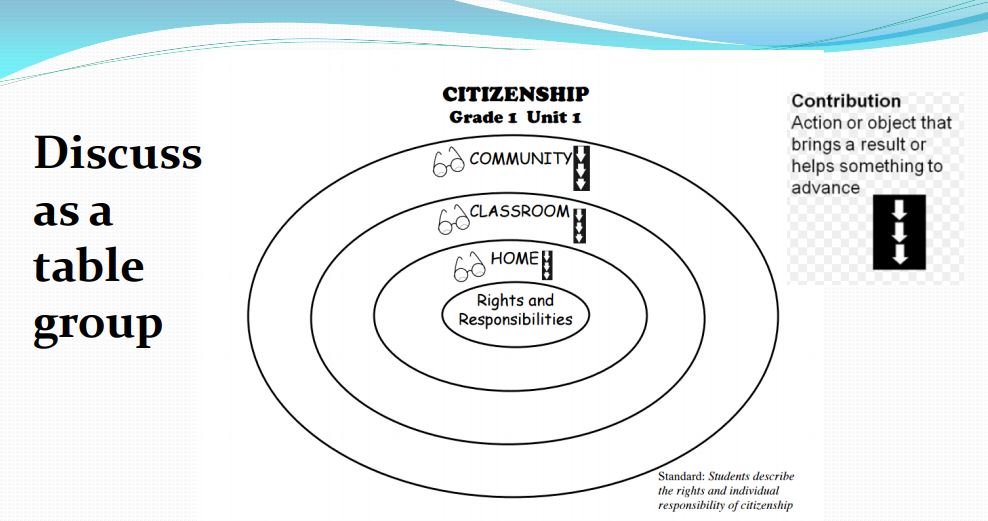
 One strategy I am excited to use is Concentric Circles.  As I read more about the activity, it is a way to include acceleration, depth, complexity, and novelty.  My group of students this year are 
not only GATE students but high achievers, so challenging and keeping them engaged throughout the day can be a struggle.  The unfamiliarity of Concentric Circles paired with how the strategy pushes the kids to go deeper into the content will offer the productive struggle that is appropriate for the students.  The way the strategy works: the content or focus goes in the middle circle, then the surrounding circles are linked to the topic, but students will go into more depth and detail with the use of Depth and Complexity prompts. The students will be asked to record their findings within the circle.  The pictures show several ways to use Concentric Circles during classroom instruction.  Afterward, I would like for students to write a short response showing what they learned about the content. 


  The overall plan is to try a variety of GATE strategies, and then share my experience, mistakes, successes, and student products.  Next time, I will be sharing out about how the students responded to learning through the use of Concentric Circles.

Thursday, August 29, 2019

Reading like a Reader, Reading like a Writer


Photo by Syd Wachs on Unsplash

This summer, I spent three thought-provoking days learning from fellow teachers at Inland Area Writing Project (IAWP) summer workshops on the UCR campus. When I signed up, I was excited to take new writing techniques and ideas back to my classroom to assist with my writing instruction. I had no idea that these workshops would change my approach to teaching literacy as a whole. The workshop teachers (all real life teachers and college professors) had great ideas for teaching writing, but one notion was mentioned again and again by all of them was- "Read like a reader, read like a writer." Now, I don't know if I've been living under a rock for my entire teaching career, but this was a novel idea to me. I started researching this 'Read like a reader, read like a writer,' and what I found made me eager to get back into the classroom and try it out!


Taking the strategies from the workshop and into the classroom


Like most teachers, I instantly started thinking about not WHAT I was going to teach but HOW. I started reading some of my favorite short stories through both lenses. The first time I read as a reader. During this read, I'd concentrate on what my mind was doing while reading (metacognition). I'd also annotate my thinking on the page. Then, I'd reread the same passage through the lens of a writer. I'd look at the details the author added about the character's house and the purposeful varied sentence structure. I noticed things that I didn't see the first time I read, but found myself clueless as to how I'd teach my students how to practice these new strategies.  

It's an art and craft kind of thing. Reading like a reader is art, 
immersing myself in the story and losing sight of the world. 
reading like a writer is craft, paying attention to the structure, 
picking things apart so I can learn. 
During my research, I found the work of Steve Peha of the website Teaching that Makes Sense most comprehensive. Below is my plan on how to introduce this new thinking to my students:
  1. Steve Peha's document starts by defining what it really means to read like a reader and read like a writer. I feel like my students will need this information to understand the journey I'm taking them on this year.  Reading like a reader. We might think of this as the "normal" way of reading where we try to figure out what a piece of writing means by understanding the words a writer is using. But even this "normal" way is more complicated than it seems. • Reading like a writer. When we read from the perspective of a writer, we focus less on what the writer is trying to say and more on how the writer is saying it. Specifically, we look at the techniques the writer is using to get his or her message across and how those techniques affect us as we experience the text.
  2. Introduce annotating- Because I teach 6th grade, I know I'll need to explicitly teach this skill, so my students will understand what my expectations are and will be of them in the future. To introduce annotating, I will be using the list of six things Peha believes that all readers do: predict, question, infer, feel, connect, and evaluate. I'm predicting that this step will take a couple of weeks to teach.
  3. Finally, I will be introducing "Read like a Writer" to my students. Peha uses the six traits of writing for this step: organization, ideas, voice, word choice, sentence fluency, and conventions. My thought is to do this using mentor texts multiple times before and during the writing process.
This is all a plan and a work in progress. If you have any tips or experience with using Read like a reader-writer in the classroom, please share! I can use all the help I can get. 


Follow along to see how our writing transforms, 

Jenni Merry


Most Viewed Posts