Capturing Learning and Engaging Parents
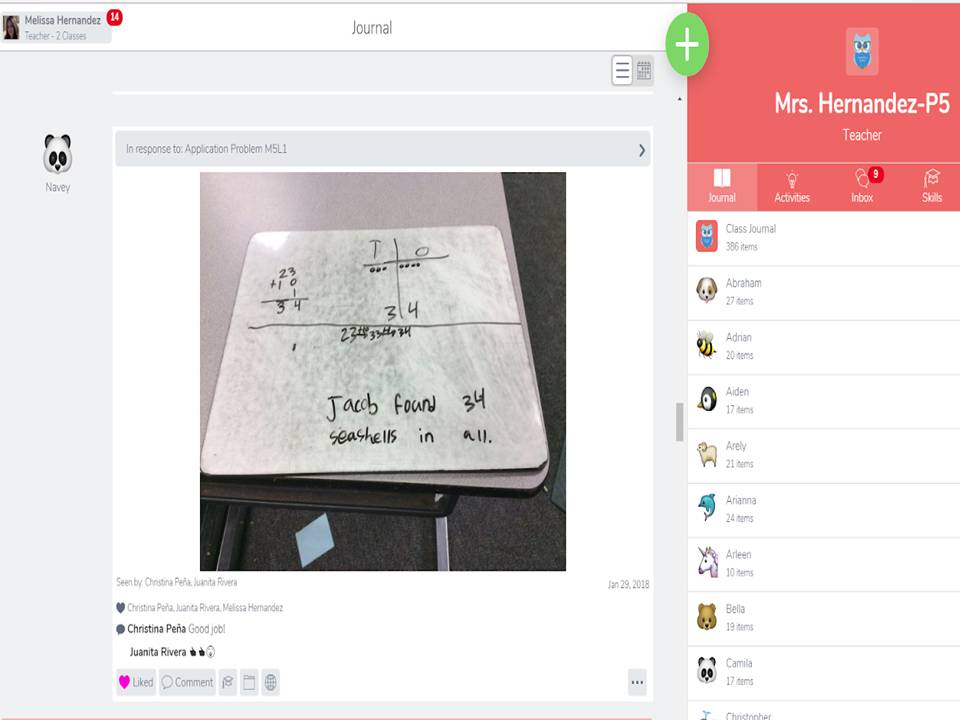 Have you run out of ideas on how to engage parents in the learning going on in your class? If you have access to technology in the classroom I would highly recommend using the Seesaw app with your students. Not only will you find your parents become more engaged and interested in what their child is learning, but it also empowers your students to show their learning. Have you run out of ideas on how to engage parents in the learning going on in your class? If you have access to technology in the classroom I would highly recommend using the Seesaw app with your students. Not only will you find your parents become more engaged and interested in what their child is learning, but it also empowers your students to show their learning.
"At the end of the day the most overwhelming key to a child’s success is the positive involvement of parents.”
-Jane D. Hull
There are so many benefits to utilizing Seesaw in the classroom. Through the use of this app students are empowered to document their learning with built-in creative tools. It also provides an authentic audience for their learning: their families, peers, and teacher of course! As far as families are concerned, Seesaw provides them with an immediate look into their child’s school day. Your parents and students will LOVE it! I can guarantee that you will too.
The following video shows a current student of mine who is sharing her constructed response to the question, “What makes an African Savannah different?” After her partner video taped her response, she uploaded this video to her Seesaw journal which was then instantly shared with her family. Seesaw Journal - Student Video Talk about powerful and engaging! As an added bonus, parents can comment on their child’s learning!
Seesaw is such a great learning, engagement, and communication tool!
So you may be asking yourself, what does it look like in the classroom? The possibilities are endless, really. The first step would be to create an account for yourself and your students. You will then invite parents to download the free app and join your class for access to ONLY their child’s journal. The great thing about this app is that it’s safe to use. Student work is private to the classroom by default. Teachers control what is shared and with whom. To learn how to create a Seesaw class for your students click on the following link: Seesaw--Creating Your Class
I can’t wait to hear your experience with Seesaw in the classroom. Tune in next month to see how I use Seesaw in writing and math!
| ||||||||||||||
Wednesday, March 14, 2018

Tuesday, March 13, 2018
Combine Kagan & Math! by Kimberly Smith
Combine Kagan & Math!

When I was a student, one of the things I loved most about school was the fact that it was fun! Now that I’m a teacher, I know how difficult it can be to make things “fun” while also trying to keep up with the rigorous pacing, especially in math. One of the easiest ways to spice up content is to try a Kagan cooperative learning structure or two!
Using cooperative learning structures in your class will not only make the content more exciting, it will also get your kids to become more engaged. Why is this, you may ask? Well, your students don’t really have a choice because one hundred percent of your students will be participating!
Because my students have been practicing certain Kagan structures for so long, they are very well versed in how to work with teams or partners. They know how to mix around the room without being disrespectful, and they know how to form groups quickly without wasting precious time. I’ve heard many teachers say things like, “My classroom gets too loud using cooperative learning structures” or, “My students can’t handle it.” As much as I understand what it’s like to have a rough class (I’ve been there before), I sincerely believe that any class can handle using the structures as long as you are very deliberate in teaching the do’s and don’ts of each one.
“Practice does not make perfect. Only perfect practice makes perfect.”
--Vince Lombardi
Modeling how a certain structure should look and how it should not look is a great place to start when teaching a new Kagan structure. I start teaching new structures on the first day of school, and I never really stop throughout the year. Ask for a volunteer in the class to be your partner and model the wrong way, (I do this in a funny, obvious way) and then model the right way.
During math time, I definitely have my go-to structures. When you have go-to’s that are easy and quick to use, they’ll be a lot easier to throw into your lessons. One way to make things less overwhelming is to categorize your favorite structures. For me, I like to separate structures which involve getting up, from structures in which kids remain seated. Then, I also separate structures which ask for partners, from structures which involve group work. Of course, there are even some structures which are considered whole group. Here are my favorites to use during math time, separated by category:
Seated Structures:
Partner- RallyRobin, RallyCoach, Timed-Pair-Share, Think-Pair-Share
Group- RoundRobin/All-Write-RoundRobin, Talking Chips, Numbered Heads Together (involves standing at the end), Jot Thoughts
Whole Group- Showdown
My go-to’s for seated partner structures:
When solving math problems which involve a process, or several steps, I love to use RallyRobin and RallyCoach. I usually give partnerships a choice of which strategy they’d like to use. With RallyRobin, partners ping-pong back and forth each solving a step in the math process. With RallyCoach, one student coaches the other student through the process of solving a problem. Then, when finished, they switch roles, and the other student now gets to be the coach/teacher. To involve more verbalization of the steps, I have either the “student” or “coach” explain every single step they’re performing, focusing on academic vocabulary.
Another fun add-on to RallyRobin is teacher vs students RallyRobin. Let’s say I ask students to name prime numbers. I might name a prime number first, and then call on a student with a hand raised to name a different prime. This back and forth game goes on as long as you’d like as you call on different students to compete against you. The kids have a lot of fun with it because it becomes a challenge as they try to stump the teacher.
My go-to seated structures:
Roundrobin is such an easy structure to use in any subject. It’s great for discussions or to discuss processes because every student in the group gets a chance to share something. Each student in the class is held accountable for participating. It’s as easy as putting kids in groups, giving them a discussion starter or problem to discuss, and then saying, “Person 2, please begin.” All-Write-RoundRobin is the same structure except all students are jotting down whatever they're working on. For example, if students are finding the area of a triangle, the first student might share that all students should write down the formula. Therefore, all students write down the formula on their papers.
Talking Chips does the same thing as RoundRobin, but it doesn’t put students on the spot as much since they must put a “chip” in, in order to speak. However, students must share at some point since the other kids can’t share again until all chips have been put in the middle.
Talking Chips does the same thing as RoundRobin, but it doesn’t put students on the spot as much since they must put a “chip” in, in order to speak. However, students must share at some point since the other kids can’t share again until all chips have been put in the middle.
Numbered Heads Together is fun because students share in a group either via RoundRobin or Talking Chips, but then one member of a group is called on to share what was discussed. For example, you can pull up the Smartboard dice, and if it lands on 3, then person 3 from each group must stand up. Then, you roll the dice again, and this will determine which table group will share. For example, person 3, table 4. The kids love this structure because it feels like a game, and it’s totally random, so all must pay attention. What’s not to love? :)
Whole Group:
Showdown is appealing to the kids because they get to use whiteboards (you can also use paper). We use Showdown in conjunction with Eureka's Rapid White Board Exchanges. All you do is list something on the board for students to solve. Students solve on whiteboards and then turn boards over to let you know they’ve finished. Once you see most students have finished, you count out loud “1,2,3, SHOWDOWN!” The students also yell out “Showdown” at the same time as they show you their answers. It’s fun and fast at the same time.
Structures Which Involve Movement:
Partner-Mix-Pair Share, Stand-Up, Hand-Up, Pair-Up, Find Someone Who, Quiz-Quiz-Trade
Group-Circle the Sage
My go-to’s for partner structures with movement:
Mix-Pair-Share is really fun for the kids because they get to walk around the room and listen to music (although you don’t have to play music). It gives them a chance to stretch and converse with different kids. One of its cons is that partnering is at random since you tell them when to pair. Even though partnering is random, you can still facilitate by walking around the room to listen to as many conversations as you can. I like to use this structure when my students are looking sleepy and could use a stretch break.
StandUp-HandUp-PairUp is another fun and easy to use structure. It gets kids out of their seats but is not time-consuming whatsoever. All you have to say is, “Stand Up, Hand Up, Pair Up with someone who is not from your table group.” You’ll also want to make sure that you explain that this structure should be performed quicker than Mix-Pair-Share and that students should not have to walk very far to find a partner.
Circle the Sage can come in handy when introducing new content. To find out more about Circle the Sage, please click here: Circle the Sage Info
Need to make your students move faster? Simply countdown while students are finding a partner--especially for your stragglers. “Okay, 10 more seconds to find your partner. 10-9-8-7…” This usually does the trick.Circle the Sage can come in handy when introducing new content. To find out more about Circle the Sage, please click here: Circle the Sage Info
Educating together,
Kimberly Smith Loya

Monday, March 12, 2018
Socratic Seminar
 |
Socratic Seminar!
Involving your students in a Socratic Seminar is one of the best ways to encourage a higher level of thinking and a deeper understanding of important texts and topics. Socratic Seminars also teach kids to establish how to discuss and build ideas off of one another. "This type of student-led discussion (based on Socrates’ method of student inquiry rather than teacher lecture) elicits student ownership, deep thinking, critical questioning,academic vocabulary usage, and a rooted sense of community. Although the teacher is seemingly offstage, a meaningful and effective Socratic seminar only occurs through intentional planning." -Edutopia
Teaching your students to conduct a Socratic Seminar is one of the most powerful teaching tools you can implement as a teacher!
"Socratic Seminar focuses on deep discussion around a central text, so it is important that complex, rich texts are chosen that invite multiple interpretations and negotiation to arrive at meaning." -AVID
For this Socratic Seminar the students are focusing on “positive change” and “taking action.” This was based on the 5th grade ELA Wonders Curriculum Unit 4, Week, 3 Essential Question “What can people do to bring about a positive change?” This was a big topic and we spent several weeks even after this one reading articles in addition to the Wonders curriculum texts that connected to this theme/idea. Texts/topics we covered included: Rosa Parks, Frederick Douglass, Abbigail Addams, as well as some current event articles such as the Athletes taking a kneel, a boy with cancer who started a foundation, a girl in Florida who created an invention to help those in need, etc. It’s extremely heart-melting to hear the passion in the kids’ voices as they share and develop their own opinions about the world. Throughout the length of this unit you could see their little light bulbs going off as they read stories about people in our history who have made positive changes by standing up for what’s right, and also about the power that even children can have in making a positive change, such as raising money, building awareness, and developing inventions to help those in need. It was a really powerful topic and one that was time well spent! We do A LOT of collaborative discussions in here, and we've done TONS of small circle Socratic Seminars so they have had practice with this type of discussion, but this was our first whole group Inside/Outside Circle Socratic Seminar this year and they did an AWESOME JOB!!
Effectively conducting a Socratic Seminar unit will enhance your students’ learning across all areas. It will strengthen their reading comprehension skills, writing skills, higher level thinking skills, and their ability to communicate and develop ideas with their peers.
Collaboratively Learning,

Here’s how to get started!:
1) You first want to introduce the topic, or question that students will be focusing on (I often times use the weekly Essential Question in our ELA Wonders curriculum as our discussion point).
2) You want to make sure you provide students with a variety of complex texts and resources to thoroughly gather information on the topic. If using the weekly Essential Question in Wonders, you already have 3 different texts built in. I then often times further enhance their knowledge on the topic by finding a couple of current event news articles that align with the topic in their reading curriculum. I use the Newsela.com site (This site is AMAZING if you don’t know about it, go there IMMEDIATELY! You can create a teacher/class account for free). This site creates current news articles for children. You can choose them by grade level, content, topic, and also Lexile level. It’s a great resource!
The students need to read closely and interact with each text/resource provided. I generally have the students annotate the texts as we read/discuss them. I walk them through note-taking (either 2 or 3 column notes) on each text as we read, annotate, and discuss. This process ensures they are reading, understanding the text, and have notes with important details laid out in an organized manner.
3) After all sources have been read and discussed, the students need to prepare for the discussion. To do this I have students write Costa's Leveled Questions (Level 1, 2, and 3) for one or two texts of their choosing (I did not have them write questions for ALL texts/sources we have read as we read about 7 sources for this particular unit). These questions are meant to guide their discussion and facilitate a deeper level of thinking.
4) Last, you decide which method(setup) of Socratic Seminar you would like you use: One Large Circle, Inside/Outside Circle (or Fishbowl), Simultaneous Seminars (multiple small circles), or Triad Circle (“pilots” and “co-pilots). For the lesson you see above in my video, I chose to do the Inside/Outside "Fishbowl" Circle. The inside circle are the speakers- these students will engage in the discussion for the first round. In the outer circle the students are observing, listening, and writing down notes. Once done, the outside circle students give their feedback to the inside circle student they were focusing on, and then they switch places- the inner circle becomes the outer circle and visa versa. In order for a Socratic Seminar to flow successfully, it's important to assign a student “facilitator” who can help guide the discussion/group if they get off track. You can see this in my video above where this student guides the group by posing a new question, and calling out students who may not be participating.
5)After the seminar is over, the students then complete a constructed response writing prompt (which is generally the initial question posed as we started the unit and the Socratic seminar). I always have the focus question/writing prompt posted on the board so they can see it throughout their discussion- helps keep them on track. In doing all this, by the time the Socratic Seminar is finished, they have not only their own ideas, but now new ideas generated from their peers through the power of discussion, in addition to their notes and text evidence. For the this lesson, the constructed response prompt was developed into the format of a 5 paragraph essay via Google Docs- following the RACES format/process (just in essay form rather than a single paragraph).
Collaboratively Learning,
Megan Brown
megan.brown@omsd.net
megan.brown@omsd.net
Tuesday, March 6, 2018
"Road Trip" - Student Voice and Choice - Project Based Learning
Student Voice and Choice

Project Based Learning
"I am going to Disneyland. Not! Disney world, yes." - Deijohn Dixon
"Can I go to Mexico?" - Aaron Jurado
"What about a car that can drive on water?" - Edgar Gonzalez
"How many places can I go to?" - Robert Wenceslao
"$20,000 is a lot of money for a trip." - Angela Lugo
"CAASPP in 21 days"
"I still have a module to teach that I have not started yet."
"When am I going to review all the topics that were taught this year?"
"How do I keep the students engaged at such a critical time of the year?"
"High school registration has begun and I need my students to do well on the high stake test."
Are these some of the thoughts you are having right now? Because I am having these thoughts.
Project Based Learning (PBL) is a method of learning where students acquire knowledge through challenges and inquiry-based learning. One of the project essential elements in PBL is student voice and choice.
Student voice and choice can allow you as much input as you would want from your students. Students deciding on the final public product, to the project requirements, to the actual project design are just a couple of the options for student voice and choice. Allowing student voice and choice in a project can build more buy-in by students. This essential element in PBL projects can be implemented at the planning stages of a project, beginning of the project, middle of the project or even the end of the project. Getting students' ideas of what is of interest to them can start the planning of a new project for an upcoming unit of study. After introducing a project, you could have students choose from what they want to study in the unit. And in the middle or end of the project, you could have students start choosing what type of public product they want to create as a demonstration of their learning.
The goal of student voice and choice is to give students the opportunity to lend their ideas and thoughts to the project they are working on.
I just started a project last Friday with my 8th graders on the unit of study with functions. I decided that I would use the idea of a "Road Trip" to keep students' interest this close to CAASPP and as a 'vehicle' to teach an important topic. As I was planning this project, I wanted to give as much student voice and choice as I could to my students. So, the project allows students to choose anywhere they want to drive to - they use Google Maps to determine the total distance and the total time required for their trip - the only restriction being that you must be able to drive there. They can bring anyone on the trip that they want to go with them - from friends to celebrities to pets. Then students are allowed to choose the cost of food per day they want to spend, the quality of lodging they each night, and the amount of spending money per day. A list of car options is given, but I added an extra 'your choice' where students can research their own vehicle - this has turned out to be a good option because students are researching motorhomes which I had never considered - great thinking on my students' part. They then calculate the amount of gasoline and the cost to buy gas for their entire trip. So many options for the students in this project that each and everyone of them is creating their own personalized "Road Trip."
Where is the CA content? Great question. The "Road Trip" must cost between $19,000 and $20,000. And each part described above must be represented four different ways - a story, an equation, a table, and a graph. Students are so focused right now on their choices that only a couple have figured out that this is a very small margin - but those that have realized that are starting to go back and make changes to their choices. And the final part of the project, students get to choose what public product they want to create to demonstrate their learnings through the project. I keep telling the students, "I want you to get it wrong the first time, and the second time, and hopefully get it right the third time." There are so many moving parts to this project but each moving part allows students to have their own voice and choice - in the hope that they are engaged for the entire project.
I encourage you to think about a project idea and ask how you can incorporate some "student voice and choice" in the project - whether it just be one part or multiple parts.
Still learning and loving it,
Kevin
Kevin
Monday, March 5, 2018
Universal Access (part 2)
Universal Access (part 2)
 Have you ever wondered how to differentiate reading in your classroom? Have you wanted to help your struggling readers and help your proficient readers dive into deeper thinking? You can! If you read my blog last month, you learned about my Language Arts Universal Access and how I group my scholars with SUCH different needs in order for them to achieve success in reading and writing. Now, as teachers, we are continuously looking at numbers for success, but I look at success as overcoming obstacles that have prohibited one from achieving a goal. To reinforce the idea of positivity and motivation getting us to where we never imagined, students watch videos and read stories of leaders and celebrities overcoming obstacles.
When students focus on the positive,
the NOW and ALL they have accomplished,
you get them to realize they ARE smart and can achieve what they set their mind to.
the NOW and ALL they have accomplished,
you get them to realize they ARE smart and can achieve what they set their mind to.
The goal of my Universal Access Time is to target the different areas and different pace due to different academic needs. The goal would be GREAT to have all Proficient/Advanced students and be able to form our groups according to the Multiple Intelligences, but it’s not likely. Therefore we celebrate the small steps, the daily effort that is leading us towards success and adds activities/lessons to also target the Multiple Intelligences. Student BUY-IN (students have to know the answer to the question, “What’s in it for me?”) leads to independent learners., but the key to continued success is keeping them engaged within their team when you are not there to support. Have them come to an agreement with a team name and draw/write the talent/strength he/she can bring to their team.
In order to keep them engaged, I keep them on track with team roles. Since I am not there to support every team on a daily basis, students know to choose a leader, writer, time-keeper, and the rest are responsible for being collaborative workers that can add to their team as they see fit necessary (this all comes from the teaching of “The Importance of Teamwork” which I have previously talked about in my blogs). Once they have the responsibility, the teams will function without your assistance); for the most part, the students will read their directions and just roll with it. Now, it’s not to say that you won’t have to revisit norms and responsibilities because it’s always good to teach at the beginning of every trimester, to give students a new and refreshed perspective when working in a team.
As you get ready to set up your Universal Access, look at numbers initially to form your teams. Form homogenous groups, meaning you focus on Diagnostic/Placement and Scholastic Reading Inventory to know who your readers are: Far-Below Basic, Below Basic, Basic, and Proficient/Advanced. I usually have 25-30 students; therefore end up with 4-5 groups. I keep my Far-Below Basic and Below Basic groups, the smallest, 5-7 students, my Basic group will have 7-8 students, and my Proficient/Advanced group will have approximately 10 students (but you can split this team into two if it suits best). Keep in mind, after setting up your groups/teams, let your students know that they are fluid; groups can and should change due to progress.
That's at the core of equity: understanding who your kids are and how to meet their needs. You are still focused on outcomes, but the path to get there may not be the same for each one. ~Pedro Noguera
Once it’s all said and done, don’t go above and beyond on recreating what’s already there. Wonders McGraw Hill has many resources for our use! I have four groups this year:
The Technology Group works on Wonders Grammar Games. The Fluency Group focuses on the fluency passage of the week, found in the Student Practice Book. The Writing Group focuses on the RACES strategy answering the Essential Question of the week; students use their student book and Anthology to find evidence in supporting their answer.
My Proficient/Advanced group works on all of this, but I also challenge them by reading a chapter book together that will lead to deeper discussions and the writing of poetry or story skits. Universal Access is an hour of our learning day; the first half hour of Mondays/Tuesdays is dedicated to my Far-Below Group and the second half hour is dedicated to my Below Basic Group. By Wednesday and Thursday, we have read the Leveled Reader twice and are ready to do the 3rd read without my support. I leave them to read and take notes to form a summary of the book. This gives me time on Thursday/ Friday to meet up with my Basic and Proficient/Advanced groups to check on their progress and know if they need my assistance in any area. It’s not a perfect setting because things will go wrong, but I can say that my students have gained an interest in reading and writing. The interest has led to LOVE for some, and that LOVE has led to academic growth.

Teacher Group
Technology Group
Fluency Group
Writing Group
The Teacher Group is meeting time with ME. We read and discuss the Wonders Leveled Readers. For my struggling readers, I always start with a 5-10 minutes Phonics review, running the Spelling Cards and focusing on segmenting and blending a couple of words that have our spelling focus of the week. We then focus on Sight Words, 5 minutes of rapid automaticity naming words that don’t follow Phonics and Decoding rules. The Technology Group works on Wonders Grammar Games. The Fluency Group focuses on the fluency passage of the week, found in the Student Practice Book. The Writing Group focuses on the RACES strategy answering the Essential Question of the week; students use their student book and Anthology to find evidence in supporting their answer.
My Proficient/Advanced group works on all of this, but I also challenge them by reading a chapter book together that will lead to deeper discussions and the writing of poetry or story skits. Universal Access is an hour of our learning day; the first half hour of Mondays/Tuesdays is dedicated to my Far-Below Group and the second half hour is dedicated to my Below Basic Group. By Wednesday and Thursday, we have read the Leveled Reader twice and are ready to do the 3rd read without my support. I leave them to read and take notes to form a summary of the book. This gives me time on Thursday/ Friday to meet up with my Basic and Proficient/Advanced groups to check on their progress and know if they need my assistance in any area. It’s not a perfect setting because things will go wrong, but I can say that my students have gained an interest in reading and writing. The interest has led to LOVE for some, and that LOVE has led to academic growth.
Live, Love, TEACH!
Hilda Sanchez

Saturday, March 3, 2018
You Can’t Put a Price on Knowledge
You Can’t Put a Price on Knowledge
As educators, we may
or may not all agree on the importance or even on the advantages of nightly
homework. In my opinion, it is better to give less, more valuable homework,
than to dole out a barrage of busy work. The sweet spot is somewhere in the middle--valuable
homework that does not consume all of our students’ time and energy, but does
propel them forward. What if the homework assignments we gave our
students could actually help them develop better focusing, thinking, writing
and speaking skills?

About
three years ago, my internal struggle (Homework? Yes or no? How much? How
often? Ahhh!) prompted me to put a new spin on our grade-level’s reading log.
Armed with Tier 2 vocabulary, the Common Core E.L.A. standards, information
from vertical-alignment conversations, and information gleaned from SBAC
Practice Tests, I set to work. Although the reading log has evolved over the
years, the basic format remains consistent. In the margins of the document, I
address the students personally; l may briefly review instruction, provide
helpful hints, offer pertinent examples, and give clear direction. I want
students to “hear” my voice speaking directly to them. Every week, every Euclid
Elementary School third grader is presented with a reading log and two sources.
I am confident
that we all want to teach our students to be clear thinkers. However, there is
a distinct difference between really thinking and just entertaining
random thoughts. I don’t want my students to robotically complete their reading
logs or any homework tasks while their minds fill with random thoughts of
everything that is competing for their attention--t.v. shows, YouTube, video
games, etc. In their defense, without direction, our minds are hosts to
countless random thoughts. In an attempt to bypass this, I make sure students
know, without a shadow of a doubt, that the work they do at home is as valuable
as the work they complete in class. Students will reap what they sow. If they
don’t put much effort into the reading log, they won’t reap the benefits. As we
all know, students’ knowledge and skill set vary greatly. The reading log is
challenging and, for that reason, frontloading is essential. I take the time to
clarify each night’s assignment. The next day, I review the assignment again.
If there was a writing component, then I build in opportunities for students to
read aloud what they wrote.
The reading log grew out of a need that my teammates and I
had prior to our district’s adoption of the McGraw-Hill reading program. At
that time, we had the Common Core standards and were responsible for preparing
our students for the SBAC, but we did not yet have a reading program in place. Now
that we have so many amazing resources available through McGraw Hill, our task
is to be mindful about matching resources to student needs. In doing so, our students
will flourish under our vigilance.

Hopeful for my student's success...
Lola Jollie
Lola Jollie
Monday, February 26, 2018
Comments vs. Questions
Comments vs Questions

Have you ever asked your class, “Does anyone have a question?” Did your students actually ask a question? Did your students share a thought?

In my class, most the time my students make a comment. This is when I realized my students need to know the difference between comments and questions. I needed to work on teaching them the difference between asking a question and telling. I also needed to teach them how to ask questions.
“Once students learn how to ask their own questions, they can become active learners in every classroom, no matter the subject.”
-Dan Rothstein and Luz Santana
Teaching young children how to ask questions
Teaching the skill of asking questions is a skill that can be accomplished with regular practice. All students are capable of learning this even in first grade!
I start with basic lessons, such as, categorizing sentences that end with a period or a question mark. We then practice correcting sentences using the correct punctuation. I also teach words that help begin a question, like the I mustache you a question chart above. This helps them formulate questions instead of making comments. The most fun part is teaching them to raise their voice as they ask their question. A question and a statement do no the sound the same, they begin to recognize that in how it sounds. These mini lessons are valuable in my classroom because once my students know the difference between asking and telling, they begin to ask really good questions. They are curious and extending their thinking beside answering my questions. My next step is to begin training them in asking each other questions while we are reading a text or explaining our math problems. Join me next month to read how first graders question each other!
 Always Learning,
Sabrina Blackwood
Lunch Buddies
Lunch Buddies
 When Punxsutawney Phil saw his shadow on February 2, he got scared and went back in his burrow. This indicates there will be 6 more weeks of winter...
But in my class, spring has come early this year; every teacher has experienced the phenomenon that is known as Spring Fever.
 spring fe·ver
After a particularly rough two days of spring fever behavior, I had the weekend to figure out what and how I was going to get my kindergarten students back on track so we all survive the next four months of school. One blogger I follow mentions often about how he eats lunch with his kindergarten students... every. single. day. I thought he was crazy! My lunch is my time to socialize, vent or discuss the morning events with my friends/colleagues/ADULTS. It's when I can do something for myself without 5 kids needing me for something. I always remembered this tidbit about that teacher I admire and how he recommended it for all teachers because of the relationships that are built during this sacred time...
And I was desperate; desperate for something to change. So one of the things I decided to do is to eat lunch with two of my students every day. One student would be the helper of the day and the other would be a student of the helper's choice. I wanted to make this time special, so I went to the teacher/mom/housewife mecca that is Target and I bought some cute trays, cups, placemats, and utensils with a camping theme. I bought myself a thermos so I wouldn't need a microwave to heat my food. I was getting mentally and physically prepared togive up enjoy my duty-free lunch with some of my students. every. single. day.
"Great teachers focus on connections and relationships." -Eric Jensen
I've always felt that I make good connections with my students, but after the first week of spending one-on-two time with my students, I realized I could've been doing more to foster a deeper connection. My lunch buddies are so excited that they get to eat lunch with their teacher that they don't even want to go to recess after we eat; they'd rather continue to sit and chat with their friend and me. We talk about food, our families, whatever they want. I let them lead the discussions. The quiet girl who barely speaks in class? She was a chatterbox for the entire 45 minutes. The rambunctious student in class was nervous and shy to be with just the teacher and one friend. I've learned more about my students during these times than I thought I would. I have learned to just enjoy their company without hustling to get to the next lesson or being worried about what I still need to prepare for class. In the end, what I thought would be a sacrifice on my part is really a pleasure. I actually look forward to this special time each day! Like Mr. Greg from thekindergartensmorgasboard.com, I recommend eating lunch with a few students for an extended period of time without an agenda, but just for enjoyment. Of course, my hope for the outcome is that our deeper connections will help settle the restlessness within my classroom. Time will tell on that, but I feel very optimistic!
Happy and Positive Teaching!
Erin Grebel
 When Punxsutawney Phil saw his shadow on February 2, he got scared and went back in his burrow. This indicates there will be 6 more weeks of winter...
But in my class, spring has come early this year; every teacher has experienced the phenomenon that is known as Spring Fever.
 spring fe·ver
spriNG ˈfēvər/
noun
- a feeling of restlessness and excitement felt at the beginning of spring.
After a particularly rough two days of spring fever behavior, I had the weekend to figure out what and how I was going to get my kindergarten students back on track so we all survive the next four months of school. One blogger I follow mentions often about how he eats lunch with his kindergarten students... every. single. day. I thought he was crazy! My lunch is my time to socialize, vent or discuss the morning events with my friends/colleagues/ADULTS. It's when I can do something for myself without 5 kids needing me for something. I always remembered this tidbit about that teacher I admire and how he recommended it for all teachers because of the relationships that are built during this sacred time...
And I was desperate; desperate for something to change. So one of the things I decided to do is to eat lunch with two of my students every day. One student would be the helper of the day and the other would be a student of the helper's choice. I wanted to make this time special, so I went to the teacher/mom/housewife mecca that is Target and I bought some cute trays, cups, placemats, and utensils with a camping theme. I bought myself a thermos so I wouldn't need a microwave to heat my food. I was getting mentally and physically prepared to
"Great teachers focus on connections and relationships." -Eric Jensen
I've always felt that I make good connections with my students, but after the first week of spending one-on-two time with my students, I realized I could've been doing more to foster a deeper connection. My lunch buddies are so excited that they get to eat lunch with their teacher that they don't even want to go to recess after we eat; they'd rather continue to sit and chat with their friend and me. We talk about food, our families, whatever they want. I let them lead the discussions. The quiet girl who barely speaks in class? She was a chatterbox for the entire 45 minutes. The rambunctious student in class was nervous and shy to be with just the teacher and one friend. I've learned more about my students during these times than I thought I would. I have learned to just enjoy their company without hustling to get to the next lesson or being worried about what I still need to prepare for class. In the end, what I thought would be a sacrifice on my part is really a pleasure. I actually look forward to this special time each day! Like Mr. Greg from thekindergartensmorgasboard.com, I recommend eating lunch with a few students for an extended period of time without an agenda, but just for enjoyment. Of course, my hope for the outcome is that our deeper connections will help settle the restlessness within my classroom. Time will tell on that, but I feel very optimistic!
Happy and Positive Teaching!
Erin Grebel
Friday, February 23, 2018
Doceri and iPads (Technology)
Don’t be tethered to your computer all day! Use Doceri!
|
Do you often feel stuck to your little desk sitting next to your SMART Board? Do you get frustrated when you need to use the document camera, but notice the kids in the back messing around or not as focused as you like? Do you wish you can show your students what they need to see without always having to be right at the front? Well, try Doceri- The interactive whiteboard for your teacher iPad!
Doceri “gives you the freedom to teach.”
There have been so many days especially related to Eureka math when I wanted to show students how to work something out, but I had to be glued to the document camera or SMART board..it would drive me crazy. Then I decided to play with the apps that are available on our iPads and discovered Doceri. It allows you to take a picture of the document you want and then write directly on it! If you project your iPad using “Reflector” which is on our computers, then everything can be seen on the SMART Board without actually having to stand at the Whiteboard. Doceri has become a significant game changer when I want to navigate the room while working.
Use Doceri with any subject
Anytime you want show and write on a document for students to see on the SMART board, just take a picture of it within the app and then use the “pen tools” to write directly on it. This app is even great if you want your students to show their work to the class. This app offers a lot of options for you to use and learn, but I just use it for writing and displaying. I also love it because it keeps my students more on track knowing I’m not always stuck in the front. No matter your tech ability you can use this app smoothly and seamlessly. If you try it out, please let me know! If you have questions about how to access this app or Reflector let me know! I can refer you to the right people.

Tech-ing with a purpose,
Tiffani Bossieux
Subscribe to:
Posts (Atom)
Most Viewed Posts
-
 In my previous post, I discussed how incorporating Kagan engagement structures into your classroom can help not only increase the engagem...
 -
 Fluency: Sprints in Eureka Math What is "fluency" in terms of mathematics? And what is the purpose? Eureka Math explains fluenc...
 -
If you're familiar with Kagan, then the "Rally Coach" structure is not a stranger. However, you may have forgotten about thi...
