Eureka! We’ve Struck Math Talk!
| ||||||
Helping students be successful with Eureka Math is not an easy task (especially in the upper grades)! It was definitely not a simple venture for us as teachers to learn how to teach Common Core with Eureka Math (we all remember that hurdle right?!) So how can we as educators, help ourselves to help our students not only BE successful in Math today, but to FEEL successful in Math today?? There’s no easy answer to this question, however, as mentioned in my last two blogs, student engagement is everything! When we think of collaborative conversations, many of us immediately think of ELA. Naturally, collaborative conversations in ELA provide vast opportunities for collaborative talk and lends itself to helping students achieve a level of thinking at a Depth of knowledge 3 and 4 (as you've seen in my last two blogs). However, these same results can be achieved when you incorporate these academic discussions during Math as well. Not to mention the added powerful benefit to the students’ learning through their collaboration with one another!
|
Here are some video clips of my students participating in a variation of the "All-Write-Round-Robin" Kagan strategy. Where each group of 4 was assigned a math problem. The students within each group first worked the problem out individually. Then took turns sharing out in their group explaining how they solved the problem, the steps they took, etc. The group then discusses and decides together on the “best” way to solve the problem and writes out a solution as a group.
| |||||
"Students who are inattentive, withdrawn, and disengaged in the classroom have poorer academic performance when compared to engaged students."
-Kathy Dyer, NWEA
| ||||||
There’s not many things more satisfying as a teacher than when you model good teaching strategies for your students, and then watch them apply these same strategies when working with their peers. I have watched my students stumble upon so many “ah-ha” moments, where they catch and learn from their mistakes when engaging in the Rally-Coach Kagan structure. This is the deeper level of learning we see when students are responsible for sharing their learning, learning from their peers, and collaborating with one another. This deeper level of learning and thinking has become very evident as I watch my students engage in the Rally-Coach Kagan strategy on a daily basis.
Below you will see clips of my students utilizing this strategy during Math to “teach” one another. This strategy involves only minimal amounts of time to “train” the kids to do this properly, and ZERO prep for the teacher, yet yields amazing progress and growth among the students. That’s what I call a “win-win!!”
| ||||||
“Tell me and I forget. Teach me and I remember. Involve me and I learn.” -Benjamin FranklinHere my students are engaging in the Rally-Robin Kagan strategy. This is where the students have a designated amount of time that I give them (usually 60 seconds, or sometimes no time limit at all) where they have to take turns going back and forth with their partner, each sharing a different answer to the question I posed. I tell the kids to think of it as being like a “ping-pong ball" going back and forth! Here, I displayed the Eureka Math “warm-up” activity for that days lesson which required them to skip- count by 2s, 3s, 4s, 5s, and 6s to a designated number, both counting forwards and backwards. They absolutely LOVE doing this!Get started implementing collaborative conversations and engagement activities in Math today! Here are some simple steps to take:
Benefits (of engagement structures)for the kids: Learning from each other, having academic discussions about Math, learning how to “explain” their thought processes, and having fun learning!
Benefits (of engagement structures) for the teacher: Students are engaged and will remain on task allowing you to work individually with a student or small group of students without worrying so much about whether or not the rest of your class is on task, working and learning. Students have practice with “reasoning” skills as they have to “explain” and demonstrate how they solved math problems to their peers. I have actually very recently noticed my students doing this ON THEIR OWN (explaining/rationalizing their answers to their teammates) even when I have not asked them to do so!💗 This goes back to what I mentioned in my first blog about creating/developing that "safe" classroom climate where students are not afraid to make and admit their mistakes, and feel comfortable sharing with one another.💕
| ||||||
Monday, November 6, 2017
Eureka! We’ve Struck Math Talk!


Friday, November 3, 2017
Interacting with the Text
Interacting with the Text
 |
| Posters I use while we interact and annotate various text. |
Many people today identify themselves as "hands on learners". This is really great, we learn by doing and interacting with tools so we can complete a task. Remember when smartphones hit the scene. The only way we learned how to use those sometimes pesky devices was by interacting with them,and pressing all the right and sometimes wrong buttons. So how do we get students to press all the right buttons while reading a text? How do we get students interacting with fiction and informational text we read in class ? I would like to suggest using various annotations/cognitive markers. A few examples are Notice & Note Signposts, Depth and Complexity Thinking Prompts, and annotations,
you or students can create.
you or students can create.
INCORPORATING ANNOTATIONS, ALSO CALLED COGNITIVE MARKERS, WHILE READING A TEXT WITH STUDENTS, WILL PROVOKE REFLECTING, RESPONDING, AND THINKING.
I'm the type of teacher who likes to implement new things. When something doesn't work, I file it away to try again later, but when something does work I invest some energy into it and incorporate it into my teacher toolbox.
After reading the books Notice & Note and Reading Non-Fiction, I made some charts (pictured above), and I got to work. Tired of my same ol' boring way of reading with the class I passed out a simple T-Chart, and told the students to grab their favorite writing utensil along with our reading material and it happened. We started interacting with the text. As we read we stopped and used "noticed and note" signpost strategies on one side of our T-Chart. On the other side we reflected on, commented or discussed our annotations relating to what we noticed in the text. From the first day of implementing this notice and note strategy, I could affirmatively we have used many different styles of thinking maps, t-charts, and teacher created activities while reading, interacting, and annotating various text. The students do not get bored and the novelty of this activity stays relatively high because you and the students can create signpost, or symbols, for specified text.
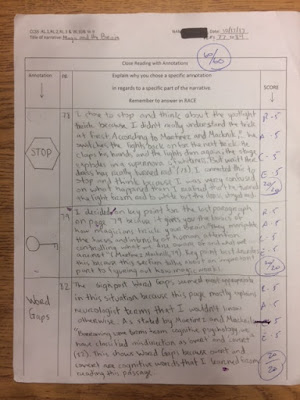
After reading the books Notice & Note and Reading Non-Fiction, I made some charts (pictured above), and I got to work. Tired of my same ol' boring way of reading with the class I passed out a simple T-Chart, and told the students to grab their favorite writing utensil along with our reading material and it happened. We started interacting with the text. As we read we stopped and used "noticed and note" signpost strategies on one side of our T-Chart. On the other side we reflected on, commented or discussed our annotations relating to what we noticed in the text. From the first day of implementing this notice and note strategy, I could affirmatively we have used many different styles of thinking maps, t-charts, and teacher created activities while reading, interacting, and annotating various text. The students do not get bored and the novelty of this activity stays relatively high because you and the students can create signpost, or symbols, for specified text.


THESE BOOKS ARE GREAT RESOURCES,TO GUIDE YOU INTO YOUR FIRST STEP TOWARD LEARNING HOW TO TEACH STUDENTS TO INTERACT AND ANNOTATE A TEXT.
(you may also find yourself interacting and annotating texts when you read on your personal time) :)
(you may also find yourself interacting and annotating texts when you read on your personal time) :)
I highly encourage you to take some time and learn how you can implement annotations, and notice and note reading strategies into your ELA time. Once you learn the process of interacting with the text, there is little prep involved, and there is a big payoff because students will surprise you with how many "signpost", they notice while reading!

Thursday, November 2, 2017
Eureka: Expressions and Equations!
This past week my 7th graders were introduced to the concept of Expressions. The activity involves inquiry and therefore, the students were not given any instructions other than to place terms that they thought went together. They needed to write down their answers in their math interactive notebooks. They were timed and asked to move to another group four times. After the activity, I asked students to tell me what terms went together and why. The conversations we had were very powerful and provided insight as to how they understood combining like terms. Check out the short 50 second clip and listen to the questions that I pose. Remember that students have not had previous instruction for this skill.
I designed this warm up activity after watching another Spotlight teacher do her warm ups in a similar fashion. I modified mine for a middle school setting by restricting the number of problems and limiting the time to 1 minute per problem. A few things happened as a result of this strategy. One, students walk around the room while they discuss math. Two, they have an opportunity to discover math skills before actual delivery of instruction takes place. It is important for me to listen to where students are in terms of the concepts or skills, so I can guide my instruction. When students are given an opportunity to discuss the mathematics, they are developing ideas and making sense of problems. This builds confidence in working with mathematics and gets them ready to receive new knowledge.
| |||||
It is my goal for this blog to give you resources for the talk moves that I use regularly with my students. Here is a video resource for you to watch if you are inclined to do so.
| |||||
During this short clip you hear Melody state her reasoning for placing certain terms together. I had to ask more questions to push her to consider other options in doing the activity. As the year continues, I notice Melody getting more frustrated with the math. She has also started dance in the after school program and refuses to stay for tutoring. I’m disappointed but will not give up on her. | |||||
Feel free to send me your comments after you have read and seen the video. I welcome all constructive criticism. Have a fantastic rest of your day!
Hilda Castillo
|  | ||||
Click here to schedule a visit
 |
Hilda.Castillo@omsd.net
|  |  | ||
Friday, October 27, 2017
Quiz, Quiz, Trade by Maite McCraney
Cooperative learning strategies are essential to creating a purposeful classroom environment. With that in mind, I wanted to bring QUIZ QUIZ TRADE into my classroom. In a nutshell, Quiz Quiz trade is a quick way to assess if students have mastered a learning objective. I tried the strategy QUIZ QUIZ TRADE to review multiple meaning words, and the students took the bait, in other words, they loved it!
|
 |
||||
Implementing Quiz Quiz Trade into your classroom will engage every student in your classroom. The students will practice the standard multiple times while interacting with multiple students. They will also learn to take turns, self-correct one another, and praise each other for their effort.
|
|||||
“Ok, guys take out your reading books and we will read the next story.” Students comply, but there is not much enthusiasm. The teacher tries to make it as fun as possible and use post-it notes to take notes. They partner share and use round robin to talk about the plot. sometimes learning has to be quiet and students need to sit still and read. I have been at that place in a lesson and I bet you have too.
Other times teachers say, “Alright, we are going to play a game called Quiz Quiz Trade.” The students squeal “YESSSSSS!” They are EXCITED to learn and who doesn’t like a game? They pop out of their seats! Quiz Quiz Trade is a strategy that I have implemented in my room and I can see every level of learner in my classroom reading, smiling, and LEARNING!
|
|||||
Quiz Quiz Trade Video |
|||||
Implement Quiz Quiz Trade in your classroom and you will witness all students engaged, accountable, learning, and having fun simultaneously.
|
|||||
Quiz Quiz Trade might require a little bit of structure, prepping, and planning, but seeing your students learn will give you a sense of pride and accomplishment! I couldn’t believe the amount of engagement from my students who are reading under 10 words per minute, to my students who are reading above grade level! I was meeting the needs of all my students.
Keep running the race and set a new personal goal!
Maite McRaney 2nd Grade Mission
|
|||||

Thursday, October 26, 2017
The Praise Phase
The Praise Phase
| |||||
As teachers, we strive to create a positive classroom community and foster a nurturing environment. Students need to feel valued not only by their teacher but also by their peers. But, cultivating the conditions and creating those relationships can be a challenge. In knowing that students walk into our classrooms daily with various backgrounds, home lives, and prior knowledge, it is necessary to create a classroom culture where praise runs rampant. We must bring each other up and teach positivity.
|  | ||||
How do we teach our students to praise each other and have them truly mean it? How can we teach them to offer encouragement that is honest and has merit? How can we turn praise into a morale booster amongst students?
| |||||
Everyone values being praised and recognized for their efforts. It is a huge part of nurturing our self-esteem and confidence. Praise plays an important role in our classrooms. It is a great way to motivate students and build an optimistic classroom culture. Children see and hear everything, and they will mirror what they see and hear from the adults around them. When we as teachers, are focused on the positive, students focus on the positive. We can find and recognize positive behaviors in all students even those who challenge us. We must be examples of what positive praise looks like in order to have students give positive praise to each other. They must feel comfortable enough to take risks while respecting each other’s mistakes and accomplishments. It’s important to live by example and make sure we are giving ourselves the praise we deserve. We need to validate the challenging work we do as teachers. It’s important to notice the wonderful work our colleagues are doing, and give them meaningful praise. This will not only help us but also our students.
| |||||
We rise by lifting others. -Robert Ingersoll | |||||
In order to help students motivate each other during partner and team talk, we must incorporate praise into our classroom culture. How do we teach our students to praise each other? | |||||
All Kagan Structures should end with praise. Students are encouraged to praise each after they complete their structure. But how do we get them there? I like to start the year off by teaching developmentally appropriate social skills. Some students need this drastically. I give them the opportunity to practice these skills through fun team and class building activities. During this stage of teaching, practicing, prompting and using these skills I model praise. I make sure to give general praise such as “I’m so proud of you”, specific praise such as “I loved the way you raised your hand and waited for me to call on you” and effective praise such as “You’re amazing! You didn’t let others distract you and you finished your work. I notice when you ignore distractions, you get your work done.” It’s important to show genuine interest in each child. Sometimes I might ask specific questions such as “You’ve been really focused on your work. What’s helping you concentrate?” A question helps students become aware of their own actions and behaviors that can lead to improvement.
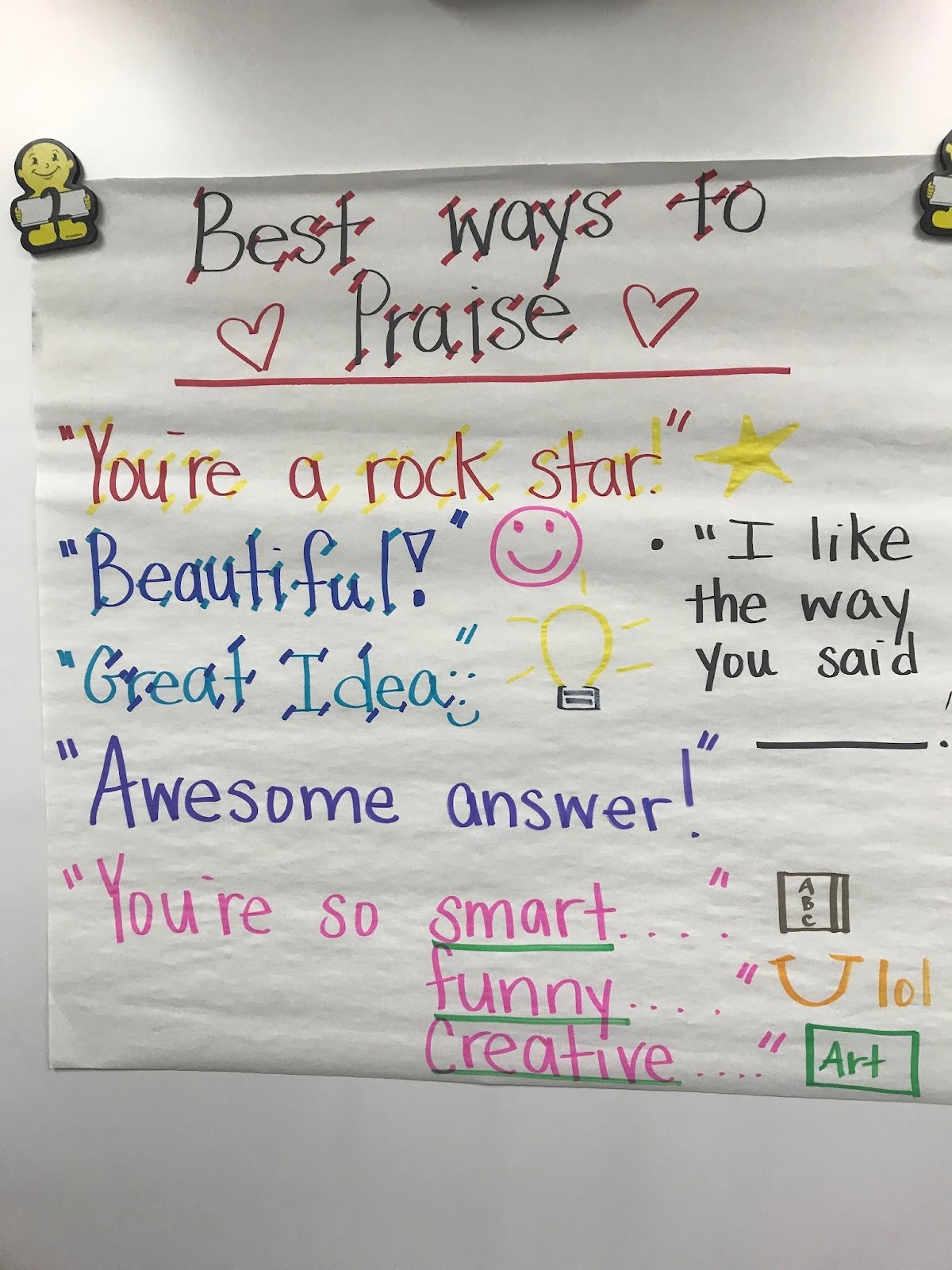
After teaching and modeling appropriate praise, I taught my students how to praise each other. It’s important for students to have peers recognize their actions. This task was not an easy one. It is unnatural for students to genuinely praise each other. It is my job to turn a culture of tattling into a culture of praise. First, we created a class poster called “Best ways to Praise.” It became a visual reminder of what was expected. Next, we practiced A LOT! After each structure, they knew that I expected to hear and see praise. I was always listening and praising them when they praised their partner or team. I made sure to point out what I noticed and gave immediate feedback. I was building and maintaining our culture by giving praise and acknowledging when it happened. My students are constantly improving on and learning new ways to praise each other. My hopes are that they will take these social and emotional skills with them and use them to empower themselves and others.
Positively Teaching,
Randi Muehlen
|  | ||||
Wednesday, October 25, 2017
Building an Interdisciplinary Classroom by Hilda Sanchez
Building an Interdisciplinary Classroom
| |||||
Is time our enemy? As days go by we battle with TIME, our opponent, as we try to stay on pace with the curriculum of the year. We’re sweating day in and day out trying to get it all done, and as we cover Language Arts and Math topics for the week, we may realize Science and Social Studies have been neglected along the way. There is something wonderful in Wonders and it’s the fact that science and math can easily be embedded within the Language Arts Units. It takes some work to put it all together, at first, but will save you teaching time in the long run.
|  | ||||
Teaching literacy with science/social studies content allows for more productive and complex learning.
| |||||
Integrating science/social studies in literacy motivates and keeps students engaged in the learning process. In doing research, this passage from Minnesota STEM Teacher Center exemplified this statement;
"In an age fueled by information and driven by technology, understanding the concepts and process of science is as indispensable as knowing how to read, write, speak, and listen...Adults in the twenty-first century...will need to be scientifically literate-to possess a set of skills that marries knowledge of science concepts, facts, and processes with the ability to use language to articulate and communicate about ideas" (Thier & Daviss, 2002.The New Science Literacy: Using Language Skills to Help Students Learn Science. Portsmouth, NH: Heinemann.)
I believe the same can be said for social studies because, not only, are students learning concepts and facts, they are also being exposed to different text features that allow for deeper understanding and meaningful connection to the reading.
| |||||
The task of the modern educator is not to cut down jungles, but to irrigate deserts. ~C.S. Lewis | |||||
| |||||
Live, Love, Teach!
~Hilda Sanchez
| |||||

Tuesday, October 24, 2017
They Did the Lab. Now What?
They Did the Lab. Now What?
| |||||
This month we look at how to teach our scientists to construct scientific explanations, just in time for Science and Engineering Fair season! This is one of the 8 Science and Engineering Practices. The full text of this practice is “constructing explanations and designing solutions in 6-8 builds on K-5 experiences and progresses to include constructing explanations and designing solutions supported by multiple sources of evidence consistent with scientific knowledge, principles and theories”.
| |||||
How often do students fail to connect the lab with the science behind it?
Constructing scientific explanations will reduce the size of this speed bump in our science classes.
| |||||

If we want to mold scientifically literate, critical thinkers, this is the key. For students to construct evidence based explanations, they must understand how to distinguish between evidence that supports their claim and evidence that does not. They have to determine validity and reliability of evidence. Are these not skills we want in our voting citizens?
If we want to show how science supports all the other disciplines, again, this is the key. In order to construct their conclusions, students must use mathematical computations to analyze and interpret their data. They must understand the components of a strong explanation, including a claim, evidence, reasoning, and possibly a rebuttal. They must know how to cite sources and make connections between scientific texts and their own experiences.
| |||||
Our science classes should be places where students get to apply the skills they are learning in their other classes in order to explain their world. | |||||
There is A LOT out there on Claim, Evidence, Reasoning (CER) writing. You have probably seen the “My Dad is an Alien” and the Sham Wow activities already. These are great places to start, but if you are ready for a more in depth look, look no further than Drs. Joseph Krajcik and Katherine McNeill. They are the creators of the framework and have published books, websites, and articles on this very skill. The site, www.argumentationtoolkit.org has several strong activities including supportive and appropriate evidence sorts, reasoning sorts, videos both for teachers and for students on the components and an incredibly helpful reasoning tool to assist student in connecting their evidence to their claims. If you want more from Drs. Joseph Krajcik and Katherine McNeill, here is a Lab Out Loud podcast all on CER writing: https://laboutloud.com/2015/04/episode-127-claim-evidence-reasoning/
Here is a journal article published by Drs. Joseph Krajcik and Katherine McNeill that I found very helpful in understanding the framework when I was beginning to include it in my science students’ lab analyses. http://www.katherinelmcneill.com/uploads/1/6/8/7/1687518/mcneillkrajcik_nsta_inquiry_2008.pdf
There are other helpful resources, such as the one linked below, that help students organize their thinking into a scientific explanation. http://georgiascienceteacher.org/Resources/Documents/eObservations/Linked%20Files/Evidence-Based%20Writing%20in%20Science.docx
Lately, in our 8th grade science classes at Wiltsey, we have been building students’ understanding of inheritance of traits. We are using Wisconsin fast plants, students own life experiences and data sets of human pedigrees in order for students to collect evidence from multiple sources to support their initial claims. This is from the IQWST curriculum and is well scaffolded in the curriculum to help students build an understanding of how to complete scientific explanations, even if they have never learned this skill before. For those who are familiar with the CER framework, they can look for the most appropriate evidence and ensure their writing reflects this work.

Explaining their results of labs, research, etc. is paramount to retaining scientific knowledge, but also gives students a voice to share their learning and their analysis. We can support students in building their awareness of their natural world, and in so doing, teach them to communicate and evaluate evidence based claims.

Stay Curious,
Sara Yeh
| |||||

Subscribe to:
Posts (Atom)
Most Viewed Posts
-
 In my previous post, I discussed how incorporating Kagan engagement structures into your classroom can help not only increase the engagem...
-
 Fluency: Sprints in Eureka Math What is "fluency" in terms of mathematics? And what is the purpose? Eureka Math explains fluenc...
-
If you're familiar with Kagan, then the "Rally Coach" structure is not a stranger. However, you may have forgotten about thi...

