Showing posts with label English learners. Show all posts

Saturday, November 27, 2021

Common Core and Math: Running to the Win with RUNNS

 By Heather Pfrunder, M.A.Ed          SDC Teacher and Education Specialist

November 27, 2021


I can attribute my learned affection for math to the teaching formula of Eureka math: concrete objects, visual models, then representative diagrams.  Somehow in the vertical alignment of visual aids, math ceased to be a rote memorization of steps and procedures to fun puzzles to be solved.  However, I quickly found that beyond the steps of number sense for my students 100% of them stumbled to understand what to do once it came time to apply the concepts in real-world scenarios (i.e. word problems).  We would go confidently from adding using 1:1 correspondence and manipulatives, to count-on strategies, to simple algorithms, and then crash into a halted stop once it came time to apply them.  Logically, the Read, Draw, Write of what we had been doing all along should have worked - but it didn’t.  We would pull out the Eureka Math workbooks and would never get past guided practice: doe-eyed, my students would wait for me to explain the vocabulary, where to find it, and what to do with it.  I was waiting for the flicker of recognition, a spark of partial understanding that would never come - or at least never come until I adjusted my strategies. Thus it came to be, I, the lover of the written word, came to research and write my Master’s Thesis on my lesser love: Math.  


What I learned was a strategy to address the specific challenge of many of our students with language delays.  It is also the challenge that faces many of our English Language Learners.  The beautiful thing about this strategy is that it nestles quite nicely within the framework of Read, Draw, Write.  By using schema-based instruction (instruction to develop metacognition for the development of problem-solving skills through the use of mnemonics and/or visual aids/charts), my students were able to have real and lasting results.  Enter the development of my RUNNS strategy: Read, Underline, Number picture, Number sentence, Solve. While I can’t lay claim to the original idea by Rockwell, Griffin, and Jones (“RUNS… (1) Read the problem, (2) Use a diagram, (3) Number sentence, and (4) State the answer” (p. 90) , I can say that via formative assessments I found my adjustment to be far more effective with my students. 

Here is how:
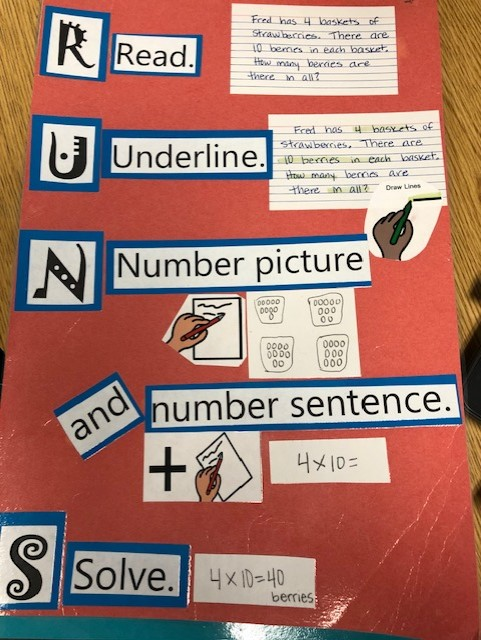


 While the acronym may seem pretty self-explanatory,  

there are a few tricks to it that really make it work.


R - Read.  Read as in 1st read in its entirety and a 2nd read for specific chunking of info/close reading.


U - Underline.  Underline numbers and “special words” (i.e. "fewer, more than, each, groups, ect…") And most importantly, underline “the ASK.”  What is the question?  What are the key words there?  To know what to underline is the trick to this step.  For this I use AVID column notes for students to reference.  They find the “math words” then match them to their chart with a dry-erase marker.  By doing so, they are able to identify the function.  
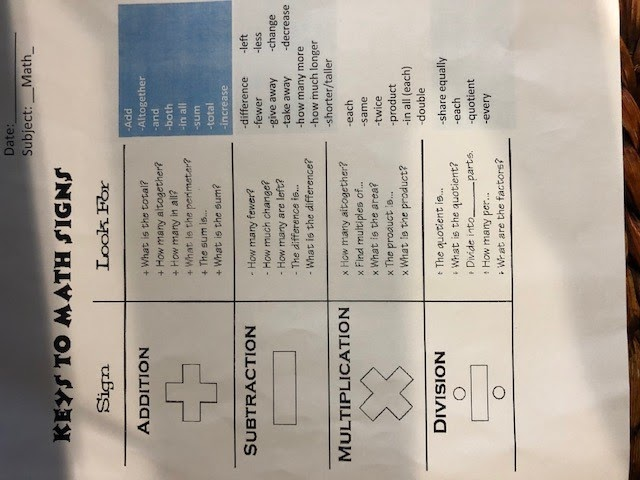


While the original note/visual was shared with me from another teacher,

I found that I needed to add more to it to be reflective of

the Eureka Math questions - thus the unofficial 3rd column.


N - Number Picture.  For this I usually like to set up expectations.  It takes a while for my students to remember just what is a number bond, a tape diagram, or an array.  Knowing which picture to use can be even more challenging.  Typically, Eureka Math highlights a specific pictorial strategy in the lesson set.  Front loading students to understand the expectation is key in helping struggling and/or unique learners.
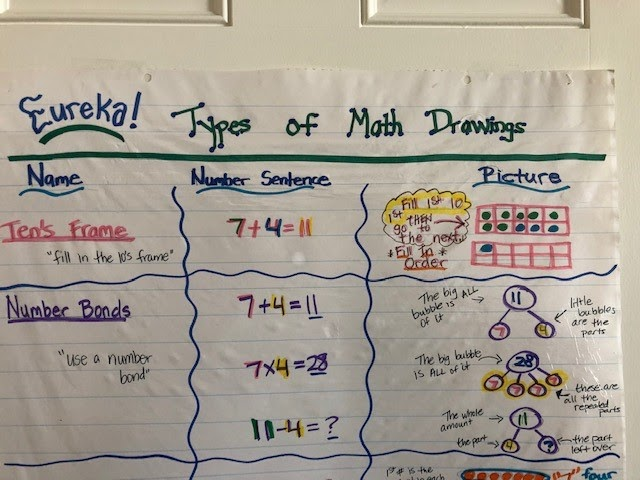


In this anchor chart I even gave examples of the Eureka Math verbiage for my 

students that require more direct examples.


N- Number Sentence.  Here we put it into place: what quantities (or use simplified verbiage to restate vocabulary “numbers”) what function do we put into place.  Tip: Vertically align the number sentence and label.  This makes the last step so much easier and keeps the train of thought connected to the word problem looking to be solved.


Numbers with their labels to make a vertical number sentence.


S - Solve. For this we double check, “Did we answer the ‘ASK’?”  This means making sure we have the written label.  I like to have students box their final answer - especially if there is a lot of work on the page.
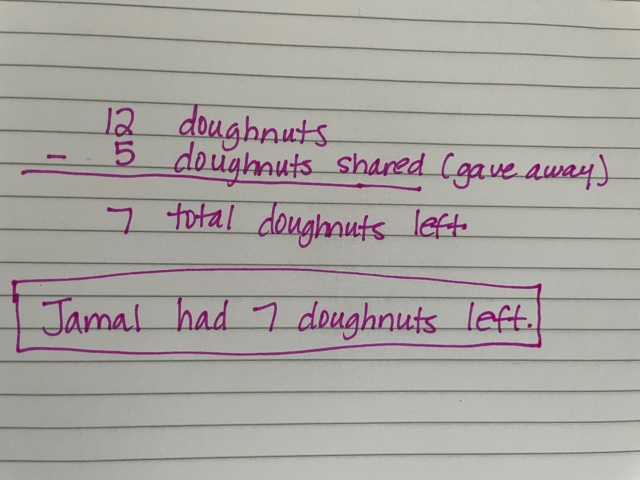

And Solved it!  The answer is in a full sentence and boxed.


Whether you are struggling with a unique learner or trying to overcome sluggish student progress, this may be the solution.  Through the RUNNS strategy multiple challenges are addressed: breaking down of the “ASK” to solve, identifying key math vocabulary and their meaning, recognizing types of visuals, and putting it all together.  Like all good visual strategies, over time they needed to be faded back.  The beauty of this math strategy is that with repeated practice, students should be able to recall the specific strategy long after their graphic organizers are tucked away.  I’d love to hear if you are running to win with RUNNS!  


Common Core RUNNS Resource: Common Core Math Tools


Like what you read? Join me in upcoming blog posts where I continue to put these strategies into place and share resources!


Rockwell, S., Griffin, C., & Jones, H. (2001). Schema-based strategy instruction in mathematics and the word problem-solving performance of a student with autism. Focus on autism and other developmental disabilities. 26(2) 87-95. Doi: 10.1177/1088357611405039.


Saturday, February 22, 2020

Stand-Up Hand-up Pair-Up Kagan Structure


Image result for stand up handup pair upWe all have those days where the kids just seem unmotivated, bored, and disengaged, which makes our job as teachers much more difficult. Kagan provides many many cooperative learning structures to prevent the above mentioned from happening.  Research shows that when students are engaged, they are learning.  If they're not engaged, then quite simply put, they're not learning.    


One super simple, super fun engagement/cooperative learning strategy that Kagan provides is called, "stand-up hand-up pair-up."  It's such a fun and easy way to get kids up and moving and its a structure that you can start implementing tomorrow!


Image result for stand up handup pair up


1) Pose a question.  Whether it be a math problem, or a reading comprehension question, or inquiry question leading into your science lesson. It' best to have the question displayed if possible.  If not, I will repeat it multiple times.

2) Then you play some sort of music to signify its time to move.  I use this timer countdown with music on YouTube: countdown timer, (you can click that link or just google it and there are SEVERAL other options).  I tell them to stand behind their chairs and take their whiteboard/marker, their book, or paper pencil (whatever materials they may need to answer the question).  Depending on the question, no materials may be needed at all.

3) When I pause the music, the kids freeze and immediately raise their hand in the air.  They then have to partner with the person NEAREST to them and form a "partner pyramid" with their hands (this is just where they basically high five each other but hold it there in the air).

4) Any hands still raised in the air (means they don't have a partner) can look around for another hand in the air who doesn't have a partner, and thus they can easily find each other and partner up.

5) I will then delegate which partner shares first (either through use of the Kagan software "who's up?") or I'll just say something simple like "the partner whose birthday is up next shares first."  

6) You can be done after the kids share, OR you can have the kids mix a few more times so that they get to share their answers with multiple partners.  This is usually what I have them do.  The more partners they share with, the more opportunities they have to practice speaking, in addition to hearing more diverse ideas from their peers.

Not only is this a SUPER quick, and efficient collaborative learning structure, this is also REALLY great support for your English Learners.  This not only provides talk time, but you're also supporting them by giving them think time (time to process), time to verbalize their thoughts, and hear thoughts from their peers.  This is why it's best to display the question and/or sentence frames when applicable to further support your English Learner students. 

Furthermore, it gets the kids up and moving which then ensures that they're thinking and learning. It's easy, it's fun, and it supports ALL learners at ALL levels in your classroom! 

Collaboratively Learning,

Megan Brown


Copy of pic- Megan Brown.jpg

Thursday, January 16, 2020

Building Background knowledge with Kagan


Building background knowledge is something we often skip over or forget about due to pacing and time constraints.  Often we want to just dive right into that days learning.  However, in an effort to both provide engagement on the new topic being learned, while also providing support for your English learners, it really is an important, yet simple step that we should take.

If you're looking for a cooperative learning structure to help you support building background knowledge when introducing a new topic, there are several Kagan structures you can use.  I am going to talk about just a couple of them here.  Like with all Kagan cooperative learning structures, these support learners at all academic levels, while also providing engagement, which research shows is key to student learning and success.


Three Step Interview
Image result for kagan three step interviewThis structure is super easy and fun to use during Day 1 of the ELA Wonders curriculum when you introduce the new Essential Question for that week. In our Wonders curriculum, on Day 1 of each week it has us "Introduce the concept."  This is  where you could easily take the essential question/concept and turn it into a question the students can relate to, and then implement this Three-Step Interview process.

 For instance, in Wonders 5th Grade Unit 3 Week 4 the Essential Question is, "What benefits come from people working as a group?"  You might then pose the question to the students, "Tell about a time where you succeeded at something when working together in a group."  You would pose the question, and either give students time to think, or have them quickly write their thoughts down.  Then proceed with the Three-Step interview process.  To summarize, Partner A would ask partner B the question and then visa versa.  They would then pair up with the other A/B pair at their table and go around the table sharing not their own thoughts, but rather their partners thoughts.  A very quick and easy way to get students engaged, talking, and sharing in groups!


Jot Thoughts

Image result for kagan jot thoughtsJot Thoughts is another fun Kagan structure than can be implemented in the beginning stages of building background knowledge of a topic or concept. Jot thoughts is a fun and  engaging way to have students brainstorm ideas about a topic.  For instance, in Wonders on Day 1 where you would introduce the topic, you always see the word web with a word (based on the essential question) in the middle.  It asks students to brainstorm words they know about that topic.  So in place of this, I will often use this Jot thoughts structure.  If we take the above mentioned essential question, the word provided in the word web for that week is "teamwork." So I will set a couple of decks of sticky notes on each table group and then ask them write down as many words, phrases, or ideas that come to mind when they think of "teamwork."  They are supposed to announce the word they're writing as they write it to prevent duplicate words.  You can then extend this Jot Thoughts activity into many other things.  For instance, once time is up, I will often times have the students work in their teams to categorize their words and develop names for the categories.  I then might ask them to do a free write about teamwork using as many of the word they can, etc.  It's fun, engaging, and gets students ready to learn more about the new concept that week.  Its also another opportunity to provide students with collaborative talk time, which supports ALL learners at ALL levels.

Additionally, this structure could also be used as a culminating activity at the end of the learning, to summarize what was learned about the topic!

Collaboratively Learning,
Megan Brown

Most Viewed Posts