Monday, September 20, 2021

Gradual Release with Eureka Math


My Math Wall

Musings

Please indulge me for a moment (if you don’t want to that’s fine, scroll to the next heading 🙂


I just finished a book in which the main character is hit by a car and needs to relearn how to walk. When the doctor checks on her, the doctor says the following


“This is a long road ahead. It’s one that can be very frustrating. It will only get more frustrating. You’re going to have to learn how to do something you already know how to do. You will get angry. You will feel like giving up. I just want you to know that it’s okay to want to give up. That it’s okay to reach a breaking point with this stuff. You have to have patience with yourself”


I feel like this year more than ever I need the reminder that it’s okay to be frustrated and feel like I’m at a breaking point. I’m human and this teaching stuff is hard. What I’ve been working on is having patience with myself and accepting the fact that this feels like I’m relearning things I used to know how to do! Case in point: Eureka Math


EUREKA! I don’t get it...


I’ve been using Eureka Math for four years, which is to say that I’ve been struggling with Eureka Math for four years. I’ve been to the amazing district Eureka Preparation and Customization PD on how to teach the lessons, I’ve watched the Eureka provided PD on it, and I’ve read more blogs than I care to count, but I’ve never been able to hit my stride and make all the pieces fit.


This year, math needs to be a special priority because over 100% of my class is below grade level in math. In my quest to learn more about MTSS and being deliberate about gradual release, I’m happy to say that I think I juuuuuust might have figured it out for myself.


Gradual Release with Eureka: Ruth’s Way!


Fluency - 5 minutes

Skip counting by 3, 4, 6, 7, 8, and 9. I used the linked videos for kids to practice skip counting. I don’t do all of them every day, but I make sure to hit every one at least once a week.


Gradual Release - 50 minutes


I DO - 15 minutes


Introduce the learning target, link it to their prior knowledge, explain the importance of the skill in real life, explain success criteria.


One of the parts of Eureka that I’ve found most challenging is that the direct instruction isn’t presented in the same way as the Problem Set and Exit Ticket. That’s led to a lot of confusion for my students about how to apply the new knowledge they’ve gained in the lesson to a novel situation.


To address that, I use the Succeed homework book to teach the concept. Each lesson has 3-4 problems that are presented exactly like those of the Problem Set and Exit Ticket. That way, students are seeing problems that are like the ones they will need to solve. 


I model the first problem step by step specifically explaining how to do each step of the problem. I then ask for up to 3 risk-takers to share what they don’t understand yet. I go through another problem specifically pointing out the answers to their questions. I ask for 3 more courageous students to share what they don’t understand yet and go back to the problem to show them how I came to that answer. I’ve found that asking students to specifically state what they don’t understand is really helpful in getting me to hone in on a particular step and also encourages students to be reflective and actively engaged in the learning process.


WE DO - 25 minutes


I dismiss the whole table of students (balanced through Kagan groupings based on the iReady diagnostic) to work with each other around the classroom on the problem set. The kids love this flexible seating option and I’ve noticed they really stay on track when they can be in a different environment for collaborative work time. Students use Math Talk sentence stems in their communication with one another. I encourage them to use the anchor chart if they are stuck and I use it as a teaching tool as I walk around to groups and guide them as needed.


After 20 minutes, I call students back to their desks and we debrief the problem set. I will either call on students to be the “tiny teacher” and explain their solution or I will clear up a common misconception I noticed while circulating. This is another key moment to have students reflect on their learning and ask for any last-minute guidance.


YOU DO - 20 minutes


Students complete the Exit Ticket independently. When they are done, they bring me the Exit Ticket and I give them instant feedback. They either get a check that it’s correct and then go to Xtra Math (more on that in a minute) or are given corrective feedback that they then apply to their Exit Ticket and they bring it back to me in the “Fast Lane” which is a line that forms at a different part of my desk and helps them move through faster.


Once they have a check, they log on to their Chromebook and go to Xtra Math. Look, I tried using the Eureka Sprints, but I could never get into a groove of giving kids feedback on them so I would have some kids who only finished two correctly and some who wrote “15” for every answer on the page and felt like they were really successful for finishing the whole thing. All that is to say that fact fluency wasn’t getting addressed in my class. In my search to rectify this, I found Xtra Math. It gives you good reports and each session is about 7-10 minutes long. It can also be linked to your Clever page for easy access (see how here). Students take a placement test and then practice only the basic facts that they don’t know. Once they show mastery of a certain operation, they move to the next one.


If a lesson has been successful, MOST of my students complete the Exit Ticket correctly within about 10 minutes. If I have a group that is struggling, I can then pull them and do a reteach while the rest of my class is on Xtra Math. Once they finish a session, they know to go to iReady Math.


DEBRIEF - 5 minutes


Students are given the signal to remove their headphones. We discuss successes and challenges of the lesson. We revisit the learning target to determine if it has been met and I then tell them how we will use this new learning to help us on our quest for math knowledge the next day.


Wrap Up


After years of struggling, I’ve finally found a way to make this powerful curriculum work for me. Students have already been very successful in meeting learning targets (I’m talking 90% of my class is correct on their Exit Ticket) and for the first time ever, I look forward to math because I feel like my daily instruction is truly best, first instruction.


We’re relearning things we already knew how to do and it’s okay to get to a breaking point. Have patience and be gentle to yourself. Always remember,


TPT links to similar resources: Math Talk Key Words  CUBES


Here for you,

Ruth Reinkymov

3rd Grade Teacher

Hawthorne IB World School


Monday, September 6, 2021

The Revolving Door of Independent Study - Facing Its Challenges


Have you recently received an email from your attendance clerk similar to this?

     "Student ###### has been signed up for short term Independent Study and will be out for a minimum of three days."

     I have and I have lost count of exactly how many.  Initially, I was of the mindset - no problem.  I simply excused the student in my gradebook for those days' assignments - no harm, no foul.  These students can just jump right in with the rest of the class when they return. . . 


     Then it hit me!  I teach Math and the lessons are sequenced to build upon each other.  A student is present for a couple days and then is out on Independent Study for three to ten days because of COVID-19 District protocols.  The student comes back to class and is totally lost.  I am also realizing that this is going to be occurring for the rest of the year.  Struggling students in any subject - Math, ELA, SS, Science, Foreign Language, Reading, etc. - may not be willing to put in the extra time and effort to catch up on what they missed while they were out.  

     So what can we do to support them during these extraordinary times where school looks totally different than when we were in school - wearing masks, staying 6 feet apart, washing hands constantly, being exposed to a known virus, teachers wearing masks, etc.?

So, I have started to develop a plan to support these students in an effort to fill those learning gaps they missed and to keep them motivated so that they can be successful during these trying times.


Start using Zoom recordings again (just when I thought I was done with that, I know).  Start a personal Zoom meeting and record the notes you give to students who are in class.  Download the video and post it into your Google Classroom for students to access.  (Right now these videos may be unedited as there is not a lot of time to make them 'pretty' but the idea being that students have access to the same material as students who are in class - try and hit stop recording during class to shorten the video).  Attach the notes to the Google Classroom as an additional resource for students.


Use a Station Rotation Model to interact with students in a smaller group setting.  The idea being here
that you meet with students who need additional support (absent students or struggling students) and
reinforce the skills through some intervention time.  The other students are working in groups on activities that can reinforce their skills as well or extend their skills through challenge problems, etc.  The Math Team that I am on has gone through two of these Station Rotation Models since the beginning of the school year and it really has offered a great opportunity to meet with struggling students 'between the bells' - while at the same time offering meaningful work for other students in the class.


I also use Khan Academy, for a few reasons, to support these students who are moving in & out of independent study.  Khan Academy is aligned with our Eureka Math Program in that the Khan lessons are set up in the same order as Eureka Math.  I realize that the Khan Academy problems are not to the same rigor as Eureka Math but it offers an option for students to get practice and at the same time Khan Academy gives students immediate feedback as to answers be correct or not.  In addition, Khan Academy offers videos for students to watch that support each skill.  I understand that 'Quality First Teaching' is the goal for teachers but when students miss this opportunity in class I want all my students to still be able and access the curriculum.  Khan Academy is also relevant for struggling students as it does provide that immediate feedback and supportive videos.


I am still struggling with this new found realization this year - supporting students who are in & out of class at any point during the school year.  Life is not easy for our students and I do not want them to feel defeated after being out of school for a short amount of time when they return to class and they have no idea what is going on.  My ideas and plans will most likely evolve over the year as I strive to support all my students through these difficult times.  I do not want my students to become unmotivated and to that end I must constantly remind myself to find ways that make students 'feel' safe when they have been out of school to no vault of their own.

Obviously, my ideas are driven by a math mindset - but I wonder if this starts you thinking of ideas for your own content area?  For starting a conversation with a colleague?  For have a PLC meeting about other ideas?  I struggle with giving ideas for other content areas but the hope is that the conversation begins or continues depending on your own individual situation.


Please feel free to add other ideas or thoughts in the comment section - as I am trying to find better ways to support our students.


And remember to give yourself grace - and then give yourself more grace as we navigate another unforgettable year.


Teaching and still loving it,

  Kevin Stott                          
De Anza Middle School      
Math 8 & Integrated Math I

Thursday, September 2, 2021

Scaffolding Beginning Writers using Power Writing

We are 19 days into school (woohoo), and I want to share how I am supporting my beginning writers. As most of us are experiencing, writing is an extra struggle this year because most kids did not use paper and pencil last year.  My kiddos are at all levels, from not knowing how to hold a pencil to writing complete sentences. So my first thought was I need to build their writing fluency. One of the best parts of 1st grade is seeing the fantastic growth students make in 9 short months. As I said above, they enter writing single sentences (sometimes single words) and leave writing cohesive paragraphs- it's incredible! BUT, students need daily, explicit writing instruction and practice for this to happen with chances to write every single day.


As I model writing throughout the year using grammar, writing traits, structural analysis, and mechanics, my students learn all the technical parts of writing a paragraph. We use what we learn to write about the stories we read using thinking maps and then turning them into paragraphs. See this previous blog post for more information- sequence-retell-and-write, but what about building writing fluency and creative writing? This is where Power Writing comes into play.  


Power Writing is a writing fluency activity. It is structured free-write where the objective is quantity. The idea is for students to write as many words as they can as fast as they can. Students are more likely to write if given a topic to write about rather than thinking of their own. This strategy helps writers free up space in their memory by eliminating so many choices in the planning stage. Power Writing is also an important part of building a community of writers, beginning with believing that we are all writers.


This will be my 4th year incorporating Power Writing, and as I sat down to plan, I had to scaffold the way I was going to introduce it because of the wide range of levels my students are at. If you don't teach primary, you would never know you need to start by teaching your students how to write in a journal. Believe me, it's important!  


How do I write in a journal?

I always start with a "how to write in a journal" mini-lesson on the 2nd day of school.  


  • Open to the first page.
  • Date in the upper right-hand corner.
  • The top empty box is for your illustration.  
  • Your letters should fit on two lines, Lowercase letters fit below the first line.
  • Leave the empty space blank between your writing.  


As you'll see from my examples, our journals are not perfect nor shall they be.  BUT, progress is being made.  Plus I am super proud of my kiddos.  They have been working SO hard on their writing and I already have some fabulous writers.


2. Introduction, Brainstorming, Oral Language Practice


Students begin by sitting at their desks, and I have my document camera open to:

  • Introduce the topic- I have been using Journals with premade topics. 
  • Students then get time to think of anything they can think of about that topic. 
  • Then students' partner shares their ideas based on the topic. I walk around throwing out ideas in case students need talking points.
  • After students brainstorm, I write a word bank using their ideas on paper under the document camera.  


3. Student Independent Writing Time

  • Student takes out their journals and a pencil.
  • They write the date.
  • They say the Mantra.
  • Students then write for 5-7 minutes while I play music.
  • I walk around the classroom while students write/draw silently. My students know that this is a quiet time where no one talks and everyone stays in their seats.  
  • Students finish up their thought when the timer goes off.
  • Students are then given 2 minutes for a quick draw.
  • Students then use "Magic Headphones" (plug their ears) to read their writing to themselves.
  • Students then count how many words they wrote and write that number on top of their paper.

Mantra


4. Troubleshoot


So what do you do about the kiddos who are shouting out, "I don't know how to spell_____, How do you spell? What letter comes next?" If you give in to these demands once and your quiet writing time turns into a Spelling Bee. As a whole class lesson, I model writing by sounding out words. I then underline words I am not sure of. My students learn that an underline means - "Hi Mrs. Muehlen, I tried hard to stretch out this word, but I still don't think it's right, and that's okay!" Underlining is a sanity saver!


5. Sharing and Feedback 

With writing journals, students need to be evaluated and encouraged. In these beginning weeks of writing, I teach my students to share their writing and give feedback. This has been the biggest motivator for my kids; they LOVE sharing their writing. I usually have 2-3 shares a day. Keep track of who shares. Our share routine looks like this:
  • Encouragement/Building Community- I say "I choose ________." (in a sing-song voice) Students say, " Let's go _______!" (in a sing-song voice that matches mine). Students may not want to share, and that's okay. Believe me; they usually want to...
  • Sharing the work- The student puts their writing under the document camera, so it projects for everyone to see. They share their work with the class.
  • Specific Feedback- The student sharing chooses a friend (using a stick) to give a specific compliment ("I love how you told me _________." You did a great job of ________." " I really liked how you_______.") These have been modeled numerous times by myself first before students begin to use them.  
  • Class Cheer- The presenter may then choose a class cheer to receive. Our favorites- Oreo, roller coaster, and Hip Hip Hooray. Click for Cheers

Friends, I am so excited to see how my first graders grow this year. I feel like we've devoted time to writing, and it's already paying off.  


Positively Teaching,  
Randi Muehlen

Tuesday, August 31, 2021

Week One Completed and We are Already Ready for a Break

  August 18, 2021 - By Heather Pfrunder, M.A.Ed.  SDC Teacher and Ed Specialist


We knew it would be interesting to transition back to in person learning.  We knew students would need to remember what it means to wake up early, wear a full uniform, and attend for a full six hours.  As teachers, we also knew it was going to take some serious preparation and an open mind to change, as well as patience as we put school norms back into place.  However, I’m not talking about the taboo subject of teacher burn-out or the restlessness before Spring Break. No, I am talking about proactive solutions to ensure a healthy classroom environment.


I spent Spring through Summer reading and researching trauma-informed restorative justice practices.  With over 20 years experience working with individuals with special needs, I wondered if there was something that I was missing.  What I discovered was practical refreshers and some new perspectives.  Since it is the beginning of the year, let me gift you with the short version and some practical applications.


Oh… That’s Why...


Mona Delahooke, PhD in her book, “Beyond Behaviors: Using Brain Science and Compassion to Understand and Solve Children’s Behavioral Challenges” (2019) states “Current neuroscience...reveals a more complex reality: many problematic behaviors reflect how the child’s brain and body perceive stress” (p. 3).. In a study done in 2013 by the CDC and Kaiser Permanente (ACES Too High) they cited over 35 million children in the USA have experienced one or more types of childhood trauma (Brummer. p. 53). Just think, without COVID many of our students were/are already having to contend with stress. Delahooke continues “When [we come] to view problematic behaviors as adaptive responses and not purposeful misbehavior I shifted nearly all my beliefs about how to help children” (p. 3).  So square one in shifting one’s mindset is not a focus of “good” or “bad” - but what simply is, and how to address it. 


Think of self-control (self-regulation) as a house.  From the floor-up we have emotional connection, social skills, and cognitive reasoning. Which means learning absolutely doesn’t happen when students are in distress.  When a student is dysregulated (i.e. often seen as mal-adaptive behavior choices) chances are they aren’t ready for a conversation that requires reasoning (that is “top-down” thinking).  They need “time-in” or what I like to call a “Rest Break.”  This is NOT punishment!  In less extreme cases it is asking, “What do you need?  How can I help?”  However, before we ask these questions we need to have a classroom game-plan.


It’s Game Time


Pre-Game Prep:

  • Set the environment as a calm space:

    • Neutral soothing colors

    • Clutter diminished, labeled items, no more than ⅔ of wall space covered (for my students prone to visual distractions I do way less).

    • Natural or lowered lights

    • Be observant of triggers like music/noise or scents

    • Consider setting up flex seating

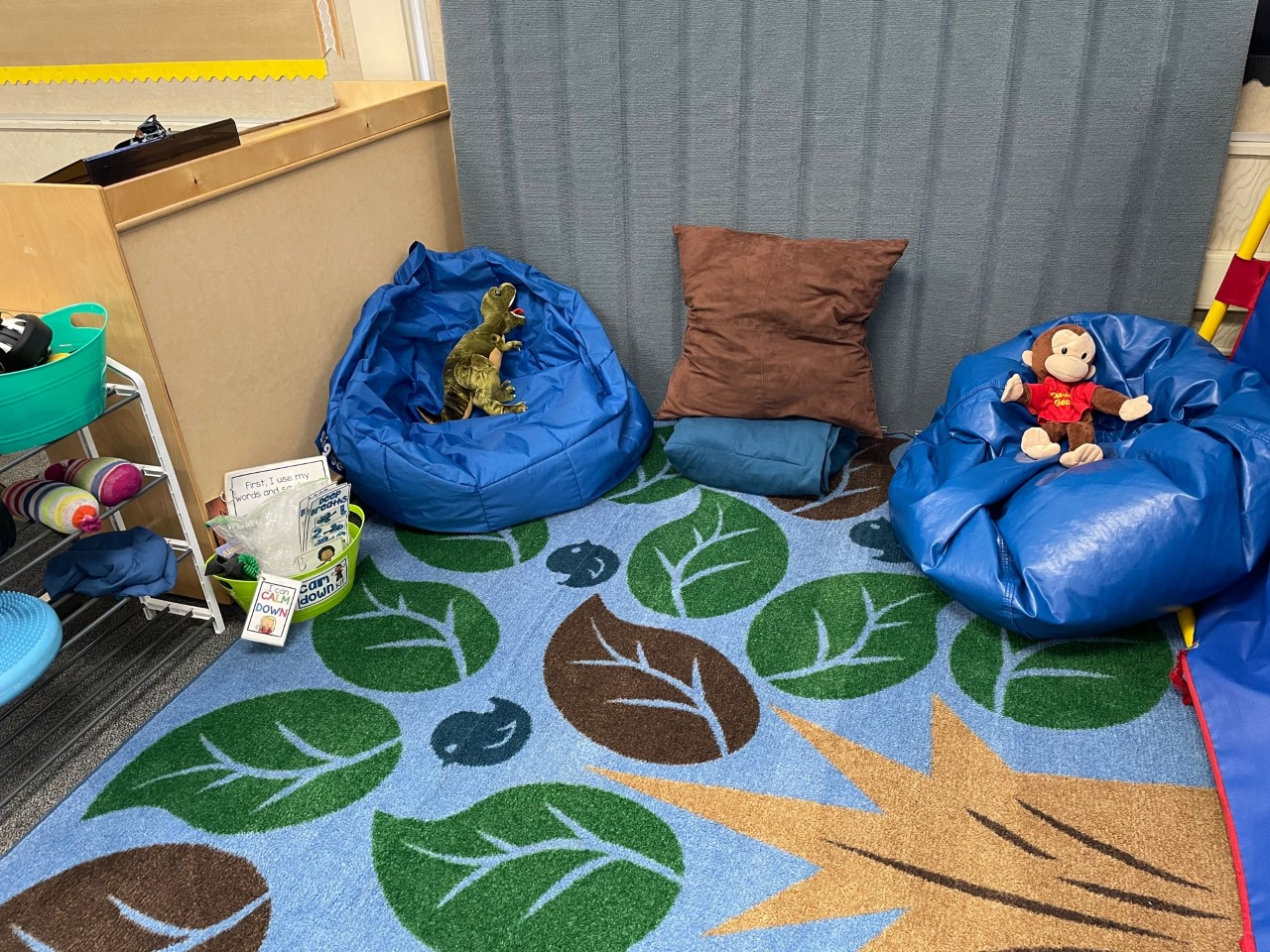
    • Set up a Rest Area & Calm Down Kit

    • For non-verbal students have resources for communication ready and available throughout the classroom. 


This Rest area has sensory equipment like a weighted blanket and a calm-down kit.  It is available at any time for all of my students. The objective is to rest and calm (versus playtime).
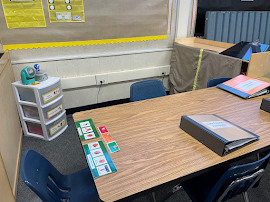
This is one of my 4 centers: While they are identified by color, most of the tones are neutral, classroom expectations are listed, icons for requesting a break or sharing if they are “Ready to Learn” are within arm’s length.
  1. Putting it in action starts with self! Co-regulation: we demonstrate regulated behavior to be a model and to demonstrate that an environment is safe. “We can’t put an oxygen mask on others unless we put one on ourselves first…[then we] can calm the toughest of students and see past the behaviors to see a kid “in-struggle” not a kid “in-trouble” (Brummer. pp. 58-60).

  • Come in a few minutes early, shut off the lights, and slow breathe for 3 full minutes to a timer.  Do it at every recess and lunch.

  • Partner with a trusted colleague

  • Reward yourself with special activities at the end of the week.

  • Give YOURSELF a break!

  1. Set the Expectations of a Safe Space for your Students

  • Use our OMSD SEL kit every morning; It's amazing! (It's the blue and orange target sign in your teacher symbaloo or click the link) SEL Toolkit
  • Do brain breaks like “Go-Noodle” videos-- it’s free and can be added to our Clever page. https://www.gonoodle.com/
  • Take time to get to know your students - likes, dislikes...share and have conversation.  Look for ways to incorporate their favorite things or topics.
  • Build classroom expectations together as a team.  (I love Pocket of Preschool’s Red and Green choice visuals). We take turns as a group and decide what’s a good choice or not. https://www.teacherspayteachers.com/Product/Behavior-Management-Green-and-Red-Choices-Preschool-Pre-K-and-Kindergarten-1931820
  • Big Breaks!  Remember when I cited emotional connection and social skills coming before cognitive reasoning?  There is a place for big breaks, focusing on collaborative play and positive interactions - especially for our exceptional learners.  For students that are neuro-typical, diving into Kagan strategies and Socratic Seminars are great ways to imbed wiggle room for social connection while still working on academic standards.
  • Allow students to self-advocate and ask for an “extra minute.”  It isn’t a problem to not be ready.  When they are ready, they are going to truly learn.
  • Click the link for my custom created visuals (open with Kami).
  •  Expectations and Self-Advocating Visuals for Exceptional Learners


Let’s be Real


I would like to tell you that day one or even week one went off without a hitch.  While a lot went really well, the truth is, I played musical chairs with seating the first three days.  I quickly realized that learning was not going to happen in a whole group setting, just yet. Big breaks went a little long. But, I took time to hear their stories, address needs, and set boundaries. By switching to small groups we found a rhythm. By Thursday we were finally able to directly address classroom rules with active student participation.  By Friday we were on target.  The old me (the new teacher me) would have truly panicked about not hitting standards fully the first week.  But guess what?  My most important job for week one was accomplished.  I connected with my students.  They understood and partnered with me on expectations.  Much of the anxiety and extra-sensory behaviors that occurred due to coping to what was new had subsided. And hey, my team even managed to get down a lot of data for IEP goals.  So now it’s onward!  Let the learning commence!  Bring it Common Core!  Hello restorative practices!  I can’t wait to see the growth in the hearts and minds of my students! I hope you join me in following our new adventures!


Learning resources referenced:


Brummer, Joe & Thoresborne, Margaret.  Building a Trauma-Informed Restorative School: Skills and Approaches for Improving Culture and Behavior. Jessica Kingsley Publishers: London, Great Britain. 2021.


Delahooke, PhD., Mona. Beyond Behaviors: Using Brain Science and Compassion to Understand and Solve Children’s Behavioral Challenges.  PESI Publishing & Media: Eau Claire, WI. 2019.


WRITTEN BY: HEATHER PFRUNDER

Most Viewed Posts