Thursday, April 13, 2023

April Showers Bring May Flowers


In elementary school, I remember one of my teachers saying that April showers bring May flowers. That saying resonated with me because I never enjoyed rainy days (or Mondays--as the song by the popular brother/sister duo, the Carpenters, accurately expressed in their 1970's hit song). My teacher's words gave me hope that the rain would not last forever. And it gives me hope now. 

As we near the April 24th date for the start of CAASP testing, I feel a change in the atmosphere--just like you do when your senses tell you it's about to start raining. This year after Spring Break, the school atmosphere at my site changed drastically. Our focus is now on preparing students for the state test. Don't get me wrong. We are not teaching to the test; rather, we are ensuring that our students are prepared to "show what they know" on the assessment.  

In the same way that I made certain I was ready for the rainy season, I am also making sure that my students are as prepared as possible for testing season. Every day of instruction matters. In my ELA instruction over the next two weeks, I will be reviewing: 

  • the RACE Strategy for answering constructed-response questions. I've linked an example of a worksheet I created for Wonders Unit 3, Week 5.

  • how to determine the meaning of unknown words by using context clues.
  • how to use my "Plug It In" strategy. If students see a blank line or an empty box, they need to "plug in" the choices.  Here is an example.

 In my math instruction over the next two weeks, I will be reviewing: 

  • the importance of working out each problem on scratch paper.
  • math terms and phrases such as perimeter, area, and equivalent fractions. I've linked a helpful handout.

Before I say goodbye, I'd like to share some very wise words:

                                Test scores and measures of achievement tell you
                                where a student is, but they don't tell you where a
                                a student could end up.

                                                    --Carol S. Dweek


Lola E. Jollie
    Wednesday, April 12, 2023

    Clothesline Math Activity (Comparing/Ordering on a Number Line)


    Welcome to my sixth 'Huddle Time' - the purpose of this time is to provide a short video that offers student centered ideas to consider for your classroom.


    HUDDLE TIME VIDEO

    Video


    Today's Huddle Time focuses on 

        -  The Number System domain in Mathematics.


    Clothesline Activity Resources:

        -  Clothesline Math

        -  Student Centered Mathematics Classroom  (Grade K thru 8th material)


    Classroom Video of Activity:

     Students working Video #1 (Enjoy the loudness of the classroom)

    Final Result Video #2 (Enjoy the birds chirping - very relaxing)


    While 6 instructional days till SBAC testing sounds ominous, there is plenty of time to make deliberate instructional decisions to support students in being fully prepared for this high stakes test.


    Remember to believe in yourself, believe that you matter, and believe that you can make a difference.


    Teaching and still loving it,      

    Kevin Stott                               

     De Anza Middle School   

    Friday, March 17, 2023

    Literature Circles: Paper Trays and Protocols

    This is the third in a series of blog posts about Literature Circles. You can find the other posts on my Spotlight webpage. My previous submission covered how my Literature Circle students select the books they will read during a three-week cycle and how they create schedules of which pages they will read each night and which roles they will be responsible for during each of the seven meetings they will hold with their group members during that time. I will now turn to how I distribute and collect the work the students do for their various roles and how the Literature Circle meetings are organized and managed.


    The Organization of Digital and Paper Resources

    As I have discussed in previous posts, there are four distinct roles that students perform during a Lit Circle meeting. From suite to suite and meeting to meeting, roles can vary, so students need to be provided with instructions for their particular roles for each meeting. I do this in two ways. First, I provide instructions for each role in a posting about the upcoming meeting on Google Classroom. In addition to these instructions, students are given access to digital versions of the thinking map jobs that are to be completed for each role. Often, there are also sample maps and other resources included in this space to help them complete their jobs (You can see examples of all of this in the image below). Posting the job sheets and resources digitally ensures that students have access to them even if they are absent or have misplaced their paper copies.


    Due to the fact that many students do not have consistent access to computers or printers when they are not at school, I also provide each student with a paper copy of the instructions for their particular job. In the back of my classroom, there is a table with various stacks of paper trays atop it. One set of trays contains all of these instructions, along with any other necessary resources (such as tips on how to identify major events in a narrative). 


    On the first day of a new Literature Circle cycle, students go back to grab these resources one job at a time. The same routine is followed at the end of each meeting because each student will perform a different role at the following meeting two days later (and because at least two of the Thinking Map jobs change for each meeting).


    Meeting Protocols

    One of my first priorities at the beginning of each school year is to teach my Literature Circle students how to transition to and operate within a meeting. This might sound like simple stuff, but, as I always tell my kids, if the meetings don’t look and sound right, they probably aren’t going to function well. In fact, I often spend the first three-week cycle of Literature Circles solely focusing on the procedures and protocols discussed below, and I use fishbowls to teach and reteach them throughout the year.


    On the day I announce which books students will be reading, I also provide each group with a number. These group numbers correspond to numbers I have written on little stickers on the ceiling above various open spaces around my classroom. I have made sure each open space is far enough away from the other meeting locations to allow each group to have a private conversation. Students are instructed to walk to their designated meeting spot and locate a nearby chair (as opposed to dragging their own chairs across the room).

    Once all the group members have arrived, the student fulfilling the Discussion Leader role (a job that involves writing questions based on the six levels of Bloom’s Taxonomy) checks to make sure that everyone has come prepared with their books and completed Thinking Map jobs. The Discussion Leader then reviews the SOLAR protocols. SOLAR is an acronym that stands for:

    S- Square off: Sitting in a square (meaning the feet of each chair touch the feet of the chairs on either side of it)

    O- Open: Bodies facing each other (meaning each student should face the student across from them with their shoulders equidistant from the shoulders of the kids on either side)

    L- Lean: Leaning in (I like to use a yardstick to show them how much closer they are to each other when they lean in instead of leaning back. This makes it much easier to use private voices.)

    A- Attend to others: Pay attention

    R- Respond: One at a time


    Once everyone is sitting properly with their books and work in hand, the meeting begins with the Summary Specialist performing their role (I have already discussed this role in detail in a previous blog post). The logic behind beginning with the Summary Specialist is that it helps to make sure everyone agrees on the major events they have read about in the preceding two days before diving into the finer points of the story. As is the case with all of the other roles, the Summary Specialist’s job is not to simply read the contents of their completed thinking map to the group. Instead, they are expected to elicit a summary from the other three group members. I have included Reciprocal Teaching Protocols at the bottom of each set of instructions so that students can rehearse what they will say when it is their turn to be the “teacher” (You can see an example in the following image). 

    Once the Summary Specialist has completed their role, the Discussion Leader takes their turn, followed by the Thinking Map Strategy and Thinking Map Skill students. When the meeting has come to an end (I usually allot about 20-25 minutes depending on the circumstances), the Discussion Leader collects everyone’s work and puts it in a paper tray labeled with their corresponding group number. Students then take turns walking over to the paper tray table to grab their job sheets for the next meeting (assuming the completed meeting was not the last one in the cycle). 


    The contents of the various Thinking Map jobs students do to prepare for their Literature roles will be discussed in future blog posts. Please check back frequently for updates!


    Writing Every Day,

    Eric Lovein

    Friday, March 3, 2023

    Edulastic Platform - Resource for SBAC Released Questions


    Welcome to my fifth 'Huddle Time' - the purpose of this time is to provide a short video that offers student centered ideas to consider for your classroom.


    HUDDLE TIME VIDEO

    Video


    Today's Huddle Time focuses on 

        -  Edulastic Assessment Platform with SBAC Released Questions


    Last month, I wrote about starting to prepare students for this year's SBAC test.  That idea continues this month as I show a resource on Edulastic that has SBAC released questions.

    You could use this resource to review questions with your students as a whole class, or have students work in groups on questions, or have students work in partners on questions, or any other way.


    Edulastic Assessment Platform


    While 30 instructional days till SBAC testing sounds ominous, there is plenty of time to make deliberate instructional decisions to support students in being fully prepared for this high stakes test.


    Remember to believe in yourself, believe that you matter, and believe that you can make a difference.


    Teaching and still loving it,      

    Kevin Stott                               

       De Anza Middle School           

    Friday, February 24, 2023

    A Recipe for Success


        Lately, I've spent quite a bit of time in the kitchen. With two three-day weekends in a row, I've had the energy and time it takes to whip up some sweet delights for my family and friends--banana bread and orange loaves of bread sprinkled with tart cranberries. Yummy!

        At some point during my baking binge, it occurred to me how much teaching and baking have in common. Perhaps you're thinking, "Well, that's quite a stretch" to which I would answer, "Not at all." Perhaps that's why I savor the time I spend baking as much as the time I spend teaching. 

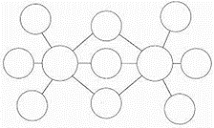
        To prove my point, I'm going to take out my imaginary Double Bubble Thinking Map for the purpose of comparing and contrasting. (I interrupt this blog for a short commercial in favor of Thinking Maps. Utilizing Thinking Maps will enable your students to connect an intangible thought process to a tangible map.) In one bubble, I'm going to write "Teaching" and in the other, "Baking". In the center bubbles, I'm going to write their similarities.   


    Now let's pretend I'm a student and I just finished talking to my partner using a Kagan Mix-Pair-Share exercise. I'm ready to take my information off the map and write about it. Here goes:

                                Both teaching and baking are alike in a variety of ways. For one thing, they are both rooted in scientific procedures. For instance, best practices in teaching spring forth from brain research that reveal how learning takes place. Science also explains how it's possible for a quickbread to rise sans yeast. A chemical reaction takes place when gas bubbles are released and the acids come in contact with base chemicals. Another similarity teaching and baking have in common is the fact that flexibility and precision can coexist in both. For example, cranberries in orange cranberry bread can be substituted with blueberries. Real eggs can be replaced with flax eggs. In the realm of teaching, children need to be exposed to text in order to learn academic vocabulary and comprehension, but the Common Core Standards provide educators with the flexibility to decide which texts to bring into the classroom. Thirdly, both endeavors require patience. On the surface, it may seem counterintuitive to say that a quick bread requires patience, but it does. You must assemble the ingredients, measure them, and finally mix them. Then you need to let the heat in the oven do its job. When the timer goes off, you need to poke the bread to see if it comes out clean. If not, you need to put the pan back for a few minutes and then test it again. At various points in a lesson, you will need to assemble the materials, measure students' understanding, and tweak the lesson based on what you discover. At the end of the lesson, you may give students an exit ticket to see if they met the learning target. Then you'll make adjustments again. As you can see, teaching and baking have a lot in common.

         Both teaching and baking have a lot of moving parts, but eventually, they come together beautifully!


    I'm still cooking up irresistible recipes for success in the kitchen and in the classroom!

    Lola E. Jollie

    Thursday, January 19, 2023

    The Truth is in the Details


    "The truth is in the details" is a quote by famed author, Stephen King. Even though I'm not much for scary books and movies, I am definitely a fan of this quote. It captures one of the trademarks of our profession. As educators, we live in the big picture and in the details. For example, as a third-grade teacher, I need to constantly have end goals in mind. Where should my students be academically by the end of the first, second, and third trimesters? Am I adequately preparing them for fourth grade? In addition, I need to keep the state test at the forefront of my teaching. No. It is not about teaching to the test. However, it is about ensuring that I expose my students to the rigorous CCSS that they will be tested on. There is a deadline that I am working towards. I only have these students until May 25th so it is imperative that I utilize my time, their time, wisely.

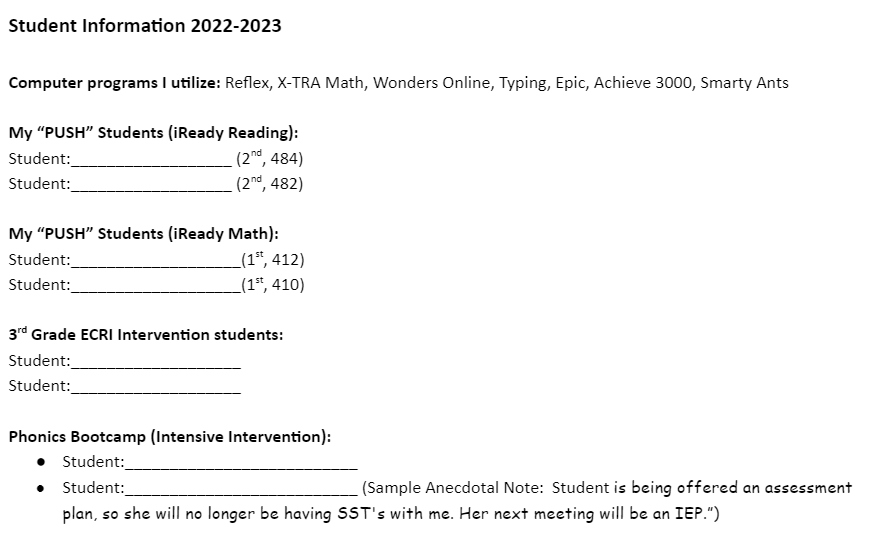
    While I am keeping my eye on the big picture, I need to also pay attention to the details, especially for students who are struggling. Having attended numerous S.S.T. and I.E.P. meetings, I am keenly aware of how specific I need to be at these meetings with my input and the information I share about my students.  Here are some sample responses to questions that are likely to be posed at an S.S.T. or I.E.P. The answers on the left are not wrong, per se, but it is always best to be as detailed and specific as possible when considering students' next steps.

    General  Responses                                    Specific Responses

    The student is having a hard time in math.                    The student has not mastered addition with regrouping.

    The student is zoned out.                                                  The student is having a difficult time focusing during...

    The student is a good reader.                                            According to the latest iReady Reading test, the student is scoring.......

    The student misses a lot of school.                                   According to our records, the student has been absent.........days of school.

    Want more ideas about how to phrase things for SSTs?  Click HERE for more examples!

    Although these examples are fresh in my mind since I attended an I.E.P. just this morning, collecting details regarding all of my students is crucial. If my intent is indeed to move all my students forward academically, then I need to know at what level each of them is functioning.

    Keeping track of all those levels and details can be daunting.  That's where organization comes into play.  Every school site has their own way of collecting data,  but we as teachers need to be prepared before the meeting.  We need to have all the information.  


    Many teachers create a document with all the pertinent data in one easily accessible place such as this:


    Click here to get the full document


    Others may use documents that track each child's interventions and referral information, such as this:


    Click here to get the full document


    Whatever path you choose, just remember  THE TRUTH IS IN THE DETAILS.


    Still living the dream,

    Lola Jollie


    Wednesday, January 18, 2023

    Preparation for CAASPP - Deliberate Instructional Strategies to Consider Now


    Welcome to my fourth 'Huddle Time' - the purpose of this time is to provide a short video that offers student centered ideas to consider for your classroom.


    HUDDLE TIME VIDEO

    Video


    Today's Huddle Time focuses on 

        -  CAASPP Preparation


    While the state test is still several months away, it is not to early to start thinking about how you prepare your students for the CAASPP.

    There is no perfect answer to 'best preparation practices' as every classroom in the District and every teacher in the District is different.

    I simply offer three ways that our site implements ongoing preparation through daily and weekly activities.

    There is a great amount of material in the subject area of Mathematics for students to recall during CAASPP and demonstrate mastery through rigorous questioning stems.


    Remember to believe in yourself, believe that you matter, and believe that you can make a difference.


    Teaching and still loving it,      

    Kevin Stott                               

     De Anza Middle School   

    Wednesday, December 21, 2022

    Literature Circles: Books and Schedules

    In my previous blog post, I tried to explain the reasons for my deep love of Literature Circles. Now, I will turn to the more practical subject of setting up your students and classroom for success with this wonderful routine. Literature Circles are flexible and can be designed to accommodate a variety of students and reading materials; in this post, I will focus on my own particular situation, but there are many potential modifications and variations that can be made. Another post will soon follow to address other elements of my classroom set up.

    I currently use Literature Circles with my “Paw” group, students who come to me during a reading intervention rotation. I work with on and above-level fifth graders during this period, so I have designed my current version of  Lit Circles to involve the students in the reading of self-selected (to a point) novels and performing jobs based on challenging reading strategies and skills using Thinking Maps. In addition, a high level of responsibility is gradually placed upon the students for the successful completion and execution of these jobs. The rest of this post will explain how I choose books to offer the students and how they go about selecting the ones they prefer to read. I will also address how individual students create reading and job schedules that help them keep pace with their group mates.


    The Books and Book Selection

    It is a truism that kids who love reading will read often and that kids who read often will generally develop strong reading skills. If we accept this logic, then shouldn’t fostering a love of reading be right at the top of our to-do list as teachers? As far as I’m concerned, this is the primary purpose of Literature Circles. 

    Many years ago, I began building a collection of sets of high-quality and high-interest books in a variety of genres. I gave myself (intrinsic) bonus points if the books were part of a series and/or written by authors who had also written several other great books. My rationale was that, if there were sequels or other appealing books by the same author, I could either offer them up as future Lit Circles books or suggest that the kids check them out from the library. In the case of sequels, I made it a rule that only kids who had read the preceding book could read a sequel, and if even a single student did not want to read the sequel, the rest of the kids in the group would have to wait until more kids had read the previous book. As I already mentioned, I want Literature Circles to foster a love of reading; forcing a student to read a book they’re not interested in would obviously have the opposite effect.

    Once I had put together a decent set of books, I put them to the kid test. Unfortunately, I was sometimes forced to discard certain books because they consistently got bad reviews from my students. This still happens from time to time as I gradually add new books to the mix. Again, if helping develop a lifelong love of reading is my goal, I can’t foist books on my students that I’m fairly sure they won’t enjoy. I will usually give a book a couple of chances before banishing it to my cabinets.


    Ideally, every Literature Circle group should have four students in it, so I start by dividing the total number of students in my class by four to determine the number of books I need for a three-week cycle. If the number of students isn’t a multiple of four, I will create one or two groups with three students and eliminate one of the jobs for those groups. I try to include books from a variety of genres to make sure there is something for everyone.

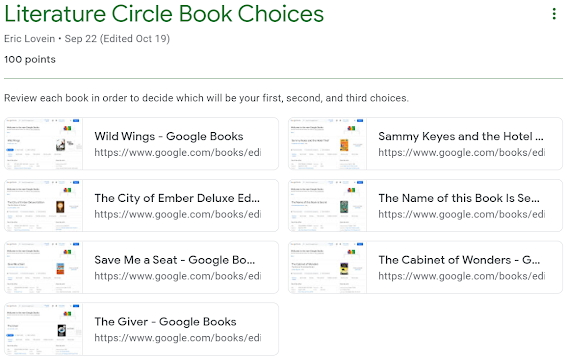
    Once I have selected a nice smattering of books to offer the students, I usually give them a brief description of each book; I also post a Google Books link for each book on Google Classroom (see below), which allows students to read descriptions of the books, see reviews, and check things like lexile levels and page numbers.


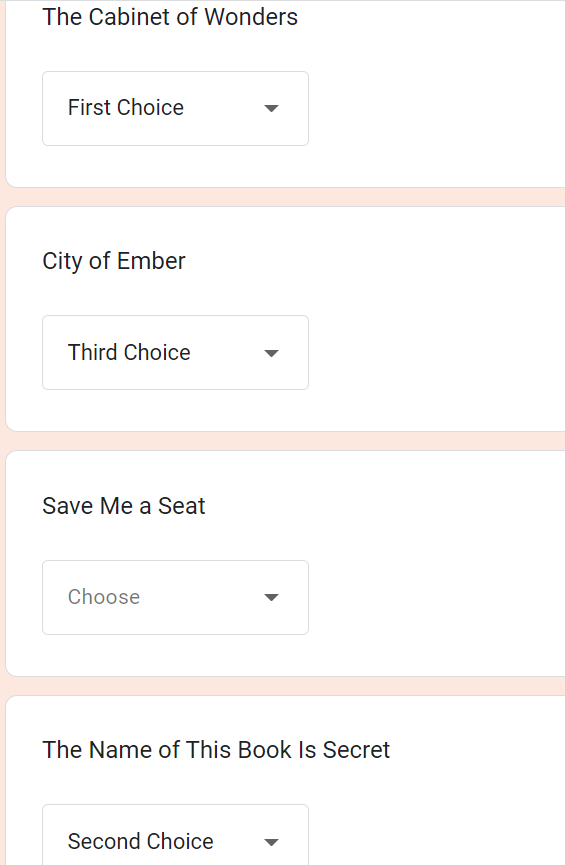
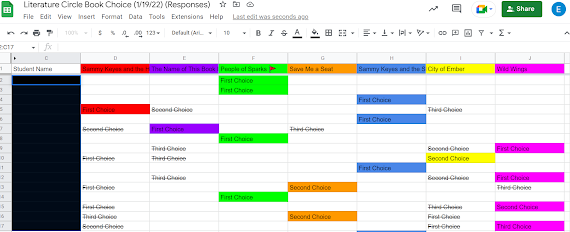
    After students have had a chance to peruse the books on offer, they fill out a Google sheet like the one below by selecting the three books they would most like to read. They are asked to rank the books (1-3) using dropdowns.


    I then convert the data collected on the Google Form to a Google Sheet (This is an option on all Google Forms; just click the Google Sheets icon in the “Responses” section). I then pick through the data to create groups. My goal is to make sure each student gets one of their three choices. Here is what a Sheet looks like after I have sorted everything:


    Schedules

    One of the most challenging aspects of Literature Circles for both teachers and students is time management—schedules are a must. After the students have been told which books they will be reading and who their group mates will be, they quickly get together to decide who will do each job for the first Literature Circles meeting of the cycle. As I explained in a previous post, the four jobs are as follows:

    Summary Specialist (Exactly what it sounds like)

    Discussion Leader (Students write questions based on the levels of Bloom’s Taxonomy)

    Thinking Map Strategy (One of the four reading strategies not addressed by the first two jobs)

    Thinking Map Skill (A map designed for the analysis of a literary element or device) 

    Once students know what job they will do for the first meeting, they can simply follow the above continuum to determine the rest.

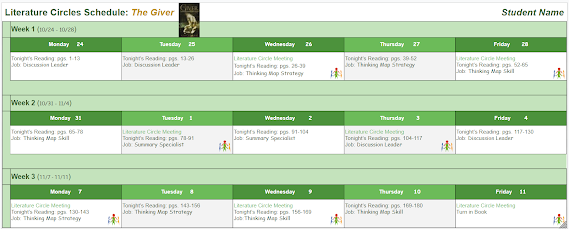
    After meeting with their groups, students return to their seats to fill out premade (by me) schedules on Google Drawings. I make a schedule like the one below for each Literature Circle book. I include the title, a picture of the book, and the page numbers that students should read each day in order to keep pace with their group. Students are responsible for locating the schedule for their book in a folder I have shared with them in Google Classroom and making a copy of the schedule for themselves. They do this within a Google Classroom assignment, so they can submit it to me when they are done. This serves two purposes. First, it allows me to easily track who has completed their schedule and whether they have done it correctly. I can also print paper copies of the schedules for the kids to keep in their folders. 

    Before submitting their schedules, students put their names on them and fill out their jobs for each night of the week and the date ranges during which the Lit Circle cycle will take place.


    My next post will address other logistical aspects of Literature Circles, including the organization of job sheets and student work and the structure and protocols of the meetings themselves.


    Writing Every Day,

    Eric Lovein


    Thursday, December 15, 2022

    Take Time to Reflect


          I selected this image precisely because it is so timely. Now that students have completed their second iReady diagnostic, it is essential to reflect on successes and areas for growth--both ours and our students'. Since students' initial diagnostic in August, our OMSD focus has been on best practices so that we can deliver "best first instruction" to them, thereby ensuring that their academic needs can be effectively and efficiently met.  During this time of reflection, a key question, therefore, is whether or not those needs were met and to what extent?
        In order to make that determination, I've presented a few questions below that you may choose to ponder.  You certainly don't need to answer each and every question. In fact, it is more beneficial for us to develop a cyclical practice of reflecting and growing. As educators, this process comes natural to us as it is part of our nature.  
    • Did students complete the 45 minute minimum requirement of iReady practice weekly?
    • Did students pass their lessons with a minimum of 70%? 
    • Did I pull students individually or in small groups when their domains were turned off or in danger of being turned off?
    When it actually came time to take the assessment:
    • did I remind students use their test-taking strategies?
    • did I encourage them to do their best?
    After the test:
    • did I tell students how important it is to not compare their scores to the scores of others. Since we are a Thinking Maps school, I tell my students to imagine themselves in a Double Bubble Map with their results on both sides. At this point in the year, August's score would be in the left bubble and the current score in the right one. With OMSD's focus on the importance of (SEL) Social Emotional Learning, it is critical that we urge our students to reflect on and celebrate their own growth. 

         We need to be as patient and encouraging with ourselves as we are with our students. On the road to college and career readiness, students--and teachers--are going to experience successes and setbacks. That's just par for the course. 
          December is a perfect time to embark on this practice. Not only is the second iReady completed, but the holidays naturally mark a halfway point in the school year. Look at the big picture. Decide how you will move your students forward. And don't forget to enjoy time with family and friends during the holidays!

    Sunday, December 11, 2022

    Huddle Time - Station Rotations In A Single Class Period


    Welcome to my third 'Huddle Time' - the purpose of this time is to provide a short video that offers student centered ideas to consider for your classroom.


    HUDDLE TIME VIDEOS

    Video #1 - Teacher Led Activity

    Video #2 - Transition

    Video #3 - Online Activity

    Video #4 - Paper/Pencil Activity


    Today's Huddle Time focuses on 

        -  Station Rotations


    Station Rotation is an instructional delivery system where students move from one activity to another activity throughout the class period.


    In my implementation of the Station Rotation Model, I have students move through three activities:

        1.  A teacher led activity

        2.  An online activity

        3.  A paper/pencil activity


    I have attempted four stations in a period but have finally landed on three stations during the period because it allows sufficient time at each station.  

    In terms of setting up my classroom, I divide the classroom in half so that both sides of the classroom have an online activity and a paper/pencil activity.  For the teacher led activity, a group from each side of the classroom comes together to meet with me as we do the activity together.  The rationale for this set up is that it allows for better classroom management and my teaching style.


    Remember to believe in yourself, believe that you matter, and believe that you can make a difference.


    Teaching and still loving it,      

    Kevin Stott                               

       De Anza Middle School           


    Tuesday, November 15, 2022

    Building Resourcefulness Using Resources

     As a third-grade teacher, I am keenly aware that third-grade bridges the gap between primary and upper grades. Each year, I have approximately ten months to equip my cherubs for the responsibilities they will assume as upper graders. The advantage I have is that I have taught both second grade and fourth grade. Therefore, I know what was, what is, and what will be expected of them.

    Certainly, the Common Core State Standards inform my instruction in terms of letting me know WHAT skills, concepts, and knowledge my students should master by the end of the year, but they are silent when it comes to the HOW.  This silence is actually advantageous in that it provides us, teachers, with the opportunity to tap into our own storehouse of experience, expertise, and creativity. Much like my car's internal GPS proposes various routes to my final destination, I am able to create my students' instructional routes to mastery of the CCSS. And like a GPS, I can "recalculate" as necessary.

    In an effort to bolster my students' independence and resourcefulness as they move towards mastery of the CCSS, I have provided each of them with a "booklet" of resources at their desks. Essentially, it's a collection of handouts, each one tucked into its own sheet protector. It is an eclectic compilation of handouts that range from academic strategies to behavioral expectations.

     The resources are subject to change depending on the need and the time of the year. For instance, at the beginning of the year, I insert a copy of The Pledge of Allegiance with numbered lines so that all students can follow along and track the words with their fingers or eyes--depending on their individual needs, abilities, familiarity with the text, and comfort level. 


      As we near the second iReady testing window, I have included a test-taking reminder handout. I copied this page directly from the iReady website. I encourage my students to do their best, but this reminder tells them specifically how I expect them to do that.


     I hope you are inspired to provide your students with the resources that you have found to be invaluable in your own classroom. Encourage students to be resourceful and to utilize those resources so that they can build independence. 


        Still Having Fun!
            Lola Jollie

    Friday, November 4, 2022

    Literature Circles: Where It's At

    My last blog post of the 2021-2022 school year began to delve into how I use Thinking Maps to teach reading strategies. The post specifically dealt with the strategy of summarizing. I briefly touched on how I use various Flow Maps for one of the jobs (Summary Specialist) my students do in Literature Circles. While I did provide a cursory overview of what Literature Circles look like in my classroom, I have now decided to devote an entire year’s-worth of blog posts to the subject. The subtitle of my piece is less an homage to Beck and more an expression of my undying love for Literature Circles and everything they add to my students’ learning. 

    I began experimenting with Literature Circles over twenty years ago after attending a wonderful Steve Dunn training on the subject. Since then, my personal approach has evolved along with my understanding of the Common Core Standards and pedagogy in general. Keep reading to find out what makes Literature Circles one of the most productive and successful parts of my teaching day!


    The Rule of 5

    Teaching is a mind-bogglingly complex pursuit, and we are given maddeningly little time to accomplish the vast number of tasks necessary to feel successful. The only way to overcome these challenges is through intelligent design. It is not enough to accomplish one goal, no matter how worthy, during a lesson or learning situation. In fact, I have developed something I call “The rule of 5.” It simply states that every lesson I teach or learning situation in which I put my students should accomplish at least five goals. This might sound absurd, and I am certainly not always successful in following the rule, but I do believe it is a realistic aspiration. Take, for instance, a lesson with the academic or cognitive goal: use a Double Bubble map to plan and write an essay comparing and contrasting two major characters in the story. To this, I can build in a language goal (use a variety of compare and contrast conjunctions or transition words appropriately), a communication goal (practice disagreeing politely when discussing your Double Bubble Map with your team), a metacognitive goal (appropriately identify the points of comparison in your map), and an Intellectual Virtue goal (make sure you demonstrate Intellectual Thoroughness when completing your map by recording all of the similarities and differences you can think of). I could even include a sixth, organizational goal: make a schedule of when you will complete the steps of your assignment.


    If you have not already guessed, I believe that Literature Circles is one of the most effective ways to ensure that my students are consistently learning, thinking, and developing on a multitude of levels and accomplishing at least five goals simultaneously. The version of Lit Circles I employ gives my students many opportunities to evaluate and make choices; create and follow schedules; demonstrate responsibility; read quality, self-selected literature; use complex Thinking Maps to organize their thoughts; and meet in structured groups to reciprocally teach their peers about what they have learned. In the coming weeks and months, I will devote blog posts to all of the elements referred to above.


    High Standards

    You may have noticed that, when discussing my “Rule of 5,” I referred to “goals” rather than standards. Not all of my learning/teaching goals are standards. For instance, when assigning a digital Thinking Map on Google Classroom, one of my goals is to improve my students’ proficiency with an app (Google Drawings) they will use frequently throughout the year. Of course, a majority of my goals do indeed involve addressing the standards, and it is not at all unusual for a single Literature Circle meeting to address as many as five or six language arts standards.


    I like to refer to Literature Circles as a “learning situation.” This is due to the fact that there is an enormous amount of diverse and personalized learning going on concurrently during the entire process. You cannot really call such an activity a “lesson,” but this is not a flaw or weakness; it is a glorious strength! Reading comprehension is an infinitely complex process, so it should not come as a surprise that teaching kids to comprehend literature cannot be reduced to a series of discrete lessons that can be taught and learned in isolation. It is my firm belief that solving a complex problem usually requires a complex solution. As I like to say, if a problem had a simple solution, we’d know it already. I love Lit Circles because they allow me to put my students in a position to do all sorts of high-level thinking and learning while rigorously addressing standards in reading, writing, listening, and speaking. It would be absurd to try to list all of the standards that can be covered during a round of Literature Circles, so I will only highlight one below and address many others in future posts.


    The first College and Career Readiness Anchor Standard for Speaking and Listening is: “Prepare for and participate effectively in a range of conversations and collaborations with diverse partners, building on others' ideas and expressing their own clearly and persuasively.” The Third Grade version of this standard states that students should, “Come to discussions prepared, having read or studied required material (and) explicitly draw on that preparation and other information known about the topic to explore ideas under discussion; follow agreed-upon rules for discussions; ask questions to check understanding of information presented, stay on topic, and link their comments to the remarks of others; and explain their own ideas and understanding in light of the discussion.” Subsequent upper-grade standards contain similar wording. As will become clear in future blog posts, students in Literature Circles learn to be responsible and organized, and the work they do before they come to a meeting is rigorous. There are strict protocols for how students should conduct meetings, and the discussions they have within a meeting are designed to allow students to reciprocally teach each other using the work they have done as a guide. One of the four jobs (Discussion Leader) is entirely devoted to questioning, and the other three participants in the meeting use questioning to encourage their group members to do the kind of thinking their jobs entailed. Given that there are seven meetings in every three-week cycle, Literature Circles help ensure that my students get many opportunities to master this important and multifaceted standard.


    As I discovered about half-way through the writing of this post, it is quite difficult to delineate even a fraction of the merits of Lit Circles in a couple of pages of text. I am just going to leave this as an incomplete introduction to the topic and begin work on the series of posts about the practical aspects of making Literature Circles work in your classroom. Please check back frequently for new additions to this series. My next post will discuss setting up your classroom and your students for Lit Circle success!


    Writing Every Day,

    Eric Lovein


    Wednesday, October 19, 2022

            I'm sure you've heard that saying: Give a man a fish and he will eat for a day. Teach a man to fish and he'll eat for a lifetime. I realize it's a stretch, but I see writing in a similar way. When it comes to writing ability and performance, incoming third graders run the whole gamut. The reasons for this variance are many and varied. For some students, English is their second language. Other students may struggle with small motor skills. Still, others may need to work on building their writing muscle through deliberate practice and time on task. Clearly, there are several reasons why students differ in writing ability and performance. 
            Regardless of whether students are or are not at grade level, as their teacher, I am tasked with moving them further along the spectrum than when they first stepped foot into my class. Meeting all my students' needs so they can experience growth is no easy feat. Success will depend on determining instructional needs by looking at my students through the following lenses: as a whole class, as small groups with similar needs, and as individuals. Additionally, I need to remember that these groups are fluid; I need to be alert to changes in need. 
            Here's a way that has served me well over the years. On the very first day of school, I have my students respond to a prompt about themselves. This year I asked them to tell me how they've changed over the past year. I steer away from content-related questions because I don't want content-area knowledge to be a barrier. In addition, I tell them to not worry about spelling. I don't want them to not use a word just simply because they don't know how to spell it. (There will be plenty of time to focus on spelling later.) Finally, I don't give them any precise directions because I don't want to influence them in any way. At this point, I want raw data. This assignment will serve as my baseline data. Looking at their writing through various lenses referenced in the previous paragraph will enable me to sort out groupings. 
            I realize that all teachers have different ways of teaching writing. In fact, I would venture to say that their approaches are as individual as the teachers themselves. Although the ensuing list of questions is certainly not exhaustive by any means, it can serve as a starting point: Do students 1) understand what a subject is? 2) what a verb is 3) know the difference between proper nouns that need to be capitalized and common nouns? 4) need to work on adding details? Taking anecdotal notes as you review students' daily writing can prompt mini-lessons for individuals, groups, or perhaps even the entire class. Of course, not every student is going to be a professional author. Still, every student needs to be a proficient enough writer to be able to skillfully convey information, ideas, and thoughts in whatever situation they find themselves in the future. 
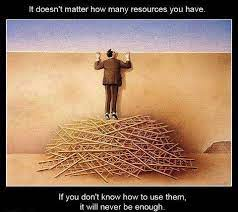
           This quote captures how I feel about writing. I hope I can inspire my students to feel the same way! 

    Wednesday, October 12, 2022

    Huddle Time - Edulastic and Creating Sub Groups


    Welcome to my second 'Huddle Time' - the purpose of this time is to provide a short video that offers student centered ideas to consider for your classroom.


    HUDDLE TIME VIDEO


    Today's Huddle Time focuses on 

        -  Edulastic and creating sub groups


    Edulastic is an assessment platform that disaggregates the data based on your classes.  However, you can also create additional groups to compare within the any assessment you administer.


    Remember to believe in yourself, believe that you matter, and believe that you can make a difference.


    Teaching and still loving it,      

    Kevin Stott                               

    De Anza Middle School 


    Owning Versus Renting


    Being an owner is way better than merely renting. And, no, I am not referring to real estate. I'm talking about knowledge. When my students are merely "renting" knowledge, it stays in short-term memory. They cannot become "owners" until that information moves into long-term memory. It can be difficult to determine owners from renters. 
       Unfortunately, I know this from firsthand experience. It became apparent to me this week. Let me explain. I've been consistently reviewing the eight Thinking Maps (that have been posted on my wall since the first day of school) and their corresponding thought processes. In fact, I've come up with a chant and gestures for each map.
        Yesterday I decided to test how many of the Thinking Maps and their thought processes they really knew. Here's what I did. I posted the various maps and assigned them each a number. Then I presented an imaginary scenario, such as "Let's imagine that I am a kindergartner and my teacher wants me to brainstorm all the animals I can come up with. Which map would describe the thought process necessary to generate all of those animals? When I say 'show me,' show me with your fingers which map I'm describing." 
        Students were eager to show me; however, their responses were literally all over the map, so to speak. Why?!? The answer: they were merely renting the chants and gestures. Sure they enjoyed the catchy chant and the playful gestures, but they weren't transferring, applying, or extending that knowledge. It wasn't their fault. It was most assuredly mine. I haven't given them the opportunity to transfer, apply, or extend that knowledge consistently. Are we still going to recite the chants with accompanying gestures? Of course. Chants are captivating, and gestures definitely help students remember. From now on, though, I am going to engage students in actually connecting the maps with their thought processes with real-world, as well as imaginary scenarios.
        Albert Einstein is credited with saying, "Insanity is doing the same thing over and over again and expecting different results." Perhaps truer words have never been uttered. If I want students to truly master Thinking Maps, then I need to change my approach. Note to self: DAILY extend students' understanding of Thinking Maps by not only presenting multiple imaginary and real-life scenarios, but by also directly teaching key words. This will enable students to become owners who can automatically connect the thought process related to a given scenario to its corresponding Thinking Map. To illustrate, I may say something like, "Imagine I am a seventh grader in a life science class and we are learning the various parts of a frog's body. Which map would help me connect the whole body of a frog to its different parts?" As time goes by, I will imbed fewer and fewer clues as students' automaticity grows. I am confident that my students will become Thinking Maps experts in no time!

    Still living the Spotlight Life,

    Lola E. Jollie

    Most Viewed Posts