Showing posts with label Reading Strategies. Show all posts

Wednesday, December 21, 2022

Literature Circles: Books and Schedules

In my previous blog post, I tried to explain the reasons for my deep love of Literature Circles. Now, I will turn to the more practical subject of setting up your students and classroom for success with this wonderful routine. Literature Circles are flexible and can be designed to accommodate a variety of students and reading materials; in this post, I will focus on my own particular situation, but there are many potential modifications and variations that can be made. Another post will soon follow to address other elements of my classroom set up.

I currently use Literature Circles with my “Paw” group, students who come to me during a reading intervention rotation. I work with on and above-level fifth graders during this period, so I have designed my current version of  Lit Circles to involve the students in the reading of self-selected (to a point) novels and performing jobs based on challenging reading strategies and skills using Thinking Maps. In addition, a high level of responsibility is gradually placed upon the students for the successful completion and execution of these jobs. The rest of this post will explain how I choose books to offer the students and how they go about selecting the ones they prefer to read. I will also address how individual students create reading and job schedules that help them keep pace with their group mates.


The Books and Book Selection

It is a truism that kids who love reading will read often and that kids who read often will generally develop strong reading skills. If we accept this logic, then shouldn’t fostering a love of reading be right at the top of our to-do list as teachers? As far as I’m concerned, this is the primary purpose of Literature Circles. 

Many years ago, I began building a collection of sets of high-quality and high-interest books in a variety of genres. I gave myself (intrinsic) bonus points if the books were part of a series and/or written by authors who had also written several other great books. My rationale was that, if there were sequels or other appealing books by the same author, I could either offer them up as future Lit Circles books or suggest that the kids check them out from the library. In the case of sequels, I made it a rule that only kids who had read the preceding book could read a sequel, and if even a single student did not want to read the sequel, the rest of the kids in the group would have to wait until more kids had read the previous book. As I already mentioned, I want Literature Circles to foster a love of reading; forcing a student to read a book they’re not interested in would obviously have the opposite effect.

Once I had put together a decent set of books, I put them to the kid test. Unfortunately, I was sometimes forced to discard certain books because they consistently got bad reviews from my students. This still happens from time to time as I gradually add new books to the mix. Again, if helping develop a lifelong love of reading is my goal, I can’t foist books on my students that I’m fairly sure they won’t enjoy. I will usually give a book a couple of chances before banishing it to my cabinets.


Ideally, every Literature Circle group should have four students in it, so I start by dividing the total number of students in my class by four to determine the number of books I need for a three-week cycle. If the number of students isn’t a multiple of four, I will create one or two groups with three students and eliminate one of the jobs for those groups. I try to include books from a variety of genres to make sure there is something for everyone.

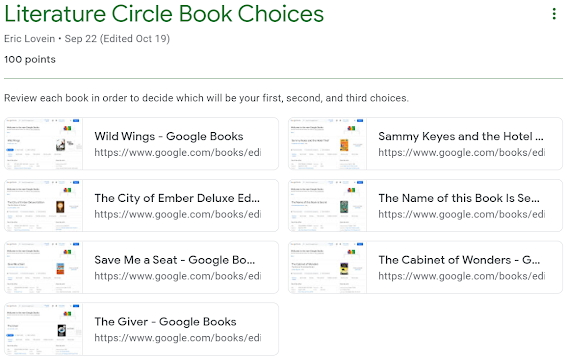
Once I have selected a nice smattering of books to offer the students, I usually give them a brief description of each book; I also post a Google Books link for each book on Google Classroom (see below), which allows students to read descriptions of the books, see reviews, and check things like lexile levels and page numbers.

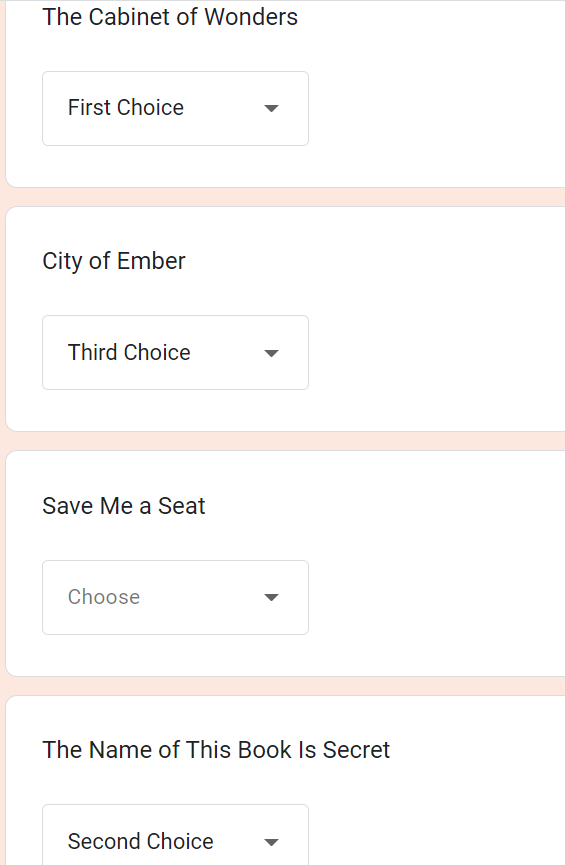
After students have had a chance to peruse the books on offer, they fill out a Google sheet like the one below by selecting the three books they would most like to read. They are asked to rank the books (1-3) using dropdowns.

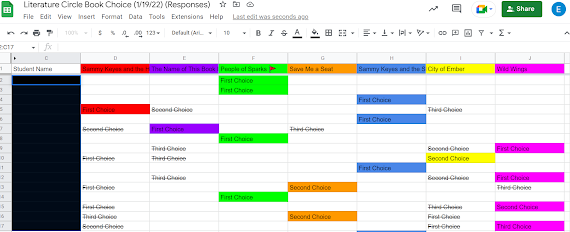
I then convert the data collected on the Google Form to a Google Sheet (This is an option on all Google Forms; just click the Google Sheets icon in the “Responses” section). I then pick through the data to create groups. My goal is to make sure each student gets one of their three choices. Here is what a Sheet looks like after I have sorted everything:


Schedules

One of the most challenging aspects of Literature Circles for both teachers and students is time management—schedules are a must. After the students have been told which books they will be reading and who their group mates will be, they quickly get together to decide who will do each job for the first Literature Circles meeting of the cycle. As I explained in a previous post, the four jobs are as follows:

Summary Specialist (Exactly what it sounds like)

Discussion Leader (Students write questions based on the levels of Bloom’s Taxonomy)

Thinking Map Strategy (One of the four reading strategies not addressed by the first two jobs)

Thinking Map Skill (A map designed for the analysis of a literary element or device) 

Once students know what job they will do for the first meeting, they can simply follow the above continuum to determine the rest.

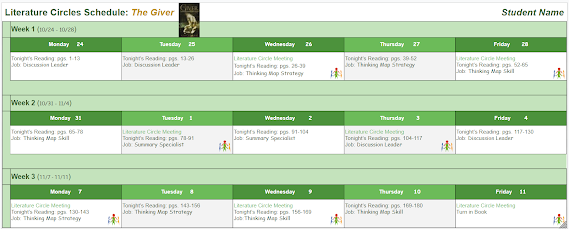
After meeting with their groups, students return to their seats to fill out premade (by me) schedules on Google Drawings. I make a schedule like the one below for each Literature Circle book. I include the title, a picture of the book, and the page numbers that students should read each day in order to keep pace with their group. Students are responsible for locating the schedule for their book in a folder I have shared with them in Google Classroom and making a copy of the schedule for themselves. They do this within a Google Classroom assignment, so they can submit it to me when they are done. This serves two purposes. First, it allows me to easily track who has completed their schedule and whether they have done it correctly. I can also print paper copies of the schedules for the kids to keep in their folders. 

Before submitting their schedules, students put their names on them and fill out their jobs for each night of the week and the date ranges during which the Lit Circle cycle will take place.

My next post will address other logistical aspects of Literature Circles, including the organization of job sheets and student work and the structure and protocols of the meetings themselves.


Writing Every Day,

Eric Lovein


Friday, November 4, 2022

Literature Circles: Where It's At

My last blog post of the 2021-2022 school year began to delve into how I use Thinking Maps to teach reading strategies. The post specifically dealt with the strategy of summarizing. I briefly touched on how I use various Flow Maps for one of the jobs (Summary Specialist) my students do in Literature Circles. While I did provide a cursory overview of what Literature Circles look like in my classroom, I have now decided to devote an entire year’s-worth of blog posts to the subject. The subtitle of my piece is less an homage to Beck and more an expression of my undying love for Literature Circles and everything they add to my students’ learning. 

I began experimenting with Literature Circles over twenty years ago after attending a wonderful Steve Dunn training on the subject. Since then, my personal approach has evolved along with my understanding of the Common Core Standards and pedagogy in general. Keep reading to find out what makes Literature Circles one of the most productive and successful parts of my teaching day!


The Rule of 5

Teaching is a mind-bogglingly complex pursuit, and we are given maddeningly little time to accomplish the vast number of tasks necessary to feel successful. The only way to overcome these challenges is through intelligent design. It is not enough to accomplish one goal, no matter how worthy, during a lesson or learning situation. In fact, I have developed something I call “The rule of 5.” It simply states that every lesson I teach or learning situation in which I put my students should accomplish at least five goals. This might sound absurd, and I am certainly not always successful in following the rule, but I do believe it is a realistic aspiration. Take, for instance, a lesson with the academic or cognitive goal: use a Double Bubble map to plan and write an essay comparing and contrasting two major characters in the story. To this, I can build in a language goal (use a variety of compare and contrast conjunctions or transition words appropriately), a communication goal (practice disagreeing politely when discussing your Double Bubble Map with your team), a metacognitive goal (appropriately identify the points of comparison in your map), and an Intellectual Virtue goal (make sure you demonstrate Intellectual Thoroughness when completing your map by recording all of the similarities and differences you can think of). I could even include a sixth, organizational goal: make a schedule of when you will complete the steps of your assignment.


If you have not already guessed, I believe that Literature Circles is one of the most effective ways to ensure that my students are consistently learning, thinking, and developing on a multitude of levels and accomplishing at least five goals simultaneously. The version of Lit Circles I employ gives my students many opportunities to evaluate and make choices; create and follow schedules; demonstrate responsibility; read quality, self-selected literature; use complex Thinking Maps to organize their thoughts; and meet in structured groups to reciprocally teach their peers about what they have learned. In the coming weeks and months, I will devote blog posts to all of the elements referred to above.


High Standards

You may have noticed that, when discussing my “Rule of 5,” I referred to “goals” rather than standards. Not all of my learning/teaching goals are standards. For instance, when assigning a digital Thinking Map on Google Classroom, one of my goals is to improve my students’ proficiency with an app (Google Drawings) they will use frequently throughout the year. Of course, a majority of my goals do indeed involve addressing the standards, and it is not at all unusual for a single Literature Circle meeting to address as many as five or six language arts standards.


I like to refer to Literature Circles as a “learning situation.” This is due to the fact that there is an enormous amount of diverse and personalized learning going on concurrently during the entire process. You cannot really call such an activity a “lesson,” but this is not a flaw or weakness; it is a glorious strength! Reading comprehension is an infinitely complex process, so it should not come as a surprise that teaching kids to comprehend literature cannot be reduced to a series of discrete lessons that can be taught and learned in isolation. It is my firm belief that solving a complex problem usually requires a complex solution. As I like to say, if a problem had a simple solution, we’d know it already. I love Lit Circles because they allow me to put my students in a position to do all sorts of high-level thinking and learning while rigorously addressing standards in reading, writing, listening, and speaking. It would be absurd to try to list all of the standards that can be covered during a round of Literature Circles, so I will only highlight one below and address many others in future posts.


The first College and Career Readiness Anchor Standard for Speaking and Listening is: “Prepare for and participate effectively in a range of conversations and collaborations with diverse partners, building on others' ideas and expressing their own clearly and persuasively.” The Third Grade version of this standard states that students should, “Come to discussions prepared, having read or studied required material (and) explicitly draw on that preparation and other information known about the topic to explore ideas under discussion; follow agreed-upon rules for discussions; ask questions to check understanding of information presented, stay on topic, and link their comments to the remarks of others; and explain their own ideas and understanding in light of the discussion.” Subsequent upper-grade standards contain similar wording. As will become clear in future blog posts, students in Literature Circles learn to be responsible and organized, and the work they do before they come to a meeting is rigorous. There are strict protocols for how students should conduct meetings, and the discussions they have within a meeting are designed to allow students to reciprocally teach each other using the work they have done as a guide. One of the four jobs (Discussion Leader) is entirely devoted to questioning, and the other three participants in the meeting use questioning to encourage their group members to do the kind of thinking their jobs entailed. Given that there are seven meetings in every three-week cycle, Literature Circles help ensure that my students get many opportunities to master this important and multifaceted standard.


As I discovered about half-way through the writing of this post, it is quite difficult to delineate even a fraction of the merits of Lit Circles in a couple of pages of text. I am just going to leave this as an incomplete introduction to the topic and begin work on the series of posts about the practical aspects of making Literature Circles work in your classroom. Please check back frequently for new additions to this series. My next post will discuss setting up your classroom and your students for Lit Circle success!


Writing Every Day,

Eric Lovein


Most Viewed Posts