Tuesday, August 31, 2021

Week One Completed and We are Already Ready for a Break

  August 18, 2021 - By Heather Pfrunder, M.A.Ed.  SDC Teacher and Ed Specialist


We knew it would be interesting to transition back to in person learning.  We knew students would need to remember what it means to wake up early, wear a full uniform, and attend for a full six hours.  As teachers, we also knew it was going to take some serious preparation and an open mind to change, as well as patience as we put school norms back into place.  However, I’m not talking about the taboo subject of teacher burn-out or the restlessness before Spring Break. No, I am talking about proactive solutions to ensure a healthy classroom environment.


I spent Spring through Summer reading and researching trauma-informed restorative justice practices.  With over 20 years experience working with individuals with special needs, I wondered if there was something that I was missing.  What I discovered was practical refreshers and some new perspectives.  Since it is the beginning of the year, let me gift you with the short version and some practical applications.


Oh… That’s Why...


Mona Delahooke, PhD in her book, “Beyond Behaviors: Using Brain Science and Compassion to Understand and Solve Children’s Behavioral Challenges” (2019) states “Current neuroscience...reveals a more complex reality: many problematic behaviors reflect how the child’s brain and body perceive stress” (p. 3).. In a study done in 2013 by the CDC and Kaiser Permanente (ACES Too High) they cited over 35 million children in the USA have experienced one or more types of childhood trauma (Brummer. p. 53). Just think, without COVID many of our students were/are already having to contend with stress. Delahooke continues “When [we come] to view problematic behaviors as adaptive responses and not purposeful misbehavior I shifted nearly all my beliefs about how to help children” (p. 3).  So square one in shifting one’s mindset is not a focus of “good” or “bad” - but what simply is, and how to address it. 


Think of self-control (self-regulation) as a house.  From the floor-up we have emotional connection, social skills, and cognitive reasoning. Which means learning absolutely doesn’t happen when students are in distress.  When a student is dysregulated (i.e. often seen as mal-adaptive behavior choices) chances are they aren’t ready for a conversation that requires reasoning (that is “top-down” thinking).  They need “time-in” or what I like to call a “Rest Break.”  This is NOT punishment!  In less extreme cases it is asking, “What do you need?  How can I help?”  However, before we ask these questions we need to have a classroom game-plan.


It’s Game Time


Pre-Game Prep:

  • Set the environment as a calm space:

    • Neutral soothing colors

    • Clutter diminished, labeled items, no more than ⅔ of wall space covered (for my students prone to visual distractions I do way less).

    • Natural or lowered lights

    • Be observant of triggers like music/noise or scents

    • Consider setting up flex seating

    • Set up a Rest Area & Calm Down Kit

    • For non-verbal students have resources for communication ready and available throughout the classroom. 
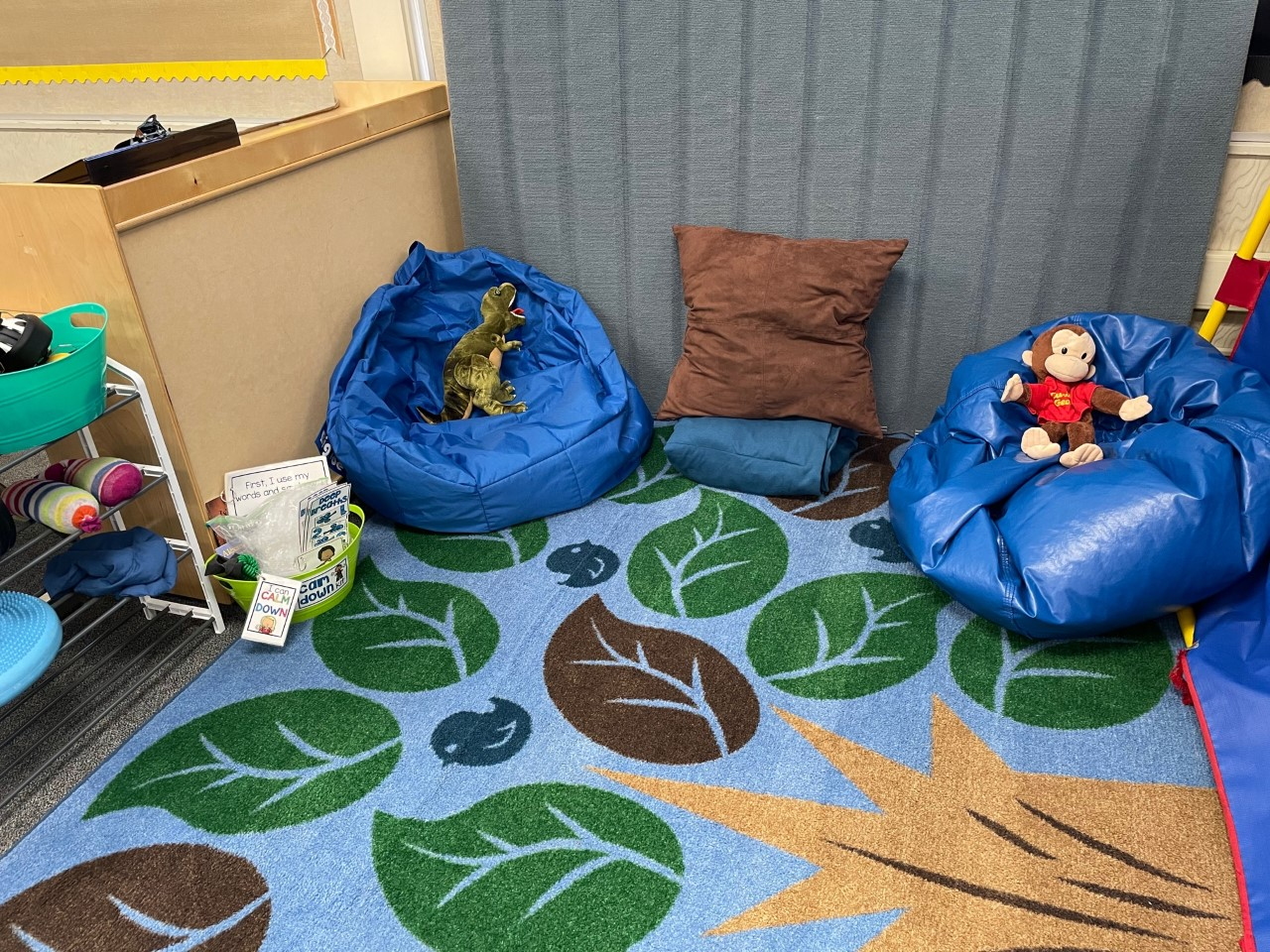

This Rest area has sensory equipment like a weighted blanket and a calm-down kit.  It is available at any time for all of my students. The objective is to rest and calm (versus playtime).
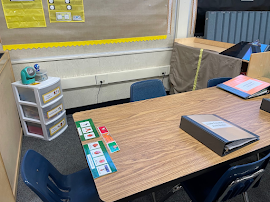
This is one of my 4 centers: While they are identified by color, most of the tones are neutral, classroom expectations are listed, icons for requesting a break or sharing if they are “Ready to Learn” are within arm’s length.
  1. Putting it in action starts with self! Co-regulation: we demonstrate regulated behavior to be a model and to demonstrate that an environment is safe. “We can’t put an oxygen mask on others unless we put one on ourselves first…[then we] can calm the toughest of students and see past the behaviors to see a kid “in-struggle” not a kid “in-trouble” (Brummer. pp. 58-60).

  • Come in a few minutes early, shut off the lights, and slow breathe for 3 full minutes to a timer.  Do it at every recess and lunch.

  • Partner with a trusted colleague

  • Reward yourself with special activities at the end of the week.

  • Give YOURSELF a break!

  1. Set the Expectations of a Safe Space for your Students

  • Use our OMSD SEL kit every morning; It's amazing! (It's the blue and orange target sign in your teacher symbaloo or click the link) SEL Toolkit
  • Do brain breaks like “Go-Noodle” videos-- it’s free and can be added to our Clever page. https://www.gonoodle.com/
  • Take time to get to know your students - likes, dislikes...share and have conversation.  Look for ways to incorporate their favorite things or topics.
  • Build classroom expectations together as a team.  (I love Pocket of Preschool’s Red and Green choice visuals). We take turns as a group and decide what’s a good choice or not. https://www.teacherspayteachers.com/Product/Behavior-Management-Green-and-Red-Choices-Preschool-Pre-K-and-Kindergarten-1931820
  • Big Breaks!  Remember when I cited emotional connection and social skills coming before cognitive reasoning?  There is a place for big breaks, focusing on collaborative play and positive interactions - especially for our exceptional learners.  For students that are neuro-typical, diving into Kagan strategies and Socratic Seminars are great ways to imbed wiggle room for social connection while still working on academic standards.
  • Allow students to self-advocate and ask for an “extra minute.”  It isn’t a problem to not be ready.  When they are ready, they are going to truly learn.
  • Click the link for my custom created visuals (open with Kami).
  •  Expectations and Self-Advocating Visuals for Exceptional Learners


Let’s be Real


I would like to tell you that day one or even week one went off without a hitch.  While a lot went really well, the truth is, I played musical chairs with seating the first three days.  I quickly realized that learning was not going to happen in a whole group setting, just yet. Big breaks went a little long. But, I took time to hear their stories, address needs, and set boundaries. By switching to small groups we found a rhythm. By Thursday we were finally able to directly address classroom rules with active student participation.  By Friday we were on target.  The old me (the new teacher me) would have truly panicked about not hitting standards fully the first week.  But guess what?  My most important job for week one was accomplished.  I connected with my students.  They understood and partnered with me on expectations.  Much of the anxiety and extra-sensory behaviors that occurred due to coping to what was new had subsided. And hey, my team even managed to get down a lot of data for IEP goals.  So now it’s onward!  Let the learning commence!  Bring it Common Core!  Hello restorative practices!  I can’t wait to see the growth in the hearts and minds of my students! I hope you join me in following our new adventures!


Learning resources referenced:


Brummer, Joe & Thoresborne, Margaret.  Building a Trauma-Informed Restorative School: Skills and Approaches for Improving Culture and Behavior. Jessica Kingsley Publishers: London, Great Britain. 2021.


Delahooke, PhD., Mona. Beyond Behaviors: Using Brain Science and Compassion to Understand and Solve Children’s Behavioral Challenges.  PESI Publishing & Media: Eau Claire, WI. 2019.


WRITTEN BY: HEATHER PFRUNDER

Friday, August 27, 2021

Setting the Tone with Read Alouds

The first few weeks of school are a great time to set the tone for the rest of the year. I find this is an excellent time to work with students to establish our classroom culture through reading aloud books that focus on my vision for the class. I have taught 1st-5th grade and have always started the year this way with great success. Now you might be thinking, “Um, Ruth, we’ve already been in school for over a month,” and yes, that’s true. But it’s never too late for a good book, especially if the stress of the start of the new school year left classroom culture building a bit neglected.

Here’s a non-exhaustive list of the books I read in the first week of class and how I use them to establish our classroom culture. I read them in sittings as they are grouped so students can make connections between the books and identify the overall theme of that particular set of books. Again, you might be thinking, “Ruth, there are nineteen books on this list. Surely you don’t read them ALL in the first week?” but indeed I do, dear reader! I find it to be a nice way to ease into the school year by having so many read alouds and it also establishes literacy as something central to our classroom.

If reading this whole list overwhelms you, I encourage you to skim the headings and just read the section you feel would be best for your current classroom situation. 


General Welcome

Our Class Is A Family by Shannon Olsen

All Are Welcome by Suzanne Kaufman

When students enter the classroom, I greet them at the door, give them a name tag, and have them head straight to the carpet. Once they are settled I introduce myself and read them these books. I tell them that we are a diverse group of learners and that I am thrilled to be working with them this year. I ask them to share ways they can make all feel welcome and how we will act like a family this year. We discuss what it means to be a classroom family and what that means about how we treat one another.


Belonging

Exclamation Mark by Amy Krouse Rosenthal and Tom Lichtenheld

It’s OK To Be Different by Sharon Purtill

I Like Myself by Karen Beaumont

I want every student to have the confidence to be themselves. I capitalize on every opportunity to highlight diversity in the classroom while ensuring there is a consistent undertone of belonging and acceptance. I ask students to reflect on a time they didn’t feel they belonged and how that impacted their emotions and experience. I then ask them to think about when they did feel they belonged and what that experience was like. We brainstorm ideas on a circle map for how to make everyone in the class and the school feel like they belong here. I follow this up with an All About Me pennant that is displayed in the classroom all year. I take a photo of each student on the first day, print them out in color, and glue them to the pennant before I display them. It’s great décor and students and families love to look at these. There are many free versions of pennants on TpT.

Restorative Practices

I Love You Because You’re You by Liza Baker

This one might raise a few eyebrows because it’s written from the perspective of a mother to her child. However, I want to establish right away that I am a caring adult to these children and that I will truly love and care for them regardless of their actions. This sets the tone for restorative practices in the classroom. When I establish from the very beginning that I want what’s best for students, they know that my reactions and expectations are all rooted in that love.


Class Norms

Lacy Walker, Nonstop Talker by Christina Jones

My Mouth Is A Volcano by Julia Cook

Interrupting Chicken by David Ezra Stein

Now here’s where the rubber really meets the road. Before I read these books I cheekily ask students to think of why I might be reading these to them. I’ll pause periodically and look at them with a meaningful glance to emphasize certain points. This never fails to make them giggle and acknowledge that yes, they’ve been guilty of monopolizing the conversation or “erupting” before. After these read alouds. I ask them to consider all the books we have read so far and what they want our class to look like, sound like, and feel like. I frame these through the lens of our PBIS key words. From this brainstorm, we create a class compact that everyone signs and that is posted at the front of the classroom. If a student violates a norm, I point to the poster, restate the norm, and redirect them to expected behavior. This is so much more powerful than what I used to do which was essentially tell kids not to interrupt. By referring to the norms they created, I am being consistent and also building their capacity for productive classroom interactions.


Responsibility

Fill A Bucket by Carol McCloud and Katherine Martin

What If Everybody Did That? By Ellen Javernick

Say Something! By Peter Hamilton Reynolds

Every morning, my students and I repeat affirmations with one another. One of them is “I am powerful” and “I can change the world.” I use these books to establish the power of one. I want students to know that they matter, their voice is important, and that they have the power to change. I use the title phrases throughout the year saying, “You filled my bucket!” when students do an act of service, “What if everybody did that?” when students make a poor choice, and “Thank you for being brave and saying something” when a student advocates for themselves or others. 


Addressing Anxieties

A Little Spot Of Anxiety by Diane Alber

Wilma Jean The Worry Machine by Julia Cook

Captain Snout And The Super Power Questions by Daniel G. Amen

This year is so full of uncertainties and our students feel the stress and anxiety of the world around them. Reading these books gives students specific skills to use in order to calm down and manage their worries. I remind students of these strategies before we take a test or when I announce I will be out and they will have a sub. These books reinforce all the vital work we are doing in our S.E.L. lessons every morning. 


Growth Mindset

The OK Book Amy Krouse Rosenthal and Tom Lichtenheld

The Girl Who Never Made Mistakes by Mark Pett and Gary Rubinstein

Yes, I Can! By Nadya Mikulinsky

I Can Do Hard Things by Gabi Garcia

I’ve noticed that this year I have a group that is very failure averse. They are afraid to try because they might not be perfect. I noticed students relaxing after I read these books and being much more willing to attempt things. They also set up the phrase I use all year “You don’t have to be perfect, you just have to try” which is echoed in one of our daily affirmations of “I can do hard things.”


Wrap Up

And there you have it! The books I read to set the tone of my classroom and establish a culture of acceptance and perseverance. If you’re interested in doing this, I encourage you to start small. Pick a few of the books and introduce them to your class. As the years go on, you’ll build up a more and more robust reading list and you can then pick which you feel are best for your group of kids that year. Feel free to reach out with any questions and I would LOVE to hear if you’ve tried these books!


As I close, I invite you to join me in these affirmations.


I am doing the best I can.

I belong here.

I deserve rest.


It’s going to be a different year than ever before and YOU are exactly where you belong, changing the world one kid at a time.


Here for you,

Ruth Reinkymov

3rd Grade Teacher

Hawthorne IB World School


Tuesday, August 24, 2021

Growth Mindset: Successful Students with Jot Thoughts


During the first few weeks back to school, it's so important to build a sense of community and belonging amongst your students.  You want them to feel that your classrom is a safe place to learn and share.  Through all the team building and classroom building activities that I engage my students in the first few weeks, I think it's equally important to place an emphasis on Growth Mindset.  We know that your mindset can change or determine your outcome and success, and that's so very true for our students as well!

Being as though we are an AVID school for many years now, one of the first activities we do at the start of the year is something called the "Successful Student." For this activity, students will brainstorm words that show what it means to be a successful student.  I copy the outline of a person onto cardstock and here they decorate the person to look like themselves and fill the poster with words that describe being a successful student.


I incorporated Growth Mindset into this activity by asing them to think of things they feel they're not good at "yet" or things they want to become better at as a studnet this year.


I used a collaboratve learning Kagan strategy called "Jot Thoughts" to help guide and facilitate discussions about growth mindset and what it means to be a successful student.  You can see the pictures I've included of this Jot Thoughts strategy as my students engaging in these discussions the first week of school!  You can also see the photos of the finished product of the "Successful Students."

This "Successful Student" activity is just one example of a very simple way to use collaborate learning (Kagan- Jot Thoughts), and Growth Mindset to help students engage in positive thinking. It's also a super fun activity, helps them to learn how to work together, and not to mention they look super cute up on the wall!

Collaboratively Learning,

Copy of pic- Megan Brown.jpg

Tuesday, August 3, 2021

Building Relationships with Our Students - Deliberate & Intentional


Welcome back to another school year like no other - yes, it will be unique in its challenges and successes.  Each of us has our own individual stories about teaching during the pandemic of 2020/21.  Hold those stories dear to you because they are important and use them to shape your teaching for this school year. 

My hope this year is to share my journey in a post pandemic school year that is shaped by how I taught prior to the pandemic, what I learned during the pandemic, and what I hope to become after the pandemic.  I hope to share how I continue to grow as a teacher in trying to make connections with my students so that they become life long learners.

To start the year off, I encourage you to get to know your students.  Find out their interests, their likes and dislikes, their favorite classes, their favorite artists, what they like to do in their free time, what they do on the weekend and on and on and on.  Getting to know your students will then allow you to tap into these interests and weave them into your subject matter - with the idea of building motivation for your students.

Here are a few ideas I use to try and build a connection with my students in the first week of school:

1.  Prior to the school year, I write each student a postcard.  The hope that I have is that students realize I am thinking about them and that I am excited about the upcoming school year.  I start writing them midsummer because writing 150 postcards takes some time.  The one additional benefit that surprised me was the parents' reactions and how they appreciated the effort to connect with their child prior to school starting.  The postcards are addressed to the parents and students - below is an example from this year.


2.  On the first day of school, I have students do an activity where they write ONE word that describes their hopes, dreams, and goals for the year.  The word should have special meaning to the student so that when you think of this word you can at least make an attempt to live by that word each day.  I give each student a blank sheet of paper where they write the word down and add color/images to the sheet of paper.  The idea for this activity came from "Write on with Miss G" during one of my many Google searches a couple years back.  This year I plan on expanding the activity by taking each student's word and displaying one word each day from each of my classes in the back of the room.  The idea being that for that day this is my 'special' student who has given the class a word to live by in the hopes that each student will feel special on their day that their word is displayed.  See below for ideas:


3.  I also do 'Name Tents with Feedback'.  The idea comes from Ms. VanDerWerf  - check out her blog post.  This does take some time during the first week of school but I have found that the time spent going through each student's response allows me to get to know each student and provide them with a personal statement back.  The purpose of this activity each day is to start the process of building a relationship with each student - a relationship that hopefully will provide the opportunities to build motivation and lifelong learners with each individual student.  I have modified the name tents so that they have these questions:  Click here


As you begin this new school year, I hope that you connect with your students in unique ways so that relationships can be forged that will allow each and every student to achieve more than they ever thought possible.  Building relationships begins the process of creating a safe environment for our students - and after last year, many students are looking for this safe place in their lives.

My upcoming blogs will focus on student motivation, Universal Design for Learning, student feedback and much, much more - I hope that you come back next month to find out what is happening in my classroom.  You can also reach out to me to come and visit my classroom anytime.

Remember, take care of yourself as well during this challenging upcoming year, and most importantly, give yourself grace.


Teaching and still loving it,     

Kevin Stott                              
De Anza Middle School          
8th grade & Integrated Math I


Wednesday, March 31, 2021

Making Math Discourse Stick- a Stick It Together Solution

Number talks, thinking mats, constructed responses... I love it all! It's ironic because as a kid I distinctly recall telling people that I wasn't a "math person". The funny thing was that I didn't get bad grades in math- I only recall saying that when I was struggling with a concept and it was then that I realized that is how many of our students feel. Regardless if it was a complete process error made on my part or a simple computational error that resulted in the incorrect answer - if it isn't correct they internalize that they don't know it at all! What I realized in the classroom that this activity addresses the issue by allowing students to talk through their thinking without having to feel like they don't know because they work together to discuss their rationale on their approach and appreciate those errors made since it was necessary to understanding the correct answer. So this sounds great and all, but how do we execute this during distance learning? Well with G Suite, of course and breakout rooms. 

The Process Before the Process 
When assigning a Stick It Together there are a few steps that need to take place to ensure that it runs smoothly and is impactful for all students.

+ Groupings- As you would in the classroom- the stick it together mat is designed to have students with varying academic abilities work together to solve a problem. The mat has four different color sticky notes which each represent a different academic level as represented with the Kagan technique: High, High Medium, Low Medium, and Low.
 
+Problem-   Application problems, exit tickets, and word problems from the Eureka curriculum lend itself well to use for the stick it together prompt. You may even choose a simple problem to determine if students are able to understand the problem at a computational level.  

+Creation-  When creating the assignment I use both Google Slides and Google Drawings. Google Drawings is where students will create their work that they will then copy onto their own virtual sticky note. When assigning this you will want to set it as "Make a copy for each student". For the Google Slides you will copy the same slide for how many groups of 4- making it "students can edit". This allows you to see all groups at the same time as well as allowing members from the same group work to create the final Best Answer. When the activity is done I change the share settings to "students can view file" so no changes can be done while I am reviewing and providing feedback. For template copies of both click HERE & HERE
The Implementation:
Having students actually working to complete the Stick It Together is the best part because it is a time where as a teacher become the facilitator and allow students to take the reins of their learning. Keep in mind that the first few times you do this activity it will take time - but with practice it will run smoother and students will ask for more time just to talk about what they could have done to make it the best possible answer- because improvement is the goal. Here are the steps that I follow to complete the stick it together. If you would like a Copy of the digital presentation click HERE

  1. x-Present the Problem= Have students open up their digital google slides assignment so they can see the problem for themselves. During this time I read the problem aloud to students and ask them to analyze what pieces of the problem they will need to be successful. Students will generally point out any vocabulary such as "product" or if there is a picture they will use math vocabulary to describe the picture (i.e "angles") 
  2.  x-Think Time =This step is crucial because it allows students to think about the process they will take in attempting the problem. During this time students may run through multiple strategies they could use to solve this problem before deciding which is the best one. When this time is provided it allows students to feel confident when it is time for them to start working on the problem. Keep in mind that NO WORK is being done during this time - it is purely time for students to Think about the problem. Your low medium and low students will thank you for this because when it is time for them to start working they won't feel rushed and it allows students to work out any misconceptions they may make without this step. 
  3. x-Completing the Problem= Have students open up their Google Drawing assignment----> click on the "line" icon------> select "scribble". This tool allows students to write and draw their numbers that best resembles writing in pen. Students may also use the "Shapes" and "Text Box" tool to fill out their sticky note. To ensure that all students are making adequate progress I monitor on Lanschool and remind them of their time and give them gentle reminders to have RDW on their sticky note or as I say: Numbers, Pictures & Words. If this is a step that is difficult for your grade level have students simply use the line/scribble tool on google slides in order to avoid step 4. I personally decided to use Google Drawings so students work is their own and they are unable to copy or all do the same strategy because they see their partners work as it is being done on the google slide. 
  4. x- Copy & Paste= Now this is a step that doesn't have to be done if you were in the classroom, but what now what I do is have students select all of their work --------> Arrange------> Group. Then I will call out my colors and as their color is called they will paste their work and drag it to their corresponding sticky note. Making sure they group their work ensures that it all stays together and doesn't split when they move it. 
  5. x- Share Your Evidence (Breakout Rooms) = Once all students have pasted their google drawing of the completed problem it is time for the breakout rooms. I tell students which color I would like to go first. You can decide for this to be your High students to set as an example because they are more inclined to use academic vocabulary and clearly explain their work or you can have your Low students go first so they have that confidence without worrying about if their answer matches their group members. I personally have students select their breakout rooms based on their number slide in the google Slides- this helps with time. I work with students on explaining their sticky note by saying "First I did.....", "Then I did.....". When students go into their breakout rooms I have the student who is explaining their work share their screen and use the "pointer" feature on the slide so students can clearly see what part of their sticky note they are referring to. In the slide I also have a 2 minute timer that the presenter may share- this is to ensure that students are using the full time to ask any questions or make comments. As I am starting off I will bring students back and do a visual check that the selected person has shared. I will then say who is sharing next and send them back into the breakout room. This continues until all students in the group have shared. When I join the breakout rooms these are the main things I am looking for. 
  6. x- Determining a Best Answer=  This is the best part of this activity because this is where the collaboration comes in. My understanding of the "the best answer" is that students work together to take portions of their groups sticky note to create one entire sticky note of the question. For example if each student used a different strategy they may go with the one that best visually represents the problem while they might use a number sentence from another person's sticky note. During the discussion students may also realize that they didn't get the correct answer or their drawing isn't correct and so this is the time to correct any errors they did have. 

Extending The Activity

This type of activity takes time so I always like to make it meaningful even after students have completed it. Here are some ways that I like to extend the activity:

% Having Students Share an Ah Ha Moment= Right after students complete their best answer I will quickly do a 1 minute breakout room with a random peer and have them share something that they learned during that stick it together. This could be: a new strategy learned, the meaning of a vocabulary word, maybe an error that they made or that another student made, or anything that they helped make this activity valuable. While this isn't very difficult in task- it does help with building a class community and working with others. It also makes them aware to really reflect on what they just did and their contribution during the activity. 

% Analyzing and Grading Best Answers= After students complete some type of assignment they always wonder "How did they do"?. Now as teachers we know that we can't always provide automatic feedback so this is not only a great way for students to challenge themselves, but also understand rubrics to provide feedback. Next what I have them do is have students look at their own best answer and rate themselves a 1, 2, 3, or 4. This grading scale rubric is similar to the Eureka understanding. When students complete this process, you start to see that they are harder then you may be which is good because they are now internalizing the expectations and how to meet it. 

% Cross Curriculum Match Up= What I love about this activity is that it can be used with many different subject areas- such as using it for a RACE response or having students create an ending to a paragraph if you are working on having students understand text features & authors point of view. What is great that if you have a prompt for whichever subject this activity can be used. 


I know this is quite a bit to take in but to whichever amount you chose to implement it your students will enjoy the opportunity to collaborate with one another. 


                                                                    Lively Teaching,


Jessica Magana

Monday, March 29, 2021

Rhyme Time!


Teaching rhyming has always been a struggle for me. In my experience, most reading programs do not systematically teach rhyming.  It's a skill that is lightly touched upon with poems and stories.  It is also assumed that students had a lot of experience with rhyming, whether in preschool or at home.

In the past, it was second nature for parents to sing rhymes, chants, and songs to their young children, even before their children spoke one word.  I have fond memories reading a special nursery rhyme book with my grandmother while sitting in her lap.  Many of my students come to me not knowing a single nursery rhyme.  There is a strong link between the nursery rhyme knowledge of Pre-K children and their future success in reading and spelling (MacLean, Bryant, and Bradley, 1987).

Rhymes teach children auditory discrimination, listening skills, a rich range of language, concentration skills, oral storytelling, to listen for and keep a steady beat, to learn whole songs and chants by heart at a very young age, and to retell stories/chants without using a book.

There are 5 Stages of Rhyming:

1. Rhyme Exposure: Mop and hop rhyme because they both end with /op/.

2. Rhyme Recognition: cat, sat. Do these words rhyme?

3. Rhyme Judgement: goat, boat, man. Which word does not rhyme?

4. Rhyme Completion: She wants to run and /pl/ /ay/, on this bright and sunny _____.

5. Rhyme Production: What is a word that rhymes with ball?

On my quest to learn more about teaching rhyming, I learned that a daily, consistent, systematic approach is the most effective.  Although I did find some instruction in our adopted ELA program, mainly in the Phonemic Awareness Intervention Teacher's Edition, I had to look for outside resources to find a daily explicit, structured program.

My class completed 10 weeks of a combination of the first five stages of rhyming, then we were ready for successful rhyme production.  Nursery Rhymes were included starting in week 9 as part of language awareness. We are currently on week 19.  Each rhyming lesson takes 2-3 minutes. If you would like to learn more about the program I used, go to www.heggerty.org.

I was curious in the data for my class and previous classes so I looked back at my ESGI data in the district rhyming assessments.  I saw my current students achievement in rhyming as 23% higher than in previous years.  As I gain more experience in teaching rhyming explicitly, I am confident that my students' scores will only increase.

Tuesday, March 16, 2021

How-To: A Quick Guide to Using Nearpod and Great Minds In-Sync (Eureka Math) Platforms

 I'm sure at this point, a year into the pandemic, you have watched a lot of "how-to" videos and learned many many different platforms.  I just thought I'd take a minute to share with you how I use the platforms Nearpod, and Great Minds In-Sync(Eureka Math) in my virtual classroom.  So this more of how I specifially use the platforms throughout my virtual instruction, and less of a how to get started type of a thing!

Nearpod

Nearpod is a digitial platfrom that allows you to make any of your lessons interactive.  You can use any lessons you have already created (ppt, google slides, word, even YouTube vids!) and make them interactive.  You can also create lessons through Nearpod.  It really increases student engagement, especially through the use of Collaborate boards, or the Draw It board feature (like a digital whiteboard).  

I create Collaborate boards across the curriculum.  I make them for Socio-Emotional Learning (morning circle discussions).  I make them for most componenets of a Eureka Math lesson: Application Problem, Student Debrief, and Exit Tickets.  I also create them for ELA to use with our Wonders curriculum for the "Making Connections" questions that are throughout the anthology stories.  I also create them with the vocab skills in mind, such as: similes, metaphors, greek roots etc.  

Additionally I often create a collaborate board for a digital version of the Kagan strategy, Jot Thoughts.  This is a strategy traditionally done in the classroom where kids work in table groups with sticky notes.  So instead, this is done with digital sticky notes on the collaborate board. Watch the video below to see a more detailed explanation of this strategy as well as examples of the above mentioned ways I use Nearpod.


Great Minds In-Sync (Eureka Math)
Great Minds is the parent company to Eureka Math.  They have created a full digital, interactive version of the Eureka Math Curriculum called "In-Sync."  This platform has been a life-saver as they have high quality engaging lesson videos.  These encompass the full concept development component of a Eureka math lesson.  Also, all student pages: Sprints, problem sets, succeed pages, etc are included as writeable PDFs, which make it really easy to use with google classroom.  Watch my video below where I talk more about how I specifically use the different features within the In-Sync site.

If you have ever considered using either of these platforms: Nearpod or In-Sync, but weren't really sure how exactly to implement in your virtual classroom, I hope this helped! Both of these platforms have been a life-saver for online learning and have really helped me boost engagment with my virtual lessons.

Virtually Learning,

Copy of pic- Megan Brown.jpg


Most Viewed Posts