Showing posts with label Productive Struggle. Show all posts

Sunday, March 15, 2020

Productive Struggling in Math


How do we challenge students in our classroom?

Is it through extension problems?  Is is through performance tasks?  Is it through projects?  Is it a discovery problem before the lesson actually begins?

We each challenge our students in various ways - it is good for students to struggle and to challenge themselves.


Image result for 3 printer image boxIn the past month, my 7th grade students have been struggling with creating a container using our only 3D printer.  The container had to hold the crayons they created from scratch in their science class.  The math component was being to design a box within a box that fits nicely together.  The creating of the box was not the struggle but it was the 'attending to precision' that was the productive struggling piece.  Students printed their initial boxes and then started to realize that the two boxes did not go nicely together - to much space or they did not fit together.  As students realized their mistakes you could see them be more careful in how they designed the second box and this was seen as they successfully printed their final boxes.



Image result for volume of cylinders cones spheres imageWith my 8th graders, the productive struggle has been with volume.  Students were given five different tasks around the concept of volume using cylinders, cones, and spheres.  The task was for students to create two different cylinders with the same volume, two different cones with the same volume and two different spheres with the same volume.  Also they had to create a cylinder and a cone with the same volume; and a cone and sphere with the same volume.  They really struggled with these tasks.  I would ask guiding questions to encourage them to try different methods.  I would encourage them to put numbers into the formulas and determine what happens.  And then it happened.  One group got an answer, then another group got the answer, and then the guiding from these successful groups allowed other groups to also find success.

Productive struggling in a classroom is good for students.  I would suggest generating some possible questions ahead of time to assist students in not giving up.  I would limit the amount of time you allow students to struggle before putting in some scaffolds to assist the students.  A lot of times students will struggle, find success, and then revisit what they have done and realize that there is another better way to solve the problem.  These type of discoveries can rarely be taught but rather discovered by the students.

I encourage you to have your students 'struggle' through meaningful and relevant work so that they can feel success and discover something new about the content and themselves.


Still teaching and loving it,


      Kevin Stott                         
De Anza Middle School     

Thursday, December 12, 2019

Integrating Depth of Complexity Gate Frames in Math

As December is upon us, so are these three words: deadlines, drowsiness, and decisions. One thing that probably does not change is the running to-do list that seems to pop into your head as your in bed. Don't forget tomorrow you have yard duty. I have to get to work early to make copies of my math assignment. Jacob, Darren, and Julie were absent, so I need to make sure they make up their test. Remember to switch my ELA and math times because students need to leave for band practice during my regular ELA block.  With extra holiday activities and chronic absenteeism, where do you find time to teach and make sure that everyone is on the same page? How do you alter your instruction to present the material in a way so they won't forget it in over the break and without coming up with something new every single time? Little did I know that the solution was one frame, a soft whiteboard, a dry erase marker, and a dry eraser. Yes! That's pretty much it. Embedding Depth of Complexity frames during my math instruction provides a solid structure for students to further their understanding of a math concept and manipulate it in many different ways. It also offers an opportunity to review previous lessons quickly. The best way for students to find the value in these frames is by using them consistently. 

1 DOK frame, 5 skills captured, ALL minds learning
"Remember, yesterday, we learned about inequalities with rational numbers and how to order them, right?" A sea of wide eyes stare back at me, a few nods, and some furrowed eyebrows expressing confusion look back at me. Alright, let me do a quick 5-minute review, and then we will be good to go. I glance at the clock, and somehow 5 minutes turned into 10 minutes, and part of me questions how valuable it was that time and if I will be able to reach today's learning target because of it. Instead of thinking of what I covered, I think about what didn't I cover! I gave simple problems that I could create on the top of my head within a quick second. I didn't check to make sure they could explain and reason their answer using vocabulary, make them represent with a number line, or have them create a situation. To top it all off, the students who didn't need the review are now bored and off task. Its times like these when I wonder how can I be prepared for these hiccups without taking time out of my day to create a review I may or may not need. That's when I realized I needed something that I could have them take out on the spot to review. Something that required students to enhance their ability to follow written directions and me to pinpoint skills for one given math concept-a depth of complexity gate frame with a few icons did the trick. I didn't realize how much one little paper could allow me to focus on the problematic math skills but also be able to walk around and pinpoint the areas of weakness of strength within a second. With embedding these frames, I could complete
maybe three problems. Now, this may not sound like a lot. Still, within these three problems, students created a real-word problem, used and internalized academic vocabulary, explained the reasoning of their answer, provided their solution in an equation, and, last but not least, provided a drawing. Now I am not saying that the second I introduce them to a new gate frame, they will meet my expectations, so when I provide them with a new one, we complete one together on the smartboard. I then give an example they can complete on their own. I've learned that sometimes, students need to feel as if they can do it. It doesn't matter that they have seen the directions one hundred times; the fear of not visually seeing your expectations can hinder them more than anything. The way I see it, if a student is willing to use my example to benefit their own understanding, then we are all winning and the ability to understand another's thinking has been internalized.  

The begining .. but definitely not the end
So as all great things, the start of something new starts with the creativity of the teacher, however once you have created it, it can be used for years to come.


  1. Pinpoint what math concepts students struggle retaining or are vital in knowing throughout the movule. Ex. Double digit multiplication
  2. On a document edit the gate frame using icons and list components that are necessary for that skill. For example, in fourth grade for multiplication the strategies would be place value chart, area model, partial products, and algorithm form so those would complete your gate frame. **Lets say there are different components of one skill-integers/rational numbers then create multiple frames for that skill in scaffolds as seen in the photos. 
  3. Print a copy for each student on cardstock and pass them out to place in a soft whiteboard (White cardstock on one side and red cardstock on the other). Students will slip the frame on the top. When it is time for a new one they will leave the previous ones and add to it. This helps review any strategies on a drop of a hat. 
  4. Use as a quick warmup (fluency) for a lesson or to introduce a topic or to review a series of strategies within a topic/Module. 
  5. Provide an example for students if necessary for the first time. Then only circle one or two portions of the gate frame. Continue adding portions until students understand or have been taught all portions of the frame.  
  6. Put on a timer and allow students to complete independently while walking around the room and monitoring and assisting where needed
  7. Pull students together and review their soft whiteboards visually and continue with following problems.
Taking it further

Accoutability: 
  • Check one student's board if everything is correct and have them check their tables to determine their answers. Have them explain to a student if they do not understand. 
  • Count it as an exit ticket
  • If a student is really struggling with a portion of the frame, check the students by staying "yes" provide another problem for them to do, but doon't allow the struggling students to move on. Allow them more time to continue with the problem they are on. 
  • Let students know that they will share their answer to a class under the document camera and another student will be referring to the frame as they are talking about it. 
Collaboration/: 
  • In pairs, divide the portions of the gate frame between the two-meaning each student has to complete two portions and then when they come together they will have to determine if their answer is correct and if they can support it with numerous methods. 
  • Allow students to complete one whole gate frame as a team switching up the portion of they gate frame. 
Kagan:
  • After completion of the gate frame allow students to discuss their answer with others, especially if a challeging problem or a skill students struggle with. Students can complete with a mix pair share, complete as a team almost as a jigsaw rotation


Regardless of when you decide to implement gate frames within the school year, the impact they can make is tremendous. Remember there is no right or wrong way to create a frame. I encourage you to create one for an upcoming module or even a past one that you feel students may forget.  


Lively Teaching,

Miss Magana


Sunday, September 2, 2018

I Know What You Did Last Summer....(a non-horror experience)


When I think of summer, I think of time off especially after an arduous year of teaching, learning, reflecting, grading, writing (lesson plans), reading, and all things academic.  So it was to my surprise that I signed up for the Invitational Summer Institute (ISI).

Image result for reluctant writersI bet your gut reaction was "Whaaat!!  Summer writing, no thanks!  MAYBE summer reading, anything but writing!"

No worries, I felt the same way.  People will do anything to avoid writing...like a horror movie it scares, frightens, worries, terrorizes and perhaps makes us sweat (a little).  I get it.  I get it.  I. Get. It!  I used to feel that way too.

Then, something changed.  A shift if you will.  Let me tell you what I did last summer.

It started with me, reluctantly (to be honest), applying and getting accepted to attend the 2018 Invitational Summer Institute (ISI) held at UC Riverside from mid-June to early July 2018.  Twelve days total.  I was unsure if I wanted to spend two weeks of my summer like this but I decided that my writing instruction needed some assistance and a fellow colleague REALLY encouraged me to attend (if you are reading this, you know who YOU are!).

Image result for transformationParticipating in ISI changed how I viewed writing and how I could make writing more meaningful for students.  I also realized that the ISI was NOT  a writing workshop with hand-outs and a mountain of strategies that you probably will never use anyway.  Don't get me wrong...there were actual hand-outs and strategies that were shared but the main takeaway for me was that writing takes many forms and accomplished writers NEED accomplished writer teachers with an emphasis on the teacher being a writer themselves and not just teachers of writing.

What does this mean exactly?  Well, by experiencing each day during the ISI as a writing "student," I realized that the reasons to write were crucial for engagement and to stimulate creativity.  Through thoughtful and carefully-planned activities, we became poets, storytellers, reporters, authors, rappers, lyrical composers, researchers, and audience members to an array of creative writing pieces.  We clapped, cheered, and encouraged each other.  We became a community of..........writers.

Writers.

Therefore, my "story" for this year's Spotlight Blog will be about writing.  I would like to share with you how the ISI has impacted my classroom practice.  I have implemented some ISI writing experiences with my current class and I am excited to share the results with you in future blogs so please return!


Want more info?  Click here:

Would you care for a "preview" - like a movie trailer showing some of the fabulous activities we participated in during the ISI?  Well, there is an annual writing conference coming up on Nov. 3rd at UCR.  There is a fee.  If your site has PD funding, this would be a great way to use it.  I hope you can join us!


Happy Writing!
Gus Macuil


Thursday, April 26, 2018

Conferencing with Students = Communicating with Parents (part 3)


Conferencing with Students =
Communicating with Parents (part 3)

    What a difference a school year makes!  Remember the first week of August when you received your students entering the classroom for the first time?  Questions swirled around your head:  Will I be an effective teacher?  Will they LOVE learning in my classroom?  Can I build their character, self-esteem, and confidence?  What will be my challenges?  Well – we find ourselves at that time of year to “wrap it up” and we feel excited as we reflect on the outcomes.  Do our students think or feel the same way?

Teachers reflect all the time!  So how can I produce reflective students?

          As you have noticed if you’ve read my previous posts, I have focused on conferencing with students in order to facilitate student reflection and then share this  with parents.  I have used familiar tools/resources such as Renaissance Learning (Accelerated Reader) since these provide quick reports that can be used in a student conferencing session.  At our school site, our wonderful principal has created a Principal’s "Challenge" in which each grade level is challenged to gain a certain amount of reading points (through computer quizzes).  These challenges are six-weeks in length.  Incentives include an extra recess, student brag tags and an end-of-year celebration.

          This week I ran a report that informs my students their total reading points for each Principal’s Challenge.  I gave each student their personal slip in order to reflect on their reading motivation throughout the year.  Here is a picture of what this report looks like:


          Next, I used this free website  https://nces.ed.gov/nceskids/createagraph/  to generate a blank graph template for students to chart their data and to set a goal for the remaining Principal’s Challenge (challenge #6).  Finally, they had to write a statement about why they chose this goal.  I made sure to make no judgments about whether their goal was too low or too high.  I left it to their discretion and overall the majority selected goals that were reasonable.  Here is an example:


          It was interesting to me that this particular student wrote: “I want this goal (30 points) because I want to get more points than any principal’s challenge points I ever had.”  It warms my heart when I read these introspective conclusions that students come to and it also motivates me to continually find other ways to facilitate goal-setting.  Of course, students take these home in order to share with their parents how they plan to keep improving their reading habits.

Student reflections will undoubtedly lead to teacher reflection.


          After I read through each reflection and goal-setting analysis, I thought about how I could help students become more voracious readers and whether goal-setting more often can help in this endeavor.  I did observe an overall trend of point decline especially after the third Principal’s Challenge.  This challenge comes right after the Winter Break and I am assuming students return from break still holding onto a “vacation” mentality especially when it comes to reading.  I am thinking of ways to  incentivize  next year’s students after this break perhaps setting goals right away after the break and more frequent progress monitoring such as reading log check-ins or offering a teacher-student lunch bunch for those students who take weekly quizzes.   

          I hope you have enjoyed these morsels of information and a small “peek” into my classroom regarding student conferencing.  May you enjoy your summer vacation and we will see you next school year!


Learning and growing along with my students!
Gus Macuil


Monday, September 18, 2017

Take a Deep Breath, and Release Your Students to...Struggle


Take a Deep Breath,
and Release Your Students to...Struggle
Have you ever been in the middle of a lesson and felt like you’ve been talking too much?  You think, “I need to let them try it on their own,” but you know they’re not quite ready.  Do you release your students and let them struggle and possibly fail, or do you keep talking and review some more examples?  

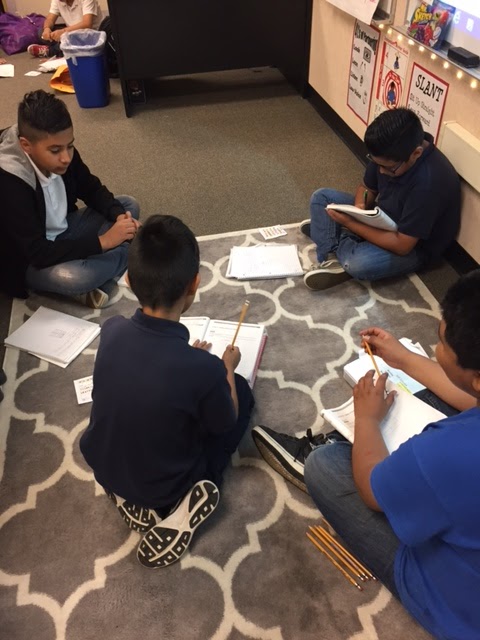
Boys on Rug.JPG

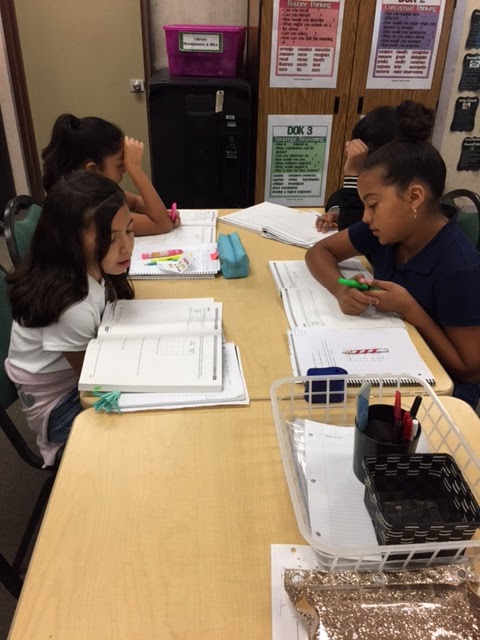
Girls at Table.JPG
By now you might be thinking, “Why would I release my students only to let them fail?”  Well, failure or productive struggle can lead to progress and perseverance!  It also doesn’t mean that you’ve completely let go of all control as their teacher.  It simply means that it’s time to take a step back and watch what your students can do.  It also means that you’re still the facilitator and available to pose questions when you see your students making mistakes. Sometimes you may even have to stop your kids and bring them back together for a helpful hint or to correct a misconception you see occurring.  This is perfectly okay!

I admit it; I often have a hard time letting my students explore their own learning.  I worry about the additional time it will take to allow my students to work in groups and learn to get along.  I get stressed over the fact that I don’t want to fall further and further behind with the pacing guide.  My anxiety kicks in when I see my small groups still struggling with the same problem, when I expected them to be on the next problem according to the time on my agenda (am I the only one who has all these amazing plans on my agenda and only get about halfway there?).  Like I’ve said--I’ve been there, and it’s not easy to release your students, but I also know it’s necessary and part of the Standards for Mathematical Practice (SMP’s).  My students need to make sense of problems and persevere in solving them (along with seven other SMP’s).  If I’m the one doing all the talking, do I really know what my students know?

I know how difficult it is to turn over the power, but you’ve got it in you to achieve awesome things and to take risks!  Together, we can use different cooperative learning structures to ease our way into group and partner work.  Here are some ideas on how I started this process with my 6th graders:


Once I set my mind to allow more time for group and partner work, I decided to make a list of as many different engagement strategies as I could.  You can find that list here: Strategy List.  As I studied my Eureka lesson, I chose a structure or two from my list that I believed would fit in well with the setup or content of that lesson.  Once I used a particular strategy, I highlighted it on my list and added the number of times it’s been used.  
  For example, when my kids were first introduced to ratio tables, I knew this would be something new but also something some could figure out without much prior knowledge.  I decided to use the Kagan structure “Circle the Sage”.  Circle the Sage is great because it gives those students who love to share the opportunity to become the teacher of a small group.  Now you have a handful of “teachers” spread out around your room teaching small groups of students.  Your students are now learning from others and answering the Eureka question at the same time.  Kind of a win-win, don’t you think?
Here’s exactly what I did, step by step Circle the Sage Directions.
Lately, I’ve been creating small groups ahead of time.  I make sure that each group is of mixed ability and purposefully assign someone to each group who is well-versed in the content, but I don’t make this known to students.  From here, I give groups the choice of either using RoundRobin or Talking Chips to work through some of the problems.  I will be honest--it was a bit rough at first.  Students were taking too long to get started and were even butting heads.  However, now that we’ve been trying this for a few weeks, they’re getting better and better at working in groups and assisting each other.  We still have a long way to go, but it goes to show that it’s possible!  Moreover, the kids enjoy becoming more independent, and you don’t have to come home so exhausted!  Join me next month when I talk about math rotations and daily morning warm-up themes!
Smith.jpegEducating together,
Kim Smith


Most Viewed Posts