Showing posts with label Special Education. Show all posts

Friday, January 28, 2022

Springing into Action: Maximizing Spring Growth

By Heather Pfrunder, M.A.Ed, SDC Teacher and Education Specialist

Jan 28, 2022


Post Winter Break is always the most exciting time of the year.   Students are in the FLOW of learning; all the pesky practices of getting used to the routines are out of the way and we simply get down to the business of learning.  It’s the time where we often see the bigger payouts for our efforts and strategies. It is also the time that can quickly get sandwiched between assessments and special projects.  However, careful attention to student progress monitoring can be the difference between meeting student goals/standards and leaving learning roll-over for summer school or the following fall. So, let’s get to it in three steps!  The following link is the organizer I have created for use.  Classroom Monitoring Worksheet How to use it is below.

**(Note: you will need to make your own copy of this document to edit it).


Step 1: Survey Student Skills

The first step seems the most challenging, but simply look at assessments and class work.  Summarize what you see and what you know from interacting with them.  Cover each basic aspect, where are they at? What objectives are they working on?  The sample I chose from my classroom is as follows: ELA: Phonics (or spelling), Sight Words (or Latin Roots), Reading Comprehension, and Writing.  For Math: Algorithms, Measurements & Graphs, Fractions & Decimals, Geometry, and Word Problems.  This may look different for your grade level or your teaching subject. Tweak what you need adjusted to match state standards and goals from your class/subject.


Step Two: Re-Organize Your Intervention Groups.

Students grow and their needs shift through the year.  Being responsive to that means that you are placing them in a place where they can collaboratively work and grow.  In the image above I have separated my students to look at what work I need them to accomplish.  However, knowing that some students may have difficulty interacting with particular individuals means my students will be regrouped differently despite ability - thus the penciled info!  Revisions are in progress!


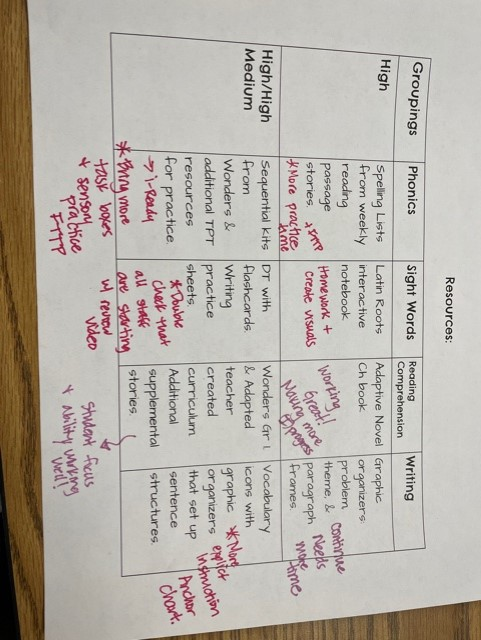
Step Three: List and Review Your Resources

Listing out your current resources helps you to frame that every need is covered.


 The important part is reviewing what is working and what is not.  What could use more attention?  Why?  More interactive lessons?  More practice?  A different program or strategy?  Maybe time needs to be shifted to a particular skill.  Here I have added notes about more intervention time with Fast Track To Phonics, videos, revised anchor charts, homework opportunities, and notes to myself of what is working great (i.e. consistent progress at an appropriate pace). Now, it’s lesson planning time. 


Wishing you and your students AMAZING Spring Growth!!


Like what you read? Join me in upcoming blog posts where I continue to put these strategies into place and share resources!


Thursday, December 30, 2021

Trouble-Shooting Kagan: Getting Cooperative Learning to be Cooperative

By Heather Pfrunder, M.A.Ed          SDC Teacher and Education Specialist

December 30, 2021


Watching Kagan strategies in action one can’t help but be excited at the level of student engagement.  Student responses which exude inactive reflection and minimal regurgitation transform into animated critical thinking.  The brain science and research behind Kagan strategies is impressive and exciting: it takes in account the varied ways our brain is engaged and uses structures and systems to ensure optimal learning.  Through the practice of collaborative learning, the brain simultaneously is engaged in multiple parts. The social structures form an emotionally safe learning environment, often while nourishing the brain through motion. You could spend a college semester learning all the facets to Kagan and the brain research behind each minute component for it’s cooperative learning structures. However, teachers with fledgling Kagan experience often are encouraged to simply “start with the Robins.” Kinda Techy Teachers on TPT has a great free resource to access visual explanations and how to use the top 5 Robin Structures.


 Click Here for a Free Resource!
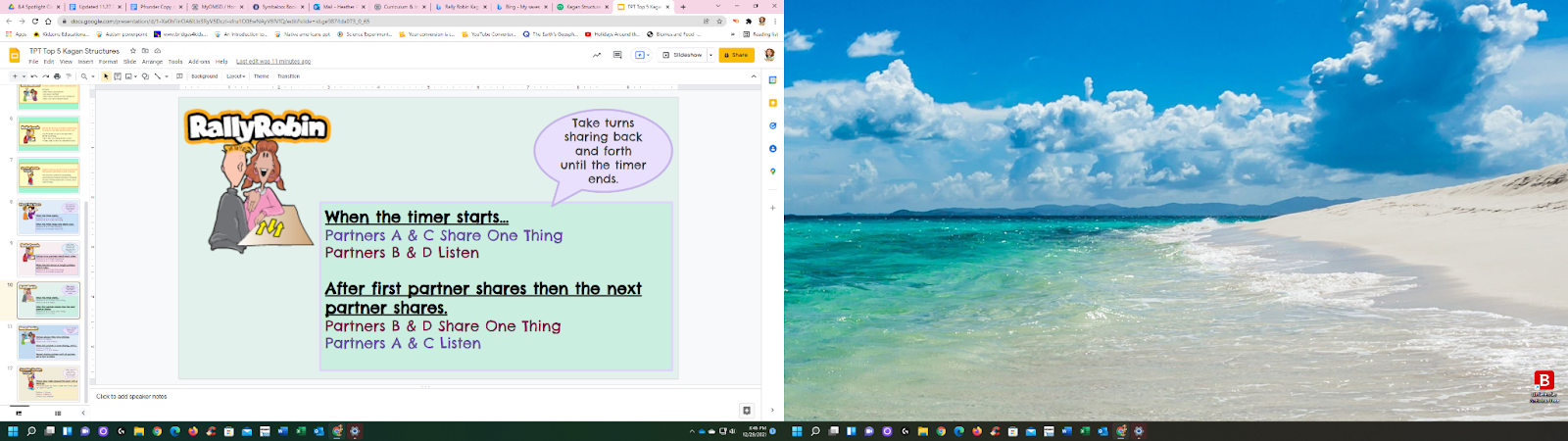

Example of a “Robin” Structure in the free TPT

Resource linked above.


This way teachers and students learn some of the basic structures and can apply them to any subject matter.  It is not the content that is being changed, rather the format of the lesson.  For many teachers the quick diagram of expectations found in the Kagan flip book is simple enough to function for many of their students.


Flip Book page example.


Colleague Randi Muehlen describes many wonderful ways to implement Kagan in her post Kids Love to Talk. However, if we are teaching ALL students, and “all means all,” chances are you have had a student (or three) who are challenged to cooperatively work in cooperative learning groups. In reflection, this challenge happens for several reasons: social skill deficits, academic skill deficits, or a combination of both represented by cognition challenges. So here we go again, my teacher friends!  A list of shortcuts, tips, and printable visual aids to address Kagan challenges is headed your way!  Because honestly, the learning pay-off is so very worth it!



1.Social Skills: In trouble shooting social skills challenges (i.e. silliness, off-task behavior, bullying, shyness…) there are commonalities among strategies to address the different kinds of social skill deficits. Modeling, praise, team reflection, and purposeful team role assignments can shape mal-adaptive behaviors into behaviors that are productive and helpful team-building.  To address the needs of all students you may find yourself rotating between strategies to give all unique students a chance to exercise growth in an area of social skills development. Chapter 11 of the Kagan book outlines Social Skills challenges, solutions, and suggested structures and feedback.  Here is a condensed and shortened list of challenges and solutions for your reference:

 Kagan Social Skills Solutions. Click here!

Social skills are a major component to cooperative learning.  However, often they are a way to cover up another challenge: academic skill deficits.


2.Academic Skill Deficit: In this area there are two key take-aways to address supporting students that may need more scaffolding in order to actively participate with their peers. The first is relatively simple: do your students understand the concepts that they are learning?  Are they able to use key vocabulary in discussions?  For students with unique learning needs this may mean that they may need to use notes with how-to steps and examples or simple vocabulary sheets with visuals and/or sentence frames.  Below are some examples of content vocabulary.


Top: More descriptive vocabulary with visuals to aid in conversation

 for mid-need learners -found on TPT American Revolution Word Vocab.


Bottom: Simple sorting and matching vocabulary for collaboration activities 

for higher-need/less verbal learners - found on TPT water cycle bingo.


The second scaffold has to do with grouping and “Positive Interdependence.” (This is the “P” in the Kagan acronym “PIES” standing for Positive Interdependence, Individual Accountability, Equal Participation, and Simultaneous Interaction.)  How we set up individuals in groups can either benefit or challenge academic growth. Strong interdependence means that each member of the group is needed for the task to be completed.  This takes careful structuring of both the task instructions (ensuring that each member of the group is building on each other’s contributions) and the careful structuring of groups.  For example, the highest achieving learner typically should not be paired with the lowest achieving learner.  Instead, group your students into 4 groups: high, high-medium, medium-low, and low.  Keep teams within 1-2 levels within their range and assign roles based on strengths and/or needs.  Number and group roles or strengths within numbers 1-4, so that you can make instructional decisions which will work for both the individual and the team.  If individual growth is not happening at the rate you were hoping for and you have adjusted strategies based on challenges, it may be time to mix up groups.
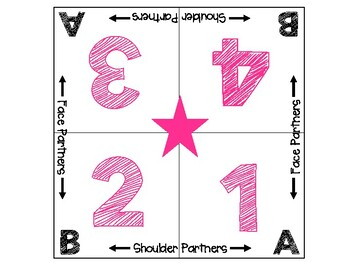
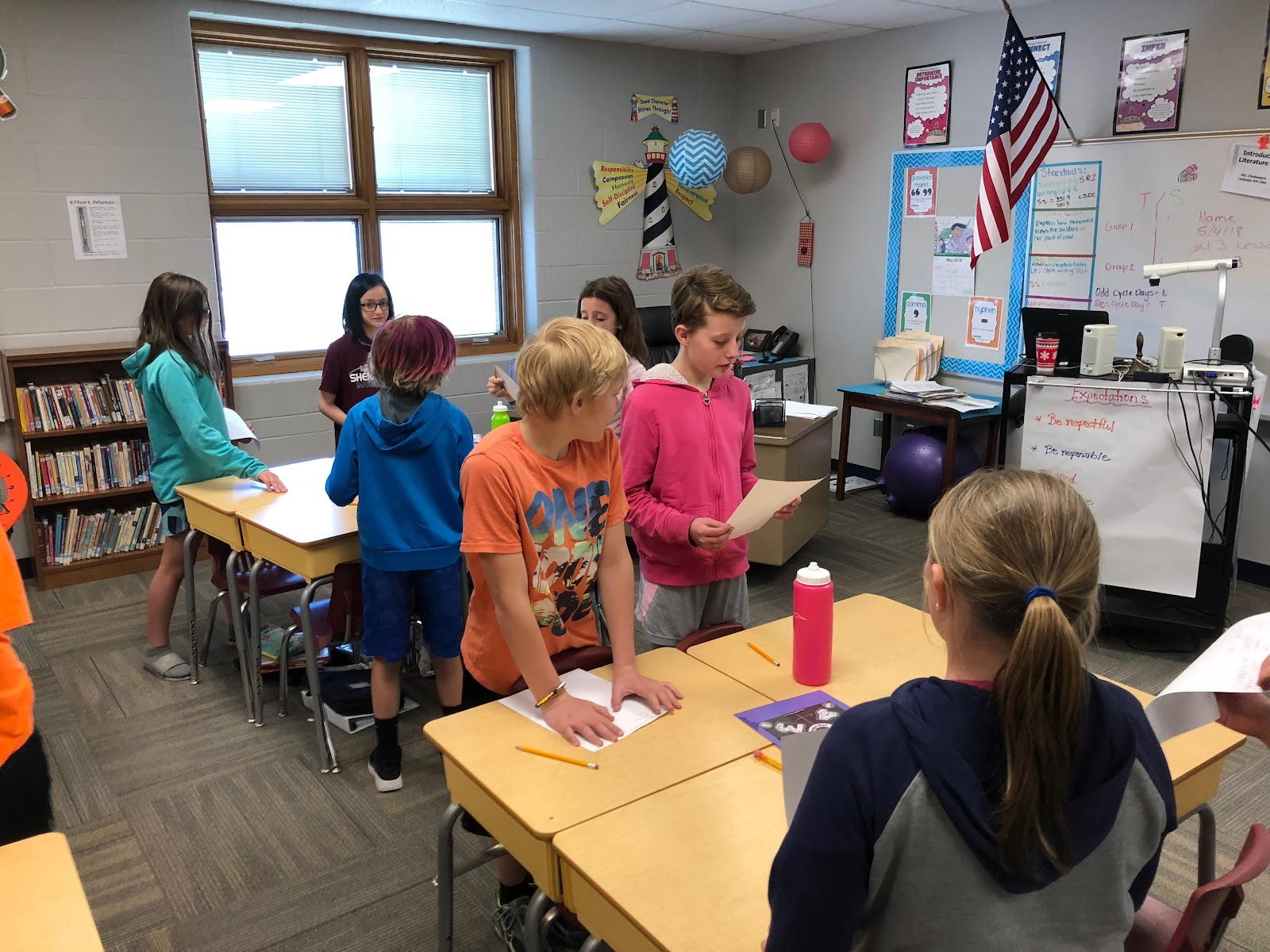
Left: Colorful Crayon Creations has this Kagan structure mat free.  

Right: Students pictured here are working in Kagan Groups. 

Their roles correspond with their numbers.


Kagan Mat Free! Click here!


3.Cognition Challenges:  As a teacher who is charged with the teaching of students with unique learning needs, Kagan can seem daunting.  It is skill upon skill that needs to be taught before groups even come close to true cooperative learning.  For this I have found that starting with simple social skills activities paired with specific structures and visuals create better successes. Think about some of our SEL lessons where we practice celebrating and sharing as individuals.  A simple practice of “Find Someone Who…” is a fun way to practice communication skills (click the link below for the resource from True Little Teacher on TPT).  I would initially have students practice this while seated with a “Face Partner,” but would work towards having students walk and find a friend within a specified area of the classroom (painters tape on the floor is fantastic for setting visual boundaries).
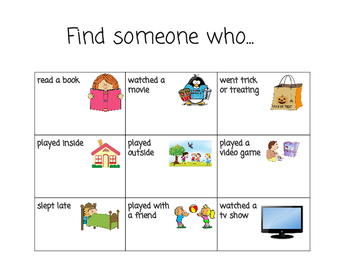
Someone Who Kagan Resource for Unique Learners


Other additional resources for Kagan really have to do with setting expectations and teaching the specific structures.  What does expected cooperative learning look like?  While Kagan uses structures and processes to facilitate learning, it prefers the flexibility of original thought. Afterall, it is the purpose is critical thinking.  However, for learners with higher levels of challenge, processes and expectations need to be specifically outlined for them. To facilitate this I have created a special resource.

Click Here for Adapted Kagan Strategies, Free!!


Being on the look out for what is working (or not) and why is second nature to educators. Simple adjustments will ensure the positive impact of both social and academic learning with Kagan. Until next time, wishing you lots of cooperative learning joy!!


Like what you read? Join me in upcoming blog posts where I continue to put these strategies into place and share resources!


Kagan, S., & Kagan, M. (2015) Kagan Cooperative Learning. Kagan Publishing.

Saturday, November 27, 2021

Common Core and Math: Running to the Win with RUNNS

 By Heather Pfrunder, M.A.Ed          SDC Teacher and Education Specialist

November 27, 2021


I can attribute my learned affection for math to the teaching formula of Eureka math: concrete objects, visual models, then representative diagrams.  Somehow in the vertical alignment of visual aids, math ceased to be a rote memorization of steps and procedures to fun puzzles to be solved.  However, I quickly found that beyond the steps of number sense for my students 100% of them stumbled to understand what to do once it came time to apply the concepts in real-world scenarios (i.e. word problems).  We would go confidently from adding using 1:1 correspondence and manipulatives, to count-on strategies, to simple algorithms, and then crash into a halted stop once it came time to apply them.  Logically, the Read, Draw, Write of what we had been doing all along should have worked - but it didn’t.  We would pull out the Eureka Math workbooks and would never get past guided practice: doe-eyed, my students would wait for me to explain the vocabulary, where to find it, and what to do with it.  I was waiting for the flicker of recognition, a spark of partial understanding that would never come - or at least never come until I adjusted my strategies. Thus it came to be, I, the lover of the written word, came to research and write my Master’s Thesis on my lesser love: Math.  


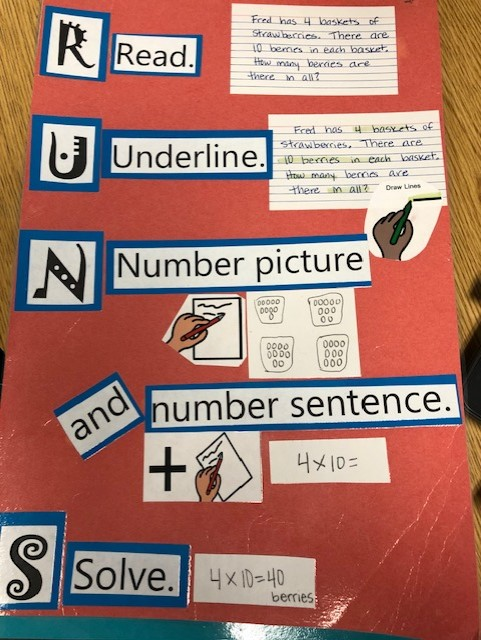
What I learned was a strategy to address the specific challenge of many of our students with language delays.  It is also the challenge that faces many of our English Language Learners.  The beautiful thing about this strategy is that it nestles quite nicely within the framework of Read, Draw, Write.  By using schema-based instruction (instruction to develop metacognition for the development of problem-solving skills through the use of mnemonics and/or visual aids/charts), my students were able to have real and lasting results.  Enter the development of my RUNNS strategy: Read, Underline, Number picture, Number sentence, Solve. While I can’t lay claim to the original idea by Rockwell, Griffin, and Jones (“RUNS… (1) Read the problem, (2) Use a diagram, (3) Number sentence, and (4) State the answer” (p. 90) , I can say that via formative assessments I found my adjustment to be far more effective with my students. 

Here is how:


 While the acronym may seem pretty self-explanatory,  

there are a few tricks to it that really make it work.


R - Read Read as in 1st read in its entirety and a 2nd read for specific chunking of info/close reading.


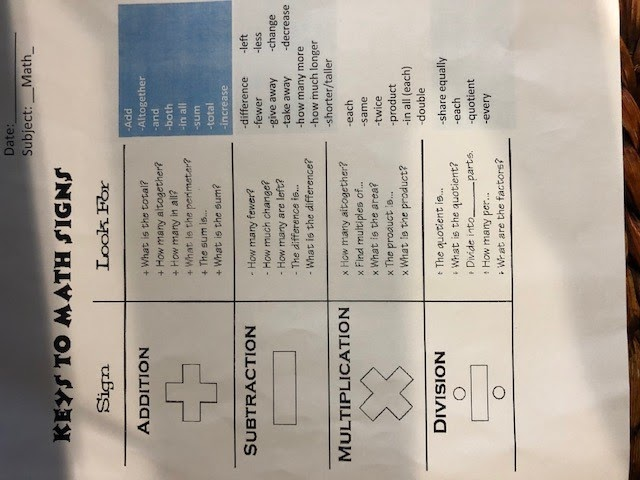
U - Underline.  Underline numbers and “special words” (i.e. "fewer, more than, each, groups, ect…") And most importantly, underline “the ASK.”  What is the question?  What are the key words there?  To know what to underline is the trick to this step.  For this I use AVID column notes for students to reference.  They find the “math words” then match them to their chart with a dry-erase marker.  By doing so, they are able to identify the function.  


While the original note/visual was shared with me from another teacher,

I found that I needed to add more to it to be reflective of

the Eureka Math questions - thus the unofficial 3rd column.


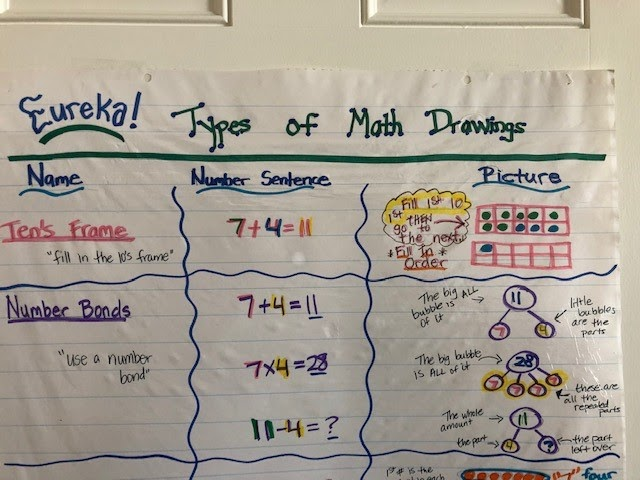
N - Number Picture.  For this I usually like to set up expectations.  It takes a while for my students to remember just what is a number bond, a tape diagram, or an array.  Knowing which picture to use can be even more challenging.  Typically, Eureka Math highlights a specific pictorial strategy in the lesson set.  Front loading students to understand the expectation is key in helping struggling and/or unique learners.


In this anchor chart I even gave examples of the Eureka Math verbiage for my 

students that require more direct examples.


N- Number Sentence.  Here we put it into place: what quantities (or use simplified verbiage to restate vocabulary “numbers”) what function do we put into place.  Tip: Vertically align the number sentence and label.  This makes the last step so much easier and keeps the train of thought connected to the word problem looking to be solved.


Numbers with their labels to make a vertical number sentence.


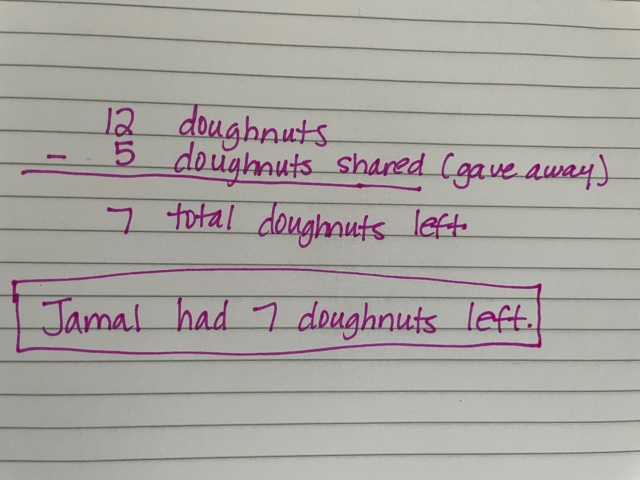
S - Solve. For this we double check, “Did we answer the ‘ASK’?”  This means making sure we have the written label.  I like to have students box their final answer - especially if there is a lot of work on the page.


And Solved it!  The answer is in a full sentence and boxed.


Whether you are struggling with a unique learner or trying to overcome sluggish student progress, this may be the solution.  Through the RUNNS strategy multiple challenges are addressed: breaking down of the “ASK” to solve, identifying key math vocabulary and their meaning, recognizing types of visuals, and putting it all together.  Like all good visual strategies, over time they needed to be faded back.  The beauty of this math strategy is that with repeated practice, students should be able to recall the specific strategy long after their graphic organizers are tucked away.  I’d love to hear if you are running to win with RUNNS!  


Common Core RUNNS Resource: Common Core Math Tools


Like what you read? Join me in upcoming blog posts where I continue to put these strategies into place and share resources!


Rockwell, S., Griffin, C., & Jones, H. (2001). Schema-based strategy instruction in mathematics and the word problem-solving performance of a student with autism. Focus on autism and other developmental disabilities. 26(2) 87-95. Doi: 10.1177/1088357611405039.

Tuesday, September 21, 2021

The Mega Task Demand: Metacognition...Oh, We are Thinking About Thinking, I Think…

 By Heather Pfrunder, M.A.Ed.   SDC Teacher and Education Specialist

September 20, 2021


It’s a mantra in my SDC classroom where I am verbally redirecting students on how to work attentively: “looking eyes, listening ears, eyes on paper, moving pencil on paper, thinking about your work,...no, try first then I can help you”...and repeat. And repeat.  I should auto-record myself, make a playlist, and hit the numbered response.  Ew, that last thought was not so stellar. But hey, in my humanness, it snuck in there.  And if you have ever taught students with metacognition challenges maybe you, too, have winced over such a thought.  So, I must ask myself: Am I really teaching thinking about thinking?  When I started this article, I was pretty sure the answer was, “Yes!  Graphic organizers and I are friends!” I can do amazing things with BoardMaker!” [For my Gen Ed teacher friends, this is a program where you create learning tools with picture icons matched with words for visual learners]. But here’s the thing about writing, you really have to research and self-reflect.  So, I’ve come face-to-face with this large mental image of a K-W-L chart.  So let’s break it down:


What we know is that metacognition in its simplest form is simply an “awareness or analysis of one's own learning or thinking processes”  (thank you Merriam-Webster).  For students with sensory processing issues, I find that often they want to focus on their own little inner worlds to find that slice of happiness, bringing them back to the uncomfortable reality of learning challenges can feel like stopping a tsunami from the shoreline.  


What we want to know is how to make this relevant for our a-typical students. 


What I learned is:

 1.) “Assign explicit instruction that addresses not just what you are learning, but how you are learning.” 

However, applying it to a lesson for an a-typical learner, often this means a visual model, a check-list of expectations, and repeat practice. Which is great (and essential for many of our visual learners with cognitive delays), but it may not be self-reflective. Instead what we often find is cognitively passive behaviors: “I counted the dots (TouchMath) and wrote the answer, I earned my tokens (my class reward system), got my i-Pad time (SDC earned time with a favorite item - the i-Pad)…”  So often it feels like a compliance check -- not actual thinking about thinking.  Learning this way is gradual, but for our non-verbal learners visual checklists of looking between the cue and the task is not merely to complete the task, but to “regulate performance and verify accuracy” through “self-monitoring” and to “signal task completion.” (Richie, G. 2005). So to be effective metacognition tools our lists cannot just be generalities, but more specific with careful thought about the actual thought process required to learn a task.


This is one of my more general in-task directions for functional skills.  

Relevant, but not specific to meta-cognition.


2.) They must be taught the concept and its language explicitly.”

This, I believe, is the golden ticket.  If it is connected to previous skills and taught over time

we can get students thinking about what they understood or didn’t.  Not just a simple exit ticket,

but “What did I understand?” and “What doesn’t make sense?”  


Examples of this:

  • “I answered the question by finding the key words in the question and underlining my text evidence”

  • “I decoded while reading”

  • “I recognized story sequence”

  • “I counted all”

  • “I regrouped”


Yup, those “I Can…” statements attached to those state standards.  However, we explicitly reflect “I did” or “I did NOT” understand.  Now we have active participants in the meta-cognition process.


When I go back into my previous check lists, they are still pretty relevant for functional skills.  However, I am looking forward to continuing on looking at objectives and having my students exit by answering self-reflection learning questions (for that last token on their token boards).  And rather than reinvent the wheel, I am going to initially have my students reference the anchor charts at my centers to reflect on their learning. 


This is a how-to process visual, but not totally self-reflective. 
I will have to add a process to this.


This is great for setting expectations, but not specific meta-cognition.


This is much better for explicitly teaching the learning process!


This anchor chart has the thinking process and the self-reflection embedded into it.


 I am looking to really celebrate learning!  And just maybe, it will be my students sayinglooking eyes, listening ears, eyes on paper, moving pencil on paper, thinking about my work, try it first…”


********************************


Join me in upcoming blog posts where I put these strategies into place and share resources!


References:


Chick, N. (2013). Metacognition. Vanderbilt University Center for Teaching. Retrieved 9/20/2021 from https://cft.vanderbilt.edu/guides-sub-pages/metacognition/.


Richie, G. (2005). Two Interventions that enhance the metacognition of students with disabilities: Cognitive Cue Cards and Correspondence Training.  Retrieved from: https://files.eric.ed.gov/fulltext/EJ914572.pdf


Most Viewed Posts