Showing posts with label Common Core Math. Show all posts

Saturday, November 27, 2021

Common Core and Math: Running to the Win with RUNNS

 By Heather Pfrunder, M.A.Ed          SDC Teacher and Education Specialist

November 27, 2021


I can attribute my learned affection for math to the teaching formula of Eureka math: concrete objects, visual models, then representative diagrams.  Somehow in the vertical alignment of visual aids, math ceased to be a rote memorization of steps and procedures to fun puzzles to be solved.  However, I quickly found that beyond the steps of number sense for my students 100% of them stumbled to understand what to do once it came time to apply the concepts in real-world scenarios (i.e. word problems).  We would go confidently from adding using 1:1 correspondence and manipulatives, to count-on strategies, to simple algorithms, and then crash into a halted stop once it came time to apply them.  Logically, the Read, Draw, Write of what we had been doing all along should have worked - but it didn’t.  We would pull out the Eureka Math workbooks and would never get past guided practice: doe-eyed, my students would wait for me to explain the vocabulary, where to find it, and what to do with it.  I was waiting for the flicker of recognition, a spark of partial understanding that would never come - or at least never come until I adjusted my strategies. Thus it came to be, I, the lover of the written word, came to research and write my Master’s Thesis on my lesser love: Math.  


What I learned was a strategy to address the specific challenge of many of our students with language delays.  It is also the challenge that faces many of our English Language Learners.  The beautiful thing about this strategy is that it nestles quite nicely within the framework of Read, Draw, Write.  By using schema-based instruction (instruction to develop metacognition for the development of problem-solving skills through the use of mnemonics and/or visual aids/charts), my students were able to have real and lasting results.  Enter the development of my RUNNS strategy: Read, Underline, Number picture, Number sentence, Solve. While I can’t lay claim to the original idea by Rockwell, Griffin, and Jones (“RUNS… (1) Read the problem, (2) Use a diagram, (3) Number sentence, and (4) State the answer” (p. 90) , I can say that via formative assessments I found my adjustment to be far more effective with my students. 

Here is how:
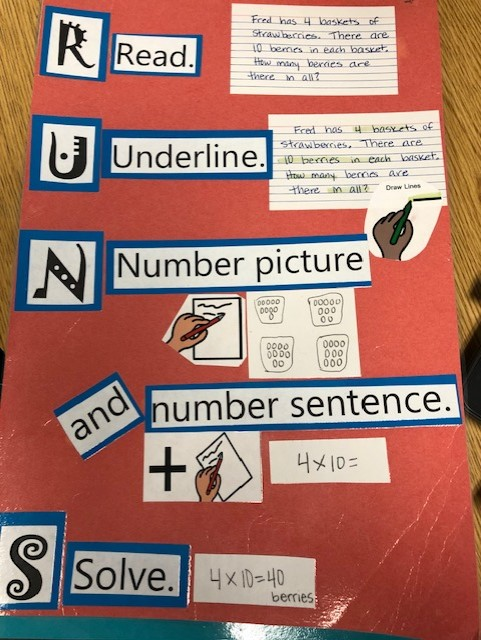


 While the acronym may seem pretty self-explanatory,  

there are a few tricks to it that really make it work.


R - Read Read as in 1st read in its entirety and a 2nd read for specific chunking of info/close reading.


U - Underline.  Underline numbers and “special words” (i.e. "fewer, more than, each, groups, ect…") And most importantly, underline “the ASK.”  What is the question?  What are the key words there?  To know what to underline is the trick to this step.  For this I use AVID column notes for students to reference.  They find the “math words” then match them to their chart with a dry-erase marker.  By doing so, they are able to identify the function.  
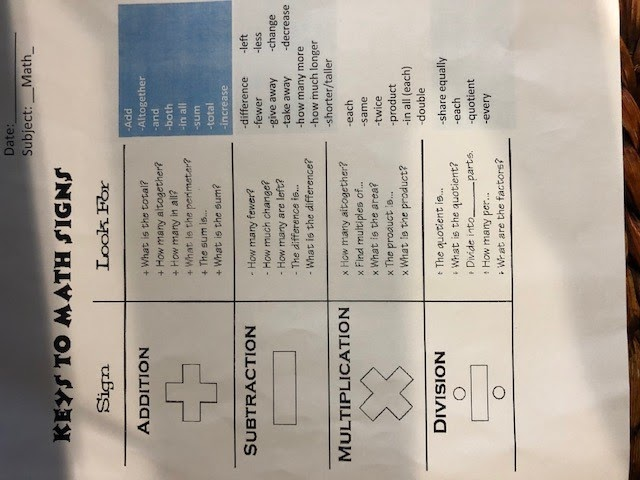


While the original note/visual was shared with me from another teacher,

I found that I needed to add more to it to be reflective of

the Eureka Math questions - thus the unofficial 3rd column.


N - Number Picture.  For this I usually like to set up expectations.  It takes a while for my students to remember just what is a number bond, a tape diagram, or an array.  Knowing which picture to use can be even more challenging.  Typically, Eureka Math highlights a specific pictorial strategy in the lesson set.  Front loading students to understand the expectation is key in helping struggling and/or unique learners.
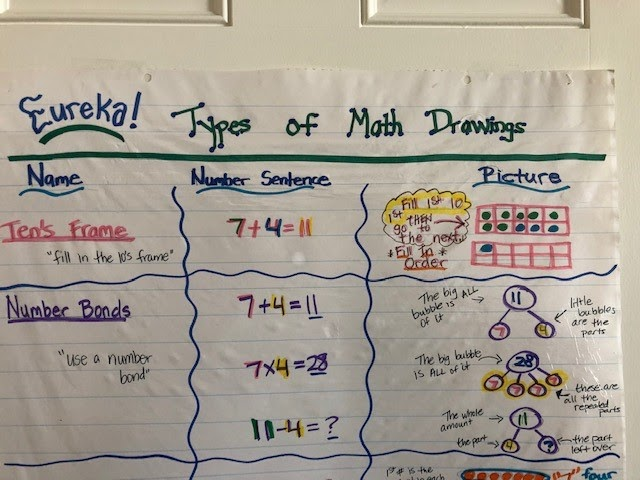


In this anchor chart I even gave examples of the Eureka Math verbiage for my 

students that require more direct examples.


N- Number Sentence.  Here we put it into place: what quantities (or use simplified verbiage to restate vocabulary “numbers”) what function do we put into place.  Tip: Vertically align the number sentence and label.  This makes the last step so much easier and keeps the train of thought connected to the word problem looking to be solved.


Numbers with their labels to make a vertical number sentence.


S - Solve. For this we double check, “Did we answer the ‘ASK’?”  This means making sure we have the written label.  I like to have students box their final answer - especially if there is a lot of work on the page.
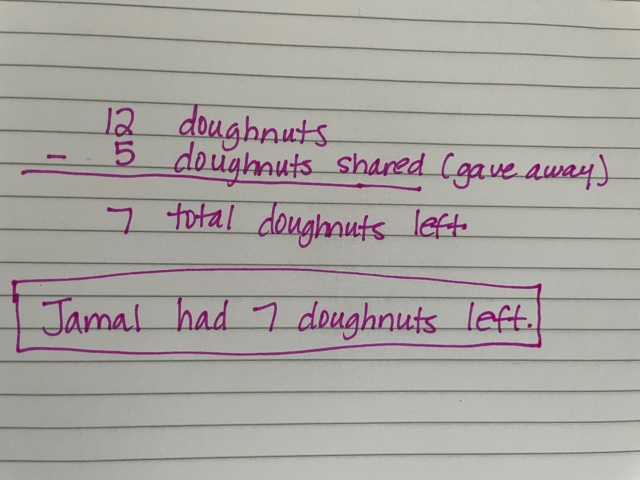

And Solved it!  The answer is in a full sentence and boxed.


Whether you are struggling with a unique learner or trying to overcome sluggish student progress, this may be the solution.  Through the RUNNS strategy multiple challenges are addressed: breaking down of the “ASK” to solve, identifying key math vocabulary and their meaning, recognizing types of visuals, and putting it all together.  Like all good visual strategies, over time they needed to be faded back.  The beauty of this math strategy is that with repeated practice, students should be able to recall the specific strategy long after their graphic organizers are tucked away.  I’d love to hear if you are running to win with RUNNS!  


Common Core RUNNS Resource: Common Core Math Tools


Like what you read? Join me in upcoming blog posts where I continue to put these strategies into place and share resources!


Rockwell, S., Griffin, C., & Jones, H. (2001). Schema-based strategy instruction in mathematics and the word problem-solving performance of a student with autism. Focus on autism and other developmental disabilities. 26(2) 87-95. Doi: 10.1177/1088357611405039.

Thursday, November 7, 2019

Integrating Visuals in Order to Build Connections in Math

"Numbers, Pictures, Words!" I am a broken record as I walk around the room and gently remind students that when completing word problems, they should have all of these three criteria by using the Read Draw Write process. As we all know, if students can use the skill successfully in a word problem, chances are they have mastered it. In 6th grade, I have come to realize, few lessons introduce a new concept without a word problem or two, so as I collect their exit tickets or tests, I am looking for these three criteria. I expect students to struggle, but the part that amazes me is what the struggle is. Some students complete the problem correctly, but their picture does not match their numeric solution. Others provided a perfect model with an inaccurate and illogical answer. The worst scenario is when they all seem to get it just to present you with wide eyes the next day when you give them a similar problem to the day before! *Cue sad music here*. Students haven't internalized the connection between their pictures and numbers, which leads to difficulty when they are trying to provide reasonableness to their answer. Is this important? Yes, because as well all know, it wouldn't be Eureka or common core if it didn't have a picture or strategy when teaching a skill. The great thing is that the solution requires 1 question and some old fashion color coding! 
                
                                                                                
                                                                               I see it!!! Can't you??
When I look at our program, I am thankful that we teach multiple methods and models to assist our students in their understanding of something as simple as addition. Models were something I wish I had growing up. As a visual learner, multi-step word problems were tricky if I was unable to picture it. I still remember the problems that sounded like this "Now Jerry lives 3. 8 miles from school and 2.6 miles from his house lives Sherry in the opposite direction. Jack can travel to the school and back in 8.6 miles. If they walked to school tomorrow, how many miles would they walk all together to arrive to school? So there I was, drawing squares to represent buildings and arrows to represent paths to their destination. Most students today could solve this problem with three simple tape diagrams and a few labels. So why the disconnect? After countless examples of a problem side by side with a tape diagram/model, they still didn't see it!  So I did what I do best when I want things to stand out--I color-coded, and the students helped me. When you make the students find the connection, they are more likely to see it and internalize it on their own. 


Bridging the GAP and making the connection
Incorporating this strategy can be completed or every lesson. The following steps to incorporating this into your lesso is simple. This is how I embed it into my daily lesson. 
1. Complete problem with your picture and your drawing. 

2. Once your model is side by side with its corresponding drawing, you break up the equation and ask students to connect it to their picture by using the following stems using my example.
          "I see 45 in my equation, but where do I see it in my picture/model?" 

3. Have students look at the picture and tell me once they see the 45. Once they have done this I color code them the same color-in the example it is represented in pink. 

4. I continue this process with all the pieces within the equation. "I see 3/4 as my divisor, where do you see it in my picture?" and then color code it--in the example it is represented in blue. 

5. I continue this process with the answer of my problem. " I see 60 as my quotient, where do you see it within my picture?"

6. Now lets look at my answer and see if based on my picture if it logically makes sense. During this time I discuss that the whole tape is bigger than the 45 which makes sense because it is only 3/4 of the tape and 15 + 15+ 15+ 15= 60. 

7. Once we have completed this together then I reveal my overall anchor chart for that lesson that have the same colors. I then leave this up throughout the entire lesson for students to refer to. You can complete this on any following problems and that way throughout the entire lesson you are building that connection. 

8. In my class I wll have students complete a seperate problem color coding their work OR provide them with a copy of my anchor chart that we colored together to glue in. Students can continue to refer to it as the module progresses. 

I have seen a big change in my students when they are required to make connections between their numbers and pictures. This is a valueable tool that not only allows for class discussion and reasonableness. 


                                                                  Lively Teaching, 


Jessica Magana

Tuesday, April 3, 2018

Let's Talk About... Math Standards!

Let’s Talk About Math Standards!


You have your Eureka TE, your district pacing guide, and your boxes of student materials- you’re ready to teach math!  But, are you ready to meet your students where they are at mathematically? 


Unless you’ve taught consecutive grade levels in the last few years since we adopted the Common Core Standards, or really studied the mathematics progressions, you may not know exactly what your students are supposed to be coming to you with.  We assume that our curriculum starts where the previous grade levels’ curriculum left off, and it does.  But can we say the same of our students’ learning?


Each year I feel like I start teaching a math concept, and when students are staring at me with blank faces, I start questioning.  “Remember last year when you learned…”  “Wait, did you learn this last year?”  (To myself, “Were they supposed to learn this last year or am I thinking of what I taught last year?”)  How do you know what they were supposed to be taught?  Enter, Achieve the Core written by Student Achievement Partners.  They are a nonprofit group whose mission it is to help teachers implement college- and career-ready standards, including the Common Core.  They have all kinds of curriculum resources for ELA and Math, but the Coherence Map is AMAZING!

First, watch

THIS VIDEO where I will walk you through some of the great things about it!  Then visit the Achieve the Core Coherence Map HERE and explore your grade level.  Remember to bookmark it, you’ll come back again and again!

The standards boxes are helpful in many ways, but I'd like to highlight two of them.  The first is that I can see what exactly my students are supposed to learn this year, and how critical that standard is to my overall year.  Secondly, if my students are struggling with a standard, I can use my Nancy Drew sleuthing skills to trace it back and see what the underlying concepts are, and where exactly the breakdown is happening. Mystery solved!

I hope you get a chance to really explore this resource, and I hope you fall as deeply in love with it as I am!  Please check it out and leave a comment below with your thoughts.  Need help?  My email is below.  Want to see math in person? Come in for a Spotlight Visit!  I’d love to meet you. 


Mathematically yours,

Sabrina Blake


Wednesday, March 21, 2018

Let's Talk About Math Intervention, Part 3

Let’s Talk About MATH INTERVENTION, Part 3!


Hi again, thanks for coming back to the final post in this 3-part series.  Over the last two posts, we’ve discussed WHY we need between-the-bells math intervention, and HOW we can structure our math block to deliver it.  Here let’s address WHAT materials we could use to best benefit our students. 


Finding what you’re going to use during intervention is actually the easiest part, and it’s probably in your classroom already!  As I said before, Math isn’t working for some of our students and that we need to mix it up and try something different, find a different way to teach what they need.


If I were a primary-grades teacher and wanting to implement this intervention style in my class, here is what I would do.  If our adopted materials have been used in both instruction and reteaching, and my students were still unsuccessful, I’d find another way to teach it- I’d go outside of the program.  This doesn’t mean go willy-nilly online purchasing items on Teachers Pay Teachers or at the local school supply store- I will not back you up on that and your administration probably won’t, either.  Let me be crystal clear- it requires very purposeful selection of materials based on the needs of your particular students. 

Maybe I have a game my students used to play from our previous adoption that did a great job at helping students understand this concept.  Perhaps someone on my team has a resource they used to use that was very successful.  I may go down a grade level or two in Eureka resources and use a strategy they missed or weren’t ready for when it was taught in that grade like fact families using number bonds or tape diagrams.  I might have them on the computer or iPad working on assigned content in Zearn, Khan Academy, iXL, or MobyMax.  If you have a parent helper you trust with a small group, put them to good use and have them work with that group!  Kindergarten, now that you’re full-day, you have helpers.  My fingers are crossed for you that they are AWESOME and you can have them pull a small group here!  Maybe they’re using Wikki-Stix to make numbers or create triangles.  Maybe they are making a collage to show the number 5. 

In the case of my upper-grade kiddos, they needed primary concepts.  Middle school teachers, you can probably relate to this as well.  For these guys, I gave a lot of thought to how I was going to reach big kid-learners with little-kid concepts without them feeling like little kids.  Would the teddy bear counters be too “babyish?”  Would kids feel like I was being condescending and not want to participate, even though they desperately needed it?  I knew I wasn’t going to go to an algorithm or shortcut, which would be the equivalent of putting a band-aid on a gunshot wound.  It may help for a little while, but it’s not a permanent fix.  I could go back in Eureka math and see how these concepts are taught now.  In the case of this year’s class, I decided that wasn’t going to be my best option so I chose to work with concrete items and other resources I know to be successful.  I pulled the Marcy Cook tiles and cards out and dusted them off.  I grabbed my Kim Sutton books and found opportunities for student learning.  I dug out the Greg Tang pack from the last math adoption and found great stuff that would help.  I pulled out my bins of base-ten blocks.  I looked through my John Van de Walle books for strategies to use in addition to the ones taught in Eureka.  I signed the students up in Khan Academy and found lessons each individual needed to work on.  And, I’m still adding to my repertoire in response to what my students are showing me they need.


All the while, my on-level and above-level students are having their needs met as well.   In their centers or on their must-do/may-do list, they may be working on problems from the problem set that are higher level DOK questions.  They’re playing a game that is extending their learning.  They’re in a media station on iXL practicing content.  They’re creating anchor charts or posters to show their understanding of the concept.  Perhaps instead of a must-do/may-do list, they have a menu for the week, incorporating choice and novelty into their math time.  They’re not doing more, they’re doing different.  Click HERE for a list of materials I've used. Please check with your administration to make sure they would support you in using these materials before starting out.


So, those are my thoughts about achieving a between-the-bells math intervention through small group instruction in the general-ed math classroom, for now.  I know I didn’t touch on everything, and this isn’t the end of this conversation, but it is the end of this trio of posts.  :)  I do believe this is a serious situation that needs to be addressed above and beyond the classroom level, but you starting it is a step in the right direction.  Is taking something like this on overwhelming?  Absolutely.  I’ve been planning on doing a version of Guided Math for awhile now.  My advice is to start slow!  One day a week or every two weeks.  But I implore you to consider it and start, and here’s my passionate plea in the name of equity.    
As a society, we value being able to read and write, hence the push for literacy.  We do RTI for reading, we have workshops for parents on how to help their children with reading, there are TV and radio commercials about the importance of reading with children.  At the same time though, not being a “math person” or not being good at math is acceptable in our society.  We aren’t okay with verbal illiteracy, but we are okay with math illiteracy?  By not offering an intervention in math during the school day, are we okay-ing failure in math?  Building in time for math intervention should be a priority in our schools to start eliminating this double standard.

If you try any of these ideas out, or come up with your own even cooler ones, I would seriously love to hear how it’s working out! The good, the bad, the ugly, I want to know.  Comment below and keep us in the loop!  Need help?  I’m here, my email is at the bottom.  Want to see my math block while guided math is happening?  Schedule a Spotlight visit, I’d love to meet you and be a part of your journey. 


Mathematically yours,
Sabrina Blake

sabrina.blake@omsd.net

Sabpic.jpg


Tuesday, March 13, 2018

Combine Kagan & Math! by Kimberly Smith


Combine Kagan & Math!


When I was a student, one of the things I loved most about school was the fact that it was fun!  Now that I’m a teacher, I know how difficult it can be to make things “fun” while also trying to keep up with the rigorous pacing, especially in math. One of the easiest ways to spice up content is to try a Kagan cooperative learning structure or two!

Using cooperative learning structures in your class will not only make the content more exciting, it will also get your kids to become more engaged.  Why is this, you may ask? Well, your students don’t really have a choice because one hundred percent of your students will be participating!

Because my students have been practicing certain Kagan structures for so long, they are very well versed in how to work with teams or partners.  They know how to mix around the room without being disrespectful, and they know how to form groups quickly without wasting precious time. I’ve heard many teachers say things like, “My classroom gets too loud using cooperative learning structures” or, “My students can’t handle it.”  As much as I understand what it’s like to have a rough class (I’ve been there before), I sincerely believe that any class can handle using the structures as long as you are very deliberate in teaching the do’s and don’ts of each one.

“Practice does not make perfect.  Only perfect practice makes perfect.”
--Vince Lombardi
Modeling how a certain structure should look and how it should not look is a great place to start when teaching a new Kagan structure.  I start teaching new structures on the first day of school, and I never really stop throughout the year. Ask for a volunteer in the class to be your partner and model the wrong way, (I do this in a funny, obvious way) and then model the right way.

During math time, I definitely have my go-to structures.  When you have go-to’s that are easy and quick to use, they’ll be a lot easier to throw into your lessons.  One way to make things less overwhelming is to categorize your favorite structures. For me, I like to separate structures which involve getting up, from structures in which kids remain seated.  Then, I also separate structures which ask for partners, from structures which involve group work. Of course, there are even some structures which are considered whole group. Here are my favorites to use during math time, separated by category:

Seated Structures:

Partner- RallyRobin, RallyCoach, Timed-Pair-Share, Think-Pair-Share
Group- RoundRobin/All-Write-RoundRobin, Talking Chips, Numbered Heads Together (involves standing at the end), Jot Thoughts
Whole Group- Showdown

My go-to’s for seated partner structures:

When solving math problems which involve a process, or several steps, I love to use RallyRobin and RallyCoach.  I usually give partnerships a choice of which strategy they’d like to use. With RallyRobin, partners ping-pong back and forth each solving a step in the math process.  With RallyCoach, one student coaches the other student through the process of solving a problem. Then, when finished, they switch roles, and the other student now gets to be the coach/teacher.  To involve more verbalization of the steps, I have either the “student” or “coach” explain every single step they’re performing, focusing on academic vocabulary.
Another fun add-on to RallyRobin is teacher vs students RallyRobin.  Let’s say I ask students to name prime numbers. I might name a prime number first, and then call on a student with a hand raised to name a different prime.  This back and forth game goes on as long as you’d like as you call on different students to compete against you. The kids have a lot of fun with it because it becomes a challenge as they try to stump the teacher.

My go-to seated structures:
Roundrobin is such an easy structure to use in any subject.  It’s great for discussions or to discuss processes because every student in the group gets a chance to share something.  Each student in the class is held accountable for participating. It’s as easy as putting kids in groups, giving them a discussion starter or problem to discuss, and then saying, “Person 2, please begin.” All-Write-RoundRobin is the same structure except all students are jotting down whatever they're working on. For example, if students are finding the area of a triangle, the first student might share that all students should write down the formula. Therefore, all students write down the formula on their papers.

Talking Chips does the same thing as RoundRobin, but it doesn’t put students on the spot as much since they must put a “chip” in, in order to speak.  However, students must share at some point since the other kids can’t share again until all chips have been put in the middle.

Numbered Heads Together is fun because students share in a group either via RoundRobin or Talking Chips, but then one member of a group is called on to share what was discussed.  For example, you can pull up the Smartboard dice, and if it lands on 3, then person 3 from each group must stand up. Then, you roll the dice again, and this will determine which table group will share.  For example, person 3, table 4. The kids love this structure because it feels like a game, and it’s totally random, so all must pay attention. What’s not to love? :)

Whole Group:
Showdown is appealing to the kids because they get to use whiteboards (you can also use paper).  We use Showdown in conjunction with Eureka's Rapid White Board Exchanges. All you do is list something on the board for students to solve.  Students solve on whiteboards and then turn boards over to let you know they’ve finished. Once you see most students have finished, you count out loud “1,2,3, SHOWDOWN!”  The students also yell out “Showdown” at the same time as they show you their answers. It’s fun and fast at the same time.

Structures Which Involve Movement:

Partner-Mix-Pair Share, Stand-Up, Hand-Up, Pair-Up, Find Someone Who, Quiz-Quiz-Trade
Group-Circle the Sage

My go-to’s for partner structures with movement:
Mix-Pair-Share is really fun for the kids because they get to walk around the room and listen to music (although you don’t have to play music).  It gives them a chance to stretch and converse with different kids. One of its cons is that partnering is at random since you tell them when to pair.  Even though partnering is random, you can still facilitate by walking around the room to listen to as many conversations as you can. I like to use this structure when my students are looking sleepy and could use a stretch break.
StandUp-HandUp-PairUp is another fun and easy to use structure.  It gets kids out of their seats but is not time-consuming whatsoever.  All you have to say is, “Stand Up, Hand Up, Pair Up with someone who is not from your table group.”  You’ll also want to make sure that you explain that this structure should be performed quicker than Mix-Pair-Share and that students should not have to walk very far to find a partner.
Circle the Sage can come in handy when introducing new content. To find out more about Circle the Sage, please click here: Circle the Sage Info

Need to make your students move faster?  Simply countdown while students are finding a partner--especially for your stragglers.  “Okay, 10 more seconds to find your partner. 10-9-8-7…” This usually does the trick.


Educating together,
Kimberly Smith Loya


Most Viewed Posts