Showing posts with label Intervention. Show all posts

Friday, January 28, 2022

Springing into Action: Maximizing Spring Growth

By Heather Pfrunder, M.A.Ed, SDC Teacher and Education Specialist

Jan 28, 2022


Post Winter Break is always the most exciting time of the year.   Students are in the FLOW of learning; all the pesky practices of getting used to the routines are out of the way and we simply get down to the business of learning.  It’s the time where we often see the bigger payouts for our efforts and strategies. It is also the time that can quickly get sandwiched between assessments and special projects.  However, careful attention to student progress monitoring can be the difference between meeting student goals/standards and leaving learning roll-over for summer school or the following fall. So, let’s get to it in three steps!  The following link is the organizer I have created for use.  Classroom Monitoring Worksheet How to use it is below.

**(Note: you will need to make your own copy of this document to edit it).


Step 1: Survey Student Skills

The first step seems the most challenging, but simply look at assessments and class work.  Summarize what you see and what you know from interacting with them.  Cover each basic aspect, where are they at? What objectives are they working on?  The sample I chose from my classroom is as follows: ELA: Phonics (or spelling), Sight Words (or Latin Roots), Reading Comprehension, and Writing.  For Math: Algorithms, Measurements & Graphs, Fractions & Decimals, Geometry, and Word Problems.  This may look different for your grade level or your teaching subject. Tweak what you need adjusted to match state standards and goals from your class/subject.


Step Two: Re-Organize Your Intervention Groups.

Students grow and their needs shift through the year.  Being responsive to that means that you are placing them in a place where they can collaboratively work and grow.  In the image above I have separated my students to look at what work I need them to accomplish.  However, knowing that some students may have difficulty interacting with particular individuals means my students will be regrouped differently despite ability - thus the penciled info!  Revisions are in progress!


Step Three: List and Review Your Resources

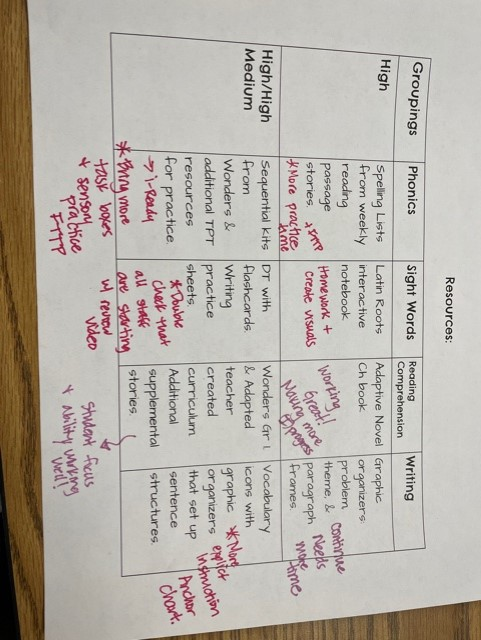
Listing out your current resources helps you to frame that every need is covered.


 The important part is reviewing what is working and what is not.  What could use more attention?  Why?  More interactive lessons?  More practice?  A different program or strategy?  Maybe time needs to be shifted to a particular skill.  Here I have added notes about more intervention time with Fast Track To Phonics, videos, revised anchor charts, homework opportunities, and notes to myself of what is working great (i.e. consistent progress at an appropriate pace). Now, it’s lesson planning time. 


Wishing you and your students AMAZING Spring Growth!!


Like what you read? Join me in upcoming blog posts where I continue to put these strategies into place and share resources!


Tuesday, April 3, 2018

Let's Talk About... Math Standards!

Let’s Talk About Math Standards!


You have your Eureka TE, your district pacing guide, and your boxes of student materials- you’re ready to teach math!  But, are you ready to meet your students where they are at mathematically? 


Unless you’ve taught consecutive grade levels in the last few years since we adopted the Common Core Standards, or really studied the mathematics progressions, you may not know exactly what your students are supposed to be coming to you with.  We assume that our curriculum starts where the previous grade levels’ curriculum left off, and it does.  But can we say the same of our students’ learning?


Each year I feel like I start teaching a math concept, and when students are staring at me with blank faces, I start questioning.  “Remember last year when you learned…”  “Wait, did you learn this last year?”  (To myself, “Were they supposed to learn this last year or am I thinking of what I taught last year?”)  How do you know what they were supposed to be taught?  Enter, Achieve the Core written by Student Achievement Partners.  They are a nonprofit group whose mission it is to help teachers implement college- and career-ready standards, including the Common Core.  They have all kinds of curriculum resources for ELA and Math, but the Coherence Map is AMAZING!

First, watch

THIS VIDEO where I will walk you through some of the great things about it!  Then visit the Achieve the Core Coherence Map HERE and explore your grade level.  Remember to bookmark it, you’ll come back again and again!

The standards boxes are helpful in many ways, but I'd like to highlight two of them.  The first is that I can see what exactly my students are supposed to learn this year, and how critical that standard is to my overall year.  Secondly, if my students are struggling with a standard, I can use my Nancy Drew sleuthing skills to trace it back and see what the underlying concepts are, and where exactly the breakdown is happening. Mystery solved!

I hope you get a chance to really explore this resource, and I hope you fall as deeply in love with it as I am!  Please check it out and leave a comment below with your thoughts.  Need help?  My email is below.  Want to see math in person? Come in for a Spotlight Visit!  I’d love to meet you. 


Mathematically yours,

Sabrina Blake


Wednesday, March 21, 2018

Let's Talk About Math Intervention, Part 3

Let’s Talk About MATH INTERVENTION, Part 3!


Hi again, thanks for coming back to the final post in this 3-part series.  Over the last two posts, we’ve discussed WHY we need between-the-bells math intervention, and HOW we can structure our math block to deliver it.  Here let’s address WHAT materials we could use to best benefit our students. 


Finding what you’re going to use during intervention is actually the easiest part, and it’s probably in your classroom already!  As I said before, Math isn’t working for some of our students and that we need to mix it up and try something different, find a different way to teach what they need.


If I were a primary-grades teacher and wanting to implement this intervention style in my class, here is what I would do.  If our adopted materials have been used in both instruction and reteaching, and my students were still unsuccessful, I’d find another way to teach it- I’d go outside of the program.  This doesn’t mean go willy-nilly online purchasing items on Teachers Pay Teachers or at the local school supply store- I will not back you up on that and your administration probably won’t, either.  Let me be crystal clear- it requires very purposeful selection of materials based on the needs of your particular students. 

Maybe I have a game my students used to play from our previous adoption that did a great job at helping students understand this concept.  Perhaps someone on my team has a resource they used to use that was very successful.  I may go down a grade level or two in Eureka resources and use a strategy they missed or weren’t ready for when it was taught in that grade like fact families using number bonds or tape diagrams.  I might have them on the computer or iPad working on assigned content in Zearn, Khan Academy, iXL, or MobyMax.  If you have a parent helper you trust with a small group, put them to good use and have them work with that group!  Kindergarten, now that you’re full-day, you have helpers.  My fingers are crossed for you that they are AWESOME and you can have them pull a small group here!  Maybe they’re using Wikki-Stix to make numbers or create triangles.  Maybe they are making a collage to show the number 5. 

In the case of my upper-grade kiddos, they needed primary concepts.  Middle school teachers, you can probably relate to this as well.  For these guys, I gave a lot of thought to how I was going to reach big kid-learners with little-kid concepts without them feeling like little kids.  Would the teddy bear counters be too “babyish?”  Would kids feel like I was being condescending and not want to participate, even though they desperately needed it?  I knew I wasn’t going to go to an algorithm or shortcut, which would be the equivalent of putting a band-aid on a gunshot wound.  It may help for a little while, but it’s not a permanent fix.  I could go back in Eureka math and see how these concepts are taught now.  In the case of this year’s class, I decided that wasn’t going to be my best option so I chose to work with concrete items and other resources I know to be successful.  I pulled the Marcy Cook tiles and cards out and dusted them off.  I grabbed my Kim Sutton books and found opportunities for student learning.  I dug out the Greg Tang pack from the last math adoption and found great stuff that would help.  I pulled out my bins of base-ten blocks.  I looked through my John Van de Walle books for strategies to use in addition to the ones taught in Eureka.  I signed the students up in Khan Academy and found lessons each individual needed to work on.  And, I’m still adding to my repertoire in response to what my students are showing me they need.


All the while, my on-level and above-level students are having their needs met as well.   In their centers or on their must-do/may-do list, they may be working on problems from the problem set that are higher level DOK questions.  They’re playing a game that is extending their learning.  They’re in a media station on iXL practicing content.  They’re creating anchor charts or posters to show their understanding of the concept.  Perhaps instead of a must-do/may-do list, they have a menu for the week, incorporating choice and novelty into their math time.  They’re not doing more, they’re doing different.  Click HERE for a list of materials I've used. Please check with your administration to make sure they would support you in using these materials before starting out.


So, those are my thoughts about achieving a between-the-bells math intervention through small group instruction in the general-ed math classroom, for now.  I know I didn’t touch on everything, and this isn’t the end of this conversation, but it is the end of this trio of posts.  :)  I do believe this is a serious situation that needs to be addressed above and beyond the classroom level, but you starting it is a step in the right direction.  Is taking something like this on overwhelming?  Absolutely.  I’ve been planning on doing a version of Guided Math for awhile now.  My advice is to start slow!  One day a week or every two weeks.  But I implore you to consider it and start, and here’s my passionate plea in the name of equity.    
As a society, we value being able to read and write, hence the push for literacy.  We do RTI for reading, we have workshops for parents on how to help their children with reading, there are TV and radio commercials about the importance of reading with children.  At the same time though, not being a “math person” or not being good at math is acceptable in our society.  We aren’t okay with verbal illiteracy, but we are okay with math illiteracy?  By not offering an intervention in math during the school day, are we okay-ing failure in math?  Building in time for math intervention should be a priority in our schools to start eliminating this double standard.

If you try any of these ideas out, or come up with your own even cooler ones, I would seriously love to hear how it’s working out! The good, the bad, the ugly, I want to know.  Comment below and keep us in the loop!  Need help?  I’m here, my email is at the bottom.  Want to see my math block while guided math is happening?  Schedule a Spotlight visit, I’d love to meet you and be a part of your journey. 


Mathematically yours,
Sabrina Blake

sabrina.blake@omsd.net

Sabpic.jpg


Friday, January 26, 2018

Math Intervention, Part 2

Let’s Talk About MATH INTERVENTION, Part 2!


In my last post, we talked about why we would need to include Math Intervention within our instructional day.  I hope you’ve given it some thought!  Here we will discuss HOW to make that idea a reality!


I understand 100% that TIME is a huge factor when planning for small group instruction in math.  There are only so many instructional minutes in the day!  Between the required minutes in the core subject areas, ELD, recess and lunch breaks, PE, what time is there that’s left?  Add to that, our math block of time is beyond packed!  There is an overabundance of stuff in Eureka to do with our students during math time, more than will even fit in our daily minutes for math.  Anyone else having a Jesse Spano moment?  Just me?  Okay, let’s carry on.  

jesse spano.jpeg

Let me start with a brief-ish outline of how I structure many of my math lessons in my 5th grade classroom in order to accomodate intervention.  I start by dividing my class into 2 smaller groups, a High & Medium-Low group and a Medium-High & Low group.  I deliver my 20-minute Concept Development lesson with one group while the other group is working in centers or a must-do/may-do list.  Then, we switch and I teach it again to the other small group.  If you’re counting, that’s about 40 minutes of my math block.  I spend the next 10 minutes working whole group on the problems I’d picked from the problem set.  As students set out to work, I start to pull the kids that are having a hard time and we work together on the problems.  After that, I have 10 minutes left in my math block to wrap up with a discussion and debrief, assuming a 60 minute math block.  I use either something suggested in the debrief section, or I go off of some misconception I’ve seen while students were working on the practice set or in small group during the lesson.  As a twist, I sometimes do a shorter debrief, but start the math block with a discussion around the Application Problem or the exit tickets from yesterday.


I’m still getting in the required parts of the Eureka lesson, just in a way that also lets me get some differentiation in not only for my below-level students, but to engage and push my higher-level and GATE students as well.  Really, it’s a win-win!
Middle School, it’s my understanding that students with unfinished learning (gaps) may be double-blocked for math.  If you don’t already, I would spend half of that time on my core content as outlined in your math program, and then reach the learners where they are at for the other time using a centers-based approach and incorporating web-based or free-app technology so they can continue the learning at home on their phones.


Why do I love teaching math in this small group format?  My super quiet kids that aren’t getting can’t hide as easily, and I can see what they need and address those needs as they arise.  My kiddos that have already got it?  I can see if they are truly understanding what they are doing.  I can slow down or speed up as the group is showing me what they understand or don't.


Above, I mentioned centers and a must-do/may-do list.  Are you curious what are students doing during that time?  My next, and final post in this series, will address WHAT I use in this differentiation.  I will give you a sneak peek though, just for sticking with me on this!  Students aren’t working on just any activities, they are differentiated ones that are easy to manage for both the teacher (we’ve got enough to do!) and the students (so they’ll be independent and let us teach!)  One of my centers is the Eureka Fluency or Sprint.  Students do that with a partner timing them or with sand timers.  Sometimes it’s differentiated where my on-level kiddos do the one suggested in the TE where my strugglers are doing a different one, like a basic fact practice one from a previous module or grade level.  Another center is sometimes the exit ticket from yesterday, checking for understanding.  Then, I differentiate further.  Tune in next time to see how!  

Sabpic.jpg
 Mathematically yours,

Sabrina Blake

sabrina.blake@omsd.net


Friday, January 12, 2018

Let's Talk About Math Intervention


Let’s Talk About MATH INTERVENTION!
Intervention.  RTI.  Whatever you call it, it’s happening every day in all of our schools.  Most of the time it’s to help our struggling readers get caught up on skills they need more time with.  What are we doing for our students who need the extra boost in math?

confused-student-girl-Getty-Images1.jpg


Students who struggle with math do so for a variety of reasons.  They may start school already behind because they don’t know their numbers or didn’t attend Kindergarten.  Maybe they lack academic support at home.  Perhaps their home lives are a mess and school is the last thing on their mind.  


Unfortunately, this describes many students sitting in our classrooms today.  And the fact of the matter is, while these situations are sad and real, we can’t control any of it.  We can only control what happens within the four walls of our classrooms.  So the question becomes, what do we do about our children who are struggling in math?  A)  Do we employ the never-effective “louder and slower” technique?  B)  Give them more problems in the practice set?  C)  Assign extra homework to do with a grown up who maybe also doesn’t understand the math?  D)  Give up and teach an algorithm/shortcut/trick to get them there?  Hint:  The answer is E, none of the above, and I hope you agree.  Math isn’t working for them, school isn’t working for them.  It’s our professional duty to mix it up and try something different.  


The different I’m talking about isn’t taking place before or after school.  We all know that some of the students that need that extra help the most, just don’t show up to those extra classes.  I’m talking about providing small group between the bells intervention during the math block you already teach.  It’s possible, I promise!  I’ve gotten creative with my math time and have managed to work it in for a majority of my instructional days. My next post will break it all down for you!  


You may be thinking, “That’s great for you, but I could never do that.  I don’t have that kind of time in my day.  I have a gigantic class.  I have a ton of behavior problems.  I don’t know how to plan for that or what resources to use.” Let’s turn that frown upside down!  Those are completely valid concerns, and I hear you.  

However, instead of focusing on why it won’t work, let’s look why it can.  Rather, why it NEEDS to.  It’s about equity.  Equity in time devoted to the core subjects, and equity provided to our learners.  If we are willing to put in the extra effort for reading by differentiating lessons and scaffolding, it’s crucial that we do the same for math.  

I suppose you’re wondering how to make this happen and manage it.  Good!  I’m happy to hear it.  Come back to my next blog post when I explain how I’ve set up my math class to make this happen!  Or, if you just can’t wait, email me and I’ll give you a preview.  Want to see this in person?  Schedule a Spotlight Visit, I’d love to meet you.  
Sabpic.jpg
Mathematically yours,
Sabrina Blake

sabrina.blake@omsd.net


Most Viewed Posts