Showing posts with label All-Write-Round-Robin. Show all posts

Thursday, December 30, 2021

Trouble-Shooting Kagan: Getting Cooperative Learning to be Cooperative

By Heather Pfrunder, M.A.Ed          SDC Teacher and Education Specialist

December 30, 2021


Watching Kagan strategies in action one can’t help but be excited at the level of student engagement.  Student responses which exude inactive reflection and minimal regurgitation transform into animated critical thinking.  The brain science and research behind Kagan strategies is impressive and exciting: it takes in account the varied ways our brain is engaged and uses structures and systems to ensure optimal learning.  Through the practice of collaborative learning, the brain simultaneously is engaged in multiple parts. The social structures form an emotionally safe learning environment, often while nourishing the brain through motion. You could spend a college semester learning all the facets to Kagan and the brain research behind each minute component for it’s cooperative learning structures. However, teachers with fledgling Kagan experience often are encouraged to simply “start with the Robins.” Kinda Techy Teachers on TPT has a great free resource to access visual explanations and how to use the top 5 Robin Structures.


 Click Here for a Free Resource!
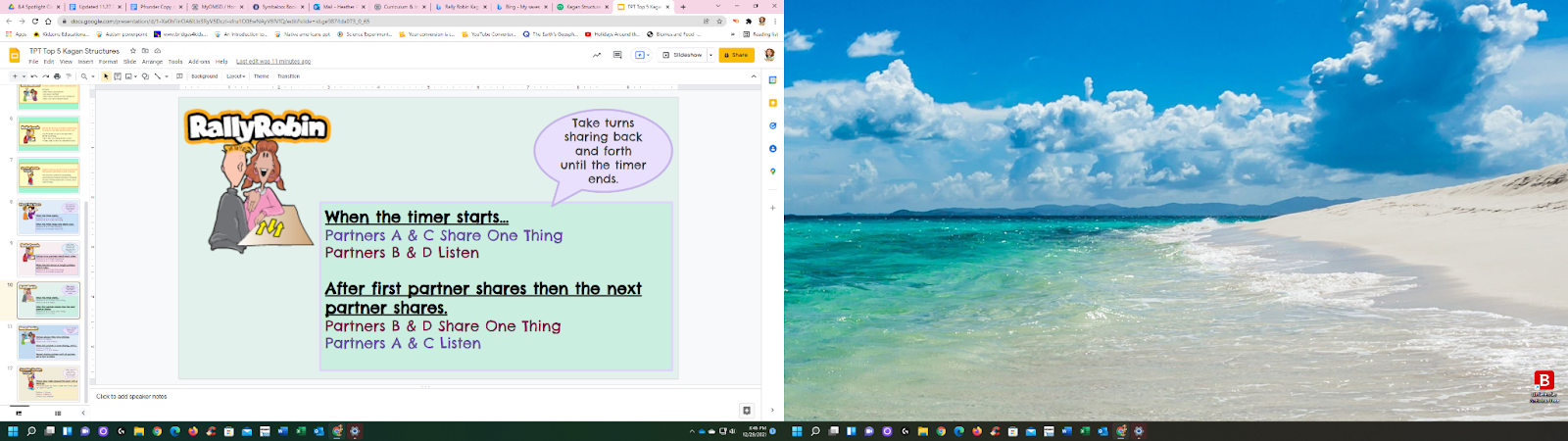

Example of a “Robin” Structure in the free TPT

Resource linked above.


This way teachers and students learn some of the basic structures and can apply them to any subject matter.  It is not the content that is being changed, rather the format of the lesson.  For many teachers the quick diagram of expectations found in the Kagan flip book is simple enough to function for many of their students.
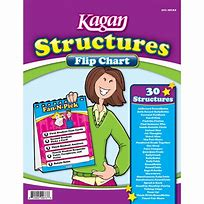


Flip Book page example.


Colleague Randi Muehlen describes many wonderful ways to implement Kagan in her post Kids Love to Talk. However, if we are teaching ALL students, and “all means all,” chances are you have had a student (or three) who are challenged to cooperatively work in cooperative learning groups. In reflection, this challenge happens for several reasons: social skill deficits, academic skill deficits, or a combination of both represented by cognition challenges. So here we go again, my teacher friends!  A list of shortcuts, tips, and printable visual aids to address Kagan challenges is headed your way!  Because honestly, the learning pay-off is so very worth it!


1.Social Skills: In trouble shooting social skills challenges (i.e. silliness, off-task behavior, bullying, shyness…) there are commonalities among strategies to address the different kinds of social skill deficits. Modeling, praise, team reflection, and purposeful team role assignments can shape mal-adaptive behaviors into behaviors that are productive and helpful team-building.  To address the needs of all students you may find yourself rotating between strategies to give all unique students a chance to exercise growth in an area of social skills development. Chapter 11 of the Kagan book outlines Social Skills challenges, solutions, and suggested structures and feedback.  Here is a condensed and shortened list of challenges and solutions for your reference:

 Kagan Social Skills Solutions. Click here!

Social skills are a major component to cooperative learning.  However, often they are a way to cover up another challenge: academic skill deficits.


2.Academic Skill Deficit: In this area there are two key take-aways to address supporting students that may need more scaffolding in order to actively participate with their peers. The first is relatively simple: do your students understand the concepts that they are learning?  Are they able to use key vocabulary in discussions?  For students with unique learning needs this may mean that they may need to use notes with how-to steps and examples or simple vocabulary sheets with visuals and/or sentence frames.  Below are some examples of content vocabulary.


Top: More descriptive vocabulary with visuals to aid in conversation

 for mid-need learners -found on TPT American Revolution Word Vocab.


Bottom: Simple sorting and matching vocabulary for collaboration activities 

for higher-need/less verbal learners - found on TPT water cycle bingo.


The second scaffold has to do with grouping and “Positive Interdependence.” (This is the “P” in the Kagan acronym “PIES” standing for Positive Interdependence, Individual Accountability, Equal Participation, and Simultaneous Interaction.)  How we set up individuals in groups can either benefit or challenge academic growth. Strong interdependence means that each member of the group is needed for the task to be completed.  This takes careful structuring of both the task instructions (ensuring that each member of the group is building on each other’s contributions) and the careful structuring of groups.  For example, the highest achieving learner typically should not be paired with the lowest achieving learner.  Instead, group your students into 4 groups: high, high-medium, medium-low, and low.  Keep teams within 1-2 levels within their range and assign roles based on strengths and/or needs.  Number and group roles or strengths within numbers 1-4, so that you can make instructional decisions which will work for both the individual and the team.  If individual growth is not happening at the rate you were hoping for and you have adjusted strategies based on challenges, it may be time to mix up groups.
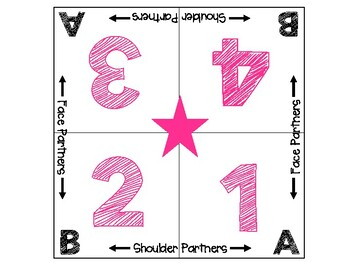
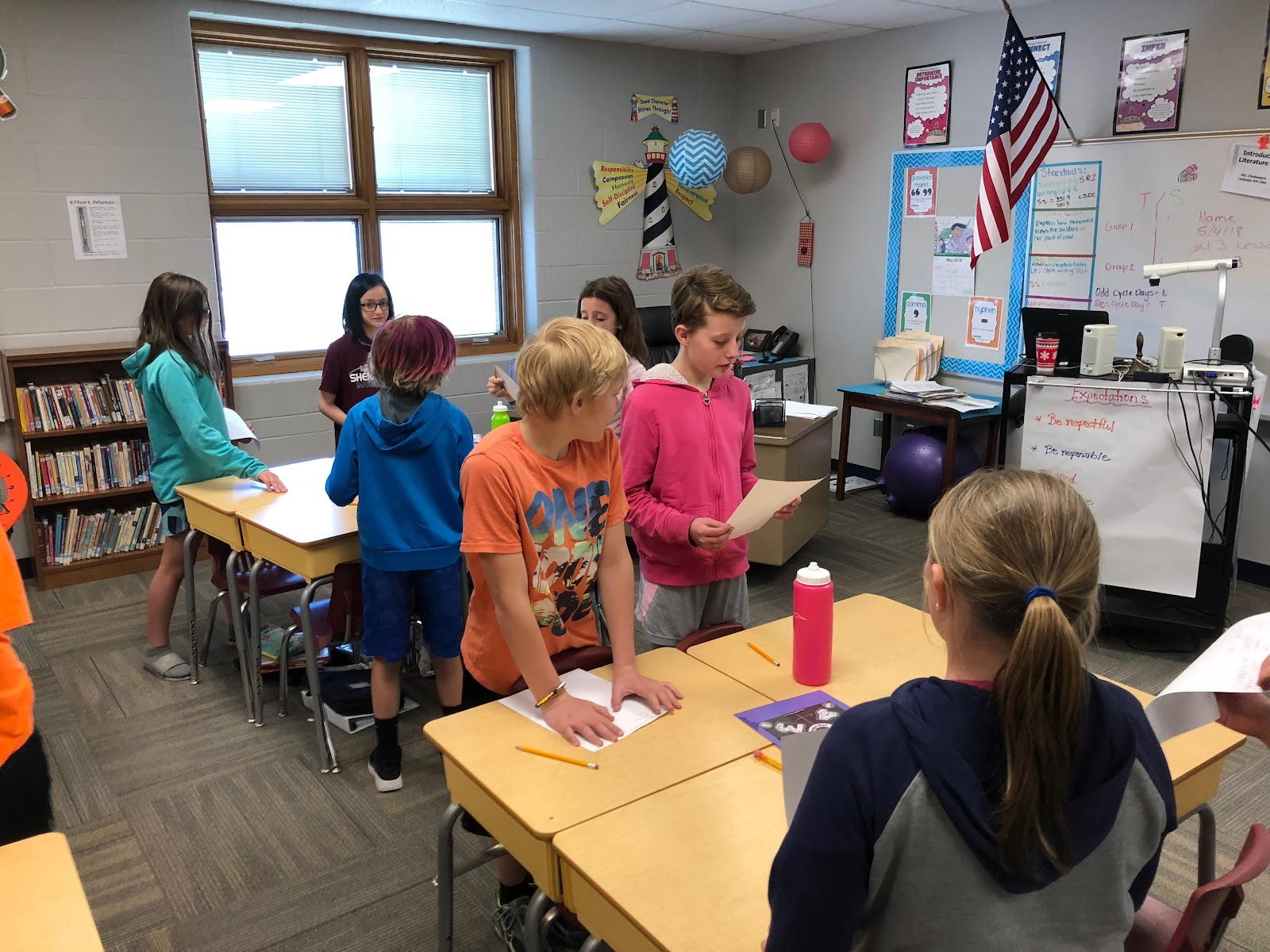
Left: Colorful Crayon Creations has this Kagan structure mat free.  

Right: Students pictured here are working in Kagan Groups. 

Their roles correspond with their numbers.


Kagan Mat Free! Click here!


3.Cognition Challenges:  As a teacher who is charged with the teaching of students with unique learning needs, Kagan can seem daunting.  It is skill upon skill that needs to be taught before groups even come close to true cooperative learning.  For this I have found that starting with simple social skills activities paired with specific structures and visuals create better successes. Think about some of our SEL lessons where we practice celebrating and sharing as individuals.  A simple practice of “Find Someone Who…” is a fun way to practice communication skills (click the link below for the resource from True Little Teacher on TPT).  I would initially have students practice this while seated with a “Face Partner,” but would work towards having students walk and find a friend within a specified area of the classroom (painters tape on the floor is fantastic for setting visual boundaries).
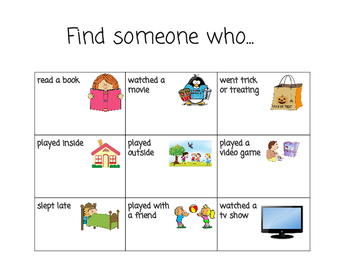
Someone Who Kagan Resource for Unique Learners


Other additional resources for Kagan really have to do with setting expectations and teaching the specific structures.  What does expected cooperative learning look like?  While Kagan uses structures and processes to facilitate learning, it prefers the flexibility of original thought. Afterall, it is the purpose is critical thinking.  However, for learners with higher levels of challenge, processes and expectations need to be specifically outlined for them. To facilitate this I have created a special resource.

Click Here for Adapted Kagan Strategies, Free!!


Being on the look out for what is working (or not) and why is second nature to educators. Simple adjustments will ensure the positive impact of both social and academic learning with Kagan. Until next time, wishing you lots of cooperative learning joy!!


Like what you read? Join me in upcoming blog posts where I continue to put these strategies into place and share resources!


Kagan, S., & Kagan, M. (2015) Kagan Cooperative Learning. Kagan Publishing.

Monday, January 22, 2018

Off to the RACES with Writing!


Off to the RACES with Writing!
I know as teachers we often feel that teaching writing can be absolutely painful at times, but it doesn’t have to be! When given a structure, students are not only successful in writing but have fun doing it! The RACES structure is intended to teach students how to write a constructed response paragraph by analyzing texts, making connections, and citing text evidence to support their reasoning. Not only is this an essential skill for students to be successful on SBAC (as they have many constructed response questions), it goes deeper than a test!  Being able to respond successfully to a constructed response prompt is also a necessary skill that focuses on student’s reasoning skills and helps them to develop and implement their own thoughts and opinions through research.  It’s a life skill!

Teaching students the RACES Writing format will not ONLY improve Writing skills but will simultaneously strengthen their reading comprehension skills as well as their ability to rationalize.  The best part: The structure is simple enough that you can implement this process TOMORROW!
When implemented correctly, the RACES format transfers across subjects successfully.  This form of Writing is not an isolated skill.  Students start to become more aware of what they’re reading and spend more time annotating the text when they know they will be writing about it.  Thus, increasing their reading comprehension skills in the process.  I also integrate many different Kagan/cooperative learning strategies throughout the writing process which really helps the students to gain a deeper understanding of the text through the power of discussion.  I have personally seen student’s constructed responses to test questions VASTLY improve after implementing this process in just over a matter of a couple of months.  I love when the students finally make the crossover from KNOWING the steps and going through the motions, to actually making connections and UNDERSTANDING  the process!❤  At this point in the year when I introduce a new prompt and tell the students we will be doing a RACES writing today, I hear “YESSSSS!” throughout the classroom.  My students have come to love writing through this process because they know they are successful and enjoy doing it!
In this video, you can see my students completing a RACES Writing constructed response through collaborative conversations.

Modeling the RACES process AND giving students the opportunity to interact with each other along the way, is a crucial contributor to seeing success with this structure.


  1. MODEL, MODEL, MODEL! It’s more than teaching students the acronym- they need to actually gain an understanding of what each component in the acronym stands for, what it looks like, and HOW to complete that task. The best way to do this is to continuously model how to do each part.
  2. Take it step by step.   Rather than modeling the entire process at once, we work on a few components at a time.  We read the prompt aloud together, discuss how to formulate the R and the A pieces, then they write them down.  As you can see in the video, after they have completed these steps, I use the Kagan All- Write-Round-Robin strategy where students go around their table group and one student at a time shares those components. As group members, they listen, give each other feedback and revise their sentences through this discussion.  My kids actually do this well, and it's really very cute to listen to them give each other feedback in a meaningful manner!
  3. Notes.  Notes are taken throughout the reading of the text (whatever the text or source may be). I usually have students organize their 2-column notes with the prompt in mind (this saves time and ensures that students are set up for success when it comes time to do the constructed response).
  4. Text evidence.  Students will then either refer to their notes or the text directly to identify 1-2 pieces of text evidence that support their answer to the prompt.  In the next part of the video, I engaged students in the Stand-Up-Hand-Up-Pair-Up (SUHUPU) Kagan strategy where they have the opportunity to share the “C” and “E” components of the RACES process.  I let them mix and share a couple of times with different partners, then have a few students share out with the group.  This also supports that modeling component by giving students the opportunity to hear and see successful models from their peers.  Upon returning to their seats they then write down those components on the planning template.
  5. Last, we discuss how to write a conclusion sentence (the “S” component), and how it closely relates to the “A”.  They complete this last step and then I guide them through peer editing.  Once this is done, they put their RACES paragraph together on the publishing paper and evaluate their own work through a quick self- assessment checklist.
Structuring the RACES writing process in this step-by-step manner ensures that students will be able to complete these steps to their own success when in a testing situation.  The consistent practice and support through collaborative discussions with their peers, myself, and the class as a whole really builds on so many different skills, and allows them to be successful!

Collaboratively Learning,
Megan Brown
megan.brown@omsd.net

Copy of pic- Megan Brown.jpg

Monday, November 6, 2017

Eureka! We’ve Struck Math Talk!


Eureka! We’ve Struck Math Talk!
Helping students be successful with Eureka Math is not an easy task (especially in the upper grades)!  It was definitely not a simple venture for us as teachers to learn how to teach Common Core with Eureka Math (we all remember that hurdle right?!) So how can we as educators, help ourselves to help our students not only BE successful in Math today, but to FEEL successful in Math today??  There’s no easy answer to this question, however, as mentioned in my last two blogs, student engagement is everything!  When we think of collaborative conversations, many of us immediately think of ELA.  Naturally, collaborative conversations in ELA provide vast opportunities for collaborative talk and lends itself to helping students achieve a level of thinking at a Depth of knowledge 3 and 4 (as you've seen in my last two blogs). However, these same results can be achieved when you incorporate these academic discussions during Math as well.  Not to mention the added powerful benefit to the students’ learning through their collaboration with one another!


Here are some video clips of my students participating in a variation of the "All-Write-Round-Robin" Kagan strategy.  Where each group of 4 was assigned a math problem.  The students within each group first worked the problem out individually.  Then took turns sharing out in their group explaining how they solved the problem, the steps they took, etc.  The group then discusses and decides together on the “best” way to solve the problem and writes out a solution as a group.


"Students who are inattentive, withdrawn, and disengaged in the classroom have poorer academic performance when compared to engaged students."
-Kathy Dyer, NWEA


So how do you get your students to have productive and effective conversations during Math, that contribute to their success?? Here, you will see how effortless it can be to implement collaborative conversations via Kagan engagement strategies in Eureka Math- WITHOUT taking away any additional instructional time!


There’s not many things more satisfying as a teacher than when you model good teaching strategies for your students, and then watch them apply these same strategies when working with their peers.  I have watched my students stumble upon so many “ah-ha” moments, where they catch and learn from their mistakes when engaging in the Rally-Coach Kagan structure.  This is the deeper level of learning we see when  students are responsible for sharing their learning, learning from their peers, and collaborating with one another. This deeper level of learning and thinking has become very evident as I watch my students engage in the Rally-Coach Kagan strategy on a daily basis.

Below you will see clips of my students utilizing this strategy during Math to “teach” one another.  This strategy involves only minimal amounts of time to “train” the kids to do this properly, and ZERO prep for the teacher, yet yields amazing progress and growth among the students.  That’s what I call a “win-win!!”


“Tell me and I forget.  Teach me and I remember.  Involve me and I learn.” -Benjamin Franklin


Here my students are engaging in the Rally-Robin Kagan strategy.  This is where the students have a designated amount of time that I give them (usually 60 seconds, or sometimes no time limit at all) where they have to take turns going back and forth with their partner, each sharing a different answer to the question I posed.  I tell the kids to think of it as being like a “ping-pong ball" going back and forth!  Here, I displayed the Eureka Math “warm-up” activity for that days lesson which required them to skip- count by 2s, 3s, 4s, 5s, and 6s to a designated number, both counting forwards and backwards. They absolutely LOVE doing this!


Get started implementing collaborative conversations and engagement activities in Math today! Here are some simple steps to take:


  1. Start implementing the Kagan Rally-Robin (ping-pong ball) strategy for the “warm-ups” portion of Eureka Math (as seen in the third video).  This is easy to do, requires no prep on your part, and the kids love it!  Display the warm-up question(s), let them know which partner will be starting (A or B), set the timer and let them go! Easy and engaging! As soon as I tell the kids we will be doing Rally-Robin they ALL turn to each other and whisper "YESSSSS!" They love it!


  1. Have students work in Rally-Coach (Kagan) pairs for designated portions of the Problem Set (as seen in the second video).  This ensures that no kiddos are left completely confused and blankly staring at their workbook when you're assisting other students.  If this strategy is implemented properly, ALL students can be successful in completing their problem sets (of course you will need to make sure that you have strategically paired students by mixed ability to support their success).   While students are doing this, you can pull your small group that you’d like to assist that day or work with students one-on-one.


  1. Have students engage in the Kagan strategy “All-Write-Round-Robin”  (see my video caption from the first video for a brief description of this process). This takes a small amount of training to teach the kids how to work and talk "collaboratively" with each other, but the more you have them do it the more successful they become! Utilizing this structure guarantees that all students are held accountable by participating,  listening, helping, and sharing their thought processes.  Again, this ensures that they will have conversations about what/how they are solving Math problems, and are less likely to make errors, or will see their errors and are able to correct them through the power of discussion. I use this structure periodically for the Eureka Math lessons that are entirely word problems. I will give each group of 4 a different problem from the problem set (as shown in the video). Once they have solved as a group, they share out with the class. My kids actually love solving word problems now because of this process!

Benefits (of engagement structures)for  the kids: Learning from each other, having academic discussions about Math, learning how to “explain” their thought processes, and having fun learning!

Benefits (of engagement structures) for the teacher: Students are engaged and will remain on task allowing you to work individually with a student or small group of students without worrying so much about whether or not the rest of your class is on task, working and learning.  Students have practice with “reasoning” skills as they have to “explain” and demonstrate how they solved math problems to their peers.  I have actually very recently noticed my students doing this ON THEIR OWN (explaining/rationalizing their answers to their teammates) even when I have not asked them to do so!💗 This goes back to what I mentioned in my first blog about creating/developing that "safe" classroom climate where students are not afraid to make and admit their mistakes, and feel comfortable sharing with one another.💕

Collaboratively Learning,
Megan Brown
megan.brown@omsd.net

Copy of pic- Megan Brown.jpg
OMSD.jpg


Most Viewed Posts