Showing posts with label classroom management. Show all posts

Friday, January 28, 2022

Springing into Action: Maximizing Spring Growth

By Heather Pfrunder, M.A.Ed, SDC Teacher and Education Specialist

Jan 28, 2022


Post Winter Break is always the most exciting time of the year.   Students are in the FLOW of learning; all the pesky practices of getting used to the routines are out of the way and we simply get down to the business of learning.  It’s the time where we often see the bigger payouts for our efforts and strategies. It is also the time that can quickly get sandwiched between assessments and special projects.  However, careful attention to student progress monitoring can be the difference between meeting student goals/standards and leaving learning roll-over for summer school or the following fall. So, let’s get to it in three steps!  The following link is the organizer I have created for use.  Classroom Monitoring Worksheet How to use it is below.

**(Note: you will need to make your own copy of this document to edit it).


Step 1: Survey Student Skills

The first step seems the most challenging, but simply look at assessments and class work.  Summarize what you see and what you know from interacting with them.  Cover each basic aspect, where are they at? What objectives are they working on?  The sample I chose from my classroom is as follows: ELA: Phonics (or spelling), Sight Words (or Latin Roots), Reading Comprehension, and Writing.  For Math: Algorithms, Measurements & Graphs, Fractions & Decimals, Geometry, and Word Problems.  This may look different for your grade level or your teaching subject. Tweak what you need adjusted to match state standards and goals from your class/subject.


Step Two: Re-Organize Your Intervention Groups.

Students grow and their needs shift through the year.  Being responsive to that means that you are placing them in a place where they can collaboratively work and grow.  In the image above I have separated my students to look at what work I need them to accomplish.  However, knowing that some students may have difficulty interacting with particular individuals means my students will be regrouped differently despite ability - thus the penciled info!  Revisions are in progress!


Step Three: List and Review Your Resources

Listing out your current resources helps you to frame that every need is covered.
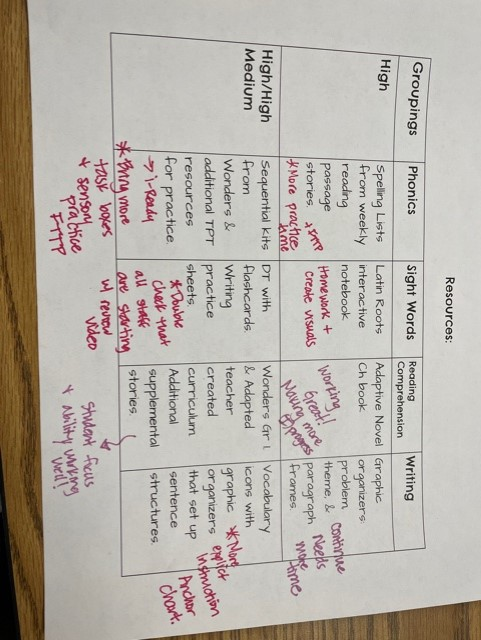


 The important part is reviewing what is working and what is not.  What could use more attention?  Why?  More interactive lessons?  More practice?  A different program or strategy?  Maybe time needs to be shifted to a particular skill.  Here I have added notes about more intervention time with Fast Track To Phonics, videos, revised anchor charts, homework opportunities, and notes to myself of what is working great (i.e. consistent progress at an appropriate pace). Now, it’s lesson planning time. 


Wishing you and your students AMAZING Spring Growth!!


Like what you read? Join me in upcoming blog posts where I continue to put these strategies into place and share resources!


Friday, October 15, 2021

Top 5 Reasons To Use A Visual Schedule


When I tell people I devote an entire white board to my daily schedule, they look at me like I’ve lost it. Why devote such valuable real estate to something so simple? Read on for * reasons why I strongly advocate for the use of a visual schedule in the classroom.


1. Predictability

Students know what is expected of them when. As children, they have very little control over their lives and with anxiety on the rise, adding this bit of predictability to their day helps students feel less stressed and more prepared to face the day. 


2. No more “What time is _____?” and “Are we doing _____ today?” etc.

I feature a digital clock next to my analog clock to help students identify exactly when we will be doing what. In the first couple of weeks, students will still ask and I will direct them to the schedule.


3. Learning targets and page numbers

Again, students know what to do. They can easily look at the clock, look at the schedule, and determine what subject and page number we are on. It also helps me by ensuring I highlight the learning target which has embedded IB Language.


4. Models time management and builds table reading skills

Students can see I pace my lessons according to how much time we have for each task. I tell students to “move with urgency” as we transition from task to task and they can see what they are expected to move on to next. Essentially, it’s a visual representation that even though we DO have all day, we DON’T have all day for Math or Writing and they need to focus on the task at hand.


5. Functions as an Emergency Sub Plan

I’ve had many unpredicted absences and writing out my schedule before I leave for the day ensures that no matter what, the day will run smoothly.


And there you have my top 5 reasons to utilize such valuable classroom real estate to a schedule because, really, it’s SO much more than a schedule.


As I close, I invite you to join me in these affirmations.


I am safe.

I am loved.

I am powerful.


Here for you,

Ruth Reinkymov

3rd Grade Teacher

Hawthorne IB World School


Tuesday, September 21, 2021

The Mega Task Demand: Metacognition...Oh, We are Thinking About Thinking, I Think…

 By Heather Pfrunder, M.A.Ed.   SDC Teacher and Education Specialist

September 20, 2021


It’s a mantra in my SDC classroom where I am verbally redirecting students on how to work attentively: “looking eyes, listening ears, eyes on paper, moving pencil on paper, thinking about your work,...no, try first then I can help you”...and repeat. And repeat.  I should auto-record myself, make a playlist, and hit the numbered response.  Ew, that last thought was not so stellar. But hey, in my humanness, it snuck in there.  And if you have ever taught students with metacognition challenges maybe you, too, have winced over such a thought.  So, I must ask myself: Am I really teaching thinking about thinking?  When I started this article, I was pretty sure the answer was, “Yes!  Graphic organizers and I are friends!” I can do amazing things with BoardMaker!” [For my Gen Ed teacher friends, this is a program where you create learning tools with picture icons matched with words for visual learners]. But here’s the thing about writing, you really have to research and self-reflect.  So, I’ve come face-to-face with this large mental image of a K-W-L chart.  So let’s break it down:


What we know is that metacognition in its simplest form is simply an “awareness or analysis of one's own learning or thinking processes”  (thank you Merriam-Webster).  For students with sensory processing issues, I find that often they want to focus on their own little inner worlds to find that slice of happiness, bringing them back to the uncomfortable reality of learning challenges can feel like stopping a tsunami from the shoreline.  


What we want to know is how to make this relevant for our a-typical students. 


What I learned is:

 1.) “Assign explicit instruction that addresses not just what you are learning, but how you are learning.” 

However, applying it to a lesson for an a-typical learner, often this means a visual model, a check-list of expectations, and repeat practice. Which is great (and essential for many of our visual learners with cognitive delays), but it may not be self-reflective. Instead what we often find is cognitively passive behaviors: “I counted the dots (TouchMath) and wrote the answer, I earned my tokens (my class reward system), got my i-Pad time (SDC earned time with a favorite item - the i-Pad)…”  So often it feels like a compliance check -- not actual thinking about thinking.  Learning this way is gradual, but for our non-verbal learners visual checklists of looking between the cue and the task is not merely to complete the task, but to “regulate performance and verify accuracy” through “self-monitoring” and to “signal task completion.” (Richie, G. 2005). So to be effective metacognition tools our lists cannot just be generalities, but more specific with careful thought about the actual thought process required to learn a task.


This is one of my more general in-task directions for functional skills.  

Relevant, but not specific to meta-cognition.


2.) They must be taught the concept and its language explicitly.”

This, I believe, is the golden ticket.  If it is connected to previous skills and taught over time

we can get students thinking about what they understood or didn’t.  Not just a simple exit ticket,

but “What did I understand?” and “What doesn’t make sense?”  


Examples of this:

  • “I answered the question by finding the key words in the question and underlining my text evidence”

  • “I decoded while reading”

  • “I recognized story sequence”

  • “I counted all”

  • “I regrouped”


Yup, those “I Can…” statements attached to those state standards.  However, we explicitly reflect “I did” or “I did NOT” understand.  Now we have active participants in the meta-cognition process.


When I go back into my previous check lists, they are still pretty relevant for functional skills.  However, I am looking forward to continuing on looking at objectives and having my students exit by answering self-reflection learning questions (for that last token on their token boards).  And rather than reinvent the wheel, I am going to initially have my students reference the anchor charts at my centers to reflect on their learning. 


This is a how-to process visual, but not totally self-reflective. 
I will have to add a process to this.


This is great for setting expectations, but not specific meta-cognition.


This is much better for explicitly teaching the learning process!


This anchor chart has the thinking process and the self-reflection embedded into it.


 I am looking to really celebrate learning!  And just maybe, it will be my students sayinglooking eyes, listening ears, eyes on paper, moving pencil on paper, thinking about my work, try it first…”


********************************


Join me in upcoming blog posts where I put these strategies into place and share resources!


References:


Chick, N. (2013). Metacognition. Vanderbilt University Center for Teaching. Retrieved 9/20/2021 from https://cft.vanderbilt.edu/guides-sub-pages/metacognition/.


Richie, G. (2005). Two Interventions that enhance the metacognition of students with disabilities: Cognitive Cue Cards and Correspondence Training.  Retrieved from: https://files.eric.ed.gov/fulltext/EJ914572.pdf


Wednesday, March 10, 2021

Forever in the Middle: Late Work and Folder Rules in Outlook


We can all agree that the amount of emails we receive and need to respond to on a daily basis has increased dramatically in the last year.  Many of the emails I was receiving regarded late work turned in on Google Classroom. This is a feature that can be turned off but I like having the notification so that I know the work was done and remember to go back to it when I get a chance. However, it got to a point where more urgent emails were getting lost in the midst of these notifications. In October, I set up a "late work" folder in Outlook, which automatically filed emails regarding late work turn in on Google Classroom from my inbox. This helped tremendously with my email overwhelm, but there were still weekends where I would find over 60 late work assignments turned in through Google Classroom in my late work folder. 

In January, I had come to my breaking point with late work being turned in despite limits being placed on due dates. Unfortunately in Google Classroom, there is no way to "lock" an assignment so even when the assignment is overdue, students can still access it. It is definitely frustrating to keep having these turned in past the grace period. I figured there had to be a better way to filter these out.

That's when I discovered a "hack" some teachers were using: they place an emoji lock icon at the beginning of assignment titles in Google Classroom once the late work "grace period" has ended. It doesn't actually lock the assignment, but it makes sorting through late assignment submissions so much easier. I went through and added that lock icon to all assignments past the due date grace period. Now when I go into my late work folder, I can see which assignments were turned in within the appropriate time and which assignments were turned in too late. This helps me prioritize what I grade and filter out what I will not.

Copy the lock emoji here --->   ðŸ”’ 

Video: How to create a rule for Outlook folders


Keep the magic alive,


Kandyce Valverde
7/8 Language Arts
Wiltsey Middle School


Tuesday, March 10, 2020

PBIS Refresher


PBIS Refresher

Here we are already in the last trimester of the 2019-2020 school year.  I don’t know about you, but this school year has seemed to go faster than any of the ones before it.  One of my favorite things about being a teacher this time of the school year is reflecting back on how much my students have learned since August.  As I prepare students for these last few months it is inevitable that we will review what we have learned.  

One of the most important things that we have started to review is school and classroom expectations. It’s important to reteach behavior expectations throughout the school year, but as we get closer to Spring Break I have noticed my students forgetting some of our rules both in the classroom and out.  Last week, my whole school participated in a PBIS Refresher Week. This was perfect timing! As a grade level, we walked our school campus and discussed behavior expectations for each area of our school. In my class, I took the time to focus on a part of our PBIS matrix for the week. For the rest of the school year, we will continue to focus on a different part each week.  

Last week we focused on Line Basics (straight line, hands still, single file, with a smile).  I have a really sweet class that is full of joy, excitement, and lots of energy which is great.  We have wonderful classroom discussions but overall the class can get really chatting at times, especially when we are lining up.  I knew that this was the thing I wanted to focus on first. Even before I knew we had a PBIS Refresher Week on the calendar, I knew I wanted to review with my students.  Here are some things that helped me plan my PBIS refresher.

When should you review student expectations:
  • Whenever a student, a group of students, or the whole class isn’t following PBIS rules and expectations.  Sometimes we just stop what we are doing and review expectations.
  • At the beginning of the year.  My school takes the first two weeks in August to teach grade-level and school-wide rules and expectations.  We even have a PBIS kick-off rally. Usually, the first review for me starts after we have been in school for about a month.  Students are a little more comfortable with you and sometimes need a behavior reminder.  
  • After holidays, and long breaks, and in this case right before a holiday break.  I know my students are excited for Spring Break and even Summer Break, so I want to remind them of PBIS rules and expectations for the rest of our year together.  
  • Ongoing throughout the school year.  You could review a different PBIS rule or expectation every week like I am doing now.  
How to review student behavior expectations:
  • Be positive! 
  • Start by asking students what the expectations are.  The will gladly remind everyone.
  • Reward students, I always have little erasers and pencils that I had out.  We also use Tiger Pride Tickets school-wide. Students earn the tickets and can use them to buy a prize.  I hand these out throughout the day but I made sure to give out rewards for students following the behaviors we are focusing on.  
  • Use a calm voice, don’t raise it
This week we are focusing on transitions in the classroom.  I have continued to reward students for last week’s focus as well as this week’s.  I love how excited students are to follow the rules and expectations. As my students were coming back from P.E. today I opened the door to hear them reminding each other of line basics! 

Learning and Teaching with Grace,Alina

Tuesday, December 3, 2019

Forever in the Middle: Student Input


When planning for my classroom I know I will need specific structures and routines to keep my own systems running effectively. However, for the routines and systems that I feel students can help with I like to allow them opportunities for feedback.


Seating
I change my seating assignments (and sometimes arrangement) at the beginning of each month. At this point, the students know the routine and are eager for the change at the beginning of the month. Last time I changed the seating, I had a few students who happened to come by on the last day of the month and were talking about the layout. I said, "Do you want to change it?" and they eagerly got to work! After that, they assigned all new seats for each of the classes. I know it's sometimes hard to release control over that, but honestly the students have known each other now for so many years and they know what will work and what won't work so why not?
The students surprised me by asking NOT
to sit in groups facing each other.
They said they get too distracted.
They decided this arrangement would help them to work
collaboratively but stay more focused. I agree so far!

Other alternatives
1. Assign a small team of students to the task of new seat assignments by providing a blank seating chart and class roster. They can finish it usually in under ten minutes.
2.  Allow students to vote on a new classroom arrangement when given four choices. Majority wins!
3. Ask for volunteers to stay after school or come in at lunch to help assign or rearrange the classroom

The students know their peers best and honestly they do not want a chaotic classroom. They will make good choices when given an opportunity when they know they have an adult's trust.

Instruction 
Giving students a quick opportunity to provide feedback
on their learning can supply data to help improve your
own future instruction. This survey was given at the end of
the year and gave me important information in planning
for the current school year. 
This takes a little bravery on your part, but really can be eye opening. We are in this for the students so really it is their opinion that matters most and we all know they will be, sometimes brutally, honest! An easy way to do this is to create a quick Google Form that they can complete. This gives you immediate results in a user-friendly format.

Possible Questions
1. What do you like most about this class?
2. What is most difficult for you in class?
3. What activities/lessons have we done that helped you feel successful in class?
4. What was the most interesting part of the last unit?
5. What should the teacher stop/start/continue doing?

The most important part of this process is to immediately take action based off the data gathered from the feedback. The last feedback form I gave my students had to do with our routines and with that data, I was able to use student suggestions such as "having a group captain like in Elementary school" to enhance my current routines.

Sometimes it is hard to let go of control over some of our structure, but the rewards of allowing student input are far greater. Students feel validated and that alone helps create an atmosphere of mutual respect within the classroom and strengthens student and teacher relationships. Try it out and let me know how it goes in the comments below!

Keep the magic alive,


Kandyce Valverde

Follow my class on Twitter! @valverderules

Sunday, October 27, 2019

Worry is Just Wasted Energy

How can we help students cope with stress when they have to take a district benchmark?  Recently, my students had to take our Reading Inventory assessment which is a reading comprehension diagnostic tool.  My fourth graders understand how this test works and that will measure their current Lexile level used to determine reading proficiency.  Of course, students can do well, struggle, or even score lower than the last time they took it. 

As any concerned teacher, I continuously try to find new ways to encourage my students to relax as much as possible and to do their best.  I came across a new strategy at a recent conference I attended and wanted to try it out.  It is quite simple to implement:

1.  Talk to students about what stress is and how it affects us during performance-type assessments.  Let them vocalize their concerns first. I described worry as just wasted energy.  If you allow it to take over, you won't get far in whatever task you have in front of you.

2.  Hand out a half-sheet of lined paper.  Give students 3 or 4 minutes to write down what worries them about the assessment they are about to take.

3.  While they are writing, place two trash cans at opposite ends of the classroom.  As soon as the timer is up, ask students to read what they wrote to themselves one more time.  At a determined signal, have students roll up their paper into a ball and toss it into a basket.

4.  When my students threw their "worry balls" into the baskets, I could feel the tension released.  There were a few cheers as well.  Do NOT pick up the rolled up worry balls.  Leave them right where they landed.  I told my students that if they begin to stress out they could simply look towards everyone's concerns on the floor or in the basket to remind them that the act of worry is just wasted energy. 

5.  Needless to say, reading gains were MUCH more than I had expected.  Of course, these gains are not exclusively because of this strategy but I hope it relaxed them enough to get through it with confidence!


Happy Writing!
Gustavo Macuil

Tuesday, October 1, 2019

Forever in the Middle: QR codes for routines


I have a Video Blog for you this month!
Play the video below to see how to use QR codes in your classroom.
Links are listed below the video.


My Spotlight page (links to the writing feedback forms under Resources)

Keep the magic alive,
Kandyce Valverde
See what my class is up to on Twitter: @valverderules


Wednesday, September 4, 2019

Forever in the Middle: Building Classroom Community


Building a Classroom Community


Welcome back to school, teachers!  One of the things I work hard to build and maintain in my classroom is a safe community environment where students feel welcome.  Creating a classroom that feels like a community only takes a few quick and easy steps.

Step 1:  Create a welcoming environment
Teachers are pros at decorating but setting up a welcoming environment really means nothing more than creating an organized and clean space with a few decorative details.  It's not necessary to go over the top with decorating.  If you walk into your own classroom and are able to feel more relaxed or happy, then you've accomplished this first step.

Step 2: Show your students you enjoy their company
I know the old mantra is "don't smile until Christmas," but I never was any good at following that. Having fun with the kids and being cheerful has always worked out better for me.  One new approach I tried out this year and am really enjoying is my Roll Call Question.  Each day, students have a question they are asked such as, "what is your favorite color?" or  "would you rather live without music or TV?" The possibilities are really endless with these.  Then I use my equity cards to call each student and instead of responding with "here," they answer the question. It takes less than 90 seconds each period and students get to know each other a little more as a bonus.

Now, three weeks into the school year, they look forward to the question and I've even had kids suggest the next day's question.  I've been extremely impressed with what effect this has had on the classroom community and it's always fun to see what they say to some of our crazy questions like, "is cereal soup?"

Step 3: Teach classroom structures
We all know that kids crave structure and usually do better in environments where they know what to expect.  This is why teaching classroom structures is a great way to build community.  Some structures to teach are: entering and exiting the classroom, passing out or handing in assignments, moving around the classroom, restroom and drinking fountain procedures, and student versus teacher areas.  Once these have been mastered, give your students jobs within the class to help things run smoothly. Sharing the responsibilities gives them a purpose within the group.

Other ways I build community:

This year I am exploring using flexible seating and I have seen great success with my students. The freedom to "choose where you learn best" allows my students to really take charge of their own success and learn how to make good choices in where they sit and who they sit with. Also, they get to feel more grownup as they see that I trust them to make these choices.

Another feature of my classroom is our class pet, Claire.  She is a two month old bearded dragon and the students love having her in the room. As she gets older and larger, she will be able to be out more as I teach but for now she is in her cage most of the time. Since she is growing and will be nearly full grown by the end of the school year, we even do a weekly measurement of her length to see how much she has grown.  She also has an Instagram account (@foxywaterclaire) because every class pet needs an Instagram, right?

Whatever approach you take to build your classroom community, the most important thing is to make sure that however you do it, make it genuine.  Kids are extremely perceptive and appreciate honesty as well as respect.
Until next time, keep the magic alive.

Kandyce Valverde

Let me know how you build relationships and community in your classroom in the comments below!

Follow what my class is up to on my teacher Twitter @valverderules

Thursday, May 9, 2019

Attention-Getters and Cheers!

Attention- Getters
Are you looking to add some new attention-getters to your current library?  Attention-getters are a fun and efficient way of getting your students' attention quickly and without having to yell over them (as we all know how effective that is right?).  Attention-gettters are an important component to any successful classroom management system.  They are a MUST HAVE to help your day run smoothly, and the kids love them! I have put together some of my current favorite attention-getters that I use with the students in my 4th grade class.  See a brief description and video clips of each one below:


Teacher Says…
Students Respond…
Hocus Pocus…
…Everybody focus
Here ye here ye…
… All eyes on the queen
Hands on top…
…Everybody stop (while putting hands on top of head)
If you can hear me put a bubble in your mouth…
…students pretend to have a giant bubble in their mouth
Can I get a…
…whoop whoop
Ready to rock?...
…Ready to roll
Class class…
…yes yes
Chop chop…
…Lollipop
Jazz hands…
Students shake their hands in a “jazz hands” fashion


Classroom Cheers!
Classroom cheers are a great way to celebrate student successes both big and small!  Kids absolutely love the cheers and thus are encouraged to constantly cheer on their classmates.  My students are always looking for their classmates successes and are excited to celebrate them.  Classroom cheers can also aide in classroom management as students are highly engaged and looking to both earn and give those cheers to their classmates.  It's a great way to encourage your students and help boost their self-esteem throughout the day.  The cheers are so simple and so fun to implement.  Here are some of my favorites that I am using with my 4th grade students this year:


Cheer Name
Student Actions…
WOW cheer
Make a “w” with each hand and put on each side of their mouth.  Open mouth to make an “o” shape.
Marshmallow Clap
Clap hands like there’s a big marshmallow between them.
Disco Cheer
Put left hand on hip, use right hand to point down to the left and then up to the right.  Repeat this action while saying “ah, ah, ah, ah, you did a great job, you did a great job.”
Truck Driver Cheer
Use hands to pretend to hold steering wheel, then use right hand to pretend to pull a semi-truck horn and say “honk honk.” Then put pretend walkie in front of mouth and say “Good job good buddy.”
Tiny Clap
Use pointer finger tips to clap.
Cheese Grater Cheer
Hold one stand still pretending to hold a cheese grater, and use the other hand to “grate” the block of cheese. While doing this students say “You’re great, great, great, great great!”
Big brrrr Cheer
Cross arms over the front of the body like you’re cold, while saying “brrrrr,” then throw both hands up in the air and say –“illiant!!”
Hip Hip Hooray Cheer
Put right hand on hip and say “hip,” put left hand on hip and say “hip,” then throw both hands up in the air and say “HOORAYYYY!”
Chili Pepper Cheer
Reach up and pretend to pick a chili pepper, bit into the pepper and say, “that’shot!” while fanning yourself with the other hand.
Lookin’ Good Cheer
Use pointer fingers to draw a mirror in the air, then say “looking good!” while girls fluff hair and boys pretend to slick theirs back.
Fantastic Cheer
Use pointer finger to twirl a circle and the air while saying “FAAAAAAAAAANTASTIC” and then point towards the person the cheer is for.


I sure hope this helps to add some new fun and engagement into your classroom as well!

Collaboratively Learning,
Megan Brown
Copy of pic- Megan Brown.jpg


Most Viewed Posts