Showing posts with label Metacognition. Show all posts

Monday, February 28, 2022

Assessing Spring Assessment Readiness

By Heather Pfrunder, Doctoral Candidate, SDC Teacher, and Education Specialist

February 28, 2022


Assessment ready or standard’s ready? Are we making students ready for life by maximizing instructional minutes? Often the answer is yes. During testing season it seems like the answer is… well… testing. However, if we address metacognition skills with test preparation, our students are becoming equipped with learning to perform under pressure.  Let’s look at how.


  1. Spiral Review and the Standards.


While the first objective seems pretty obvious, it really piggy-backs onto my previous article about maximizing spring growth. In a year with so much change, transition, and re-learning educators have had to rethink lessons into spiral review formats. Assessment prep is simply one more tool to refine this practice. Taking time to review objectives and test formats informs instructional minutes, especially during intervention periods. Looking over the practice test questions and formats are not only for students, but a great tool for educators in knowing how to prep students.
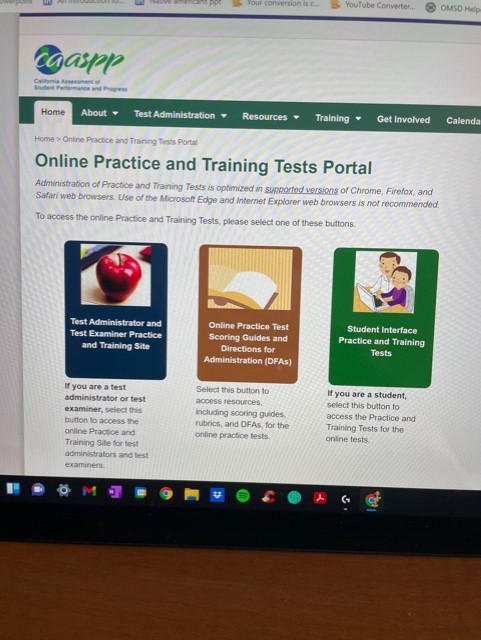

In the caaspp website teachers can review tests 

and set students up with practice test opportunities.


  1. Mindfulness and Testing


Slowing students down to breathe and focus on clarity of thought is the first step to effective test-taking skills. It also replicates needed life skills. From driver’s tests to college exams to employment tests, much of what we do in life is dependent on effective test-taking skills. Practice breathing and focusing on the question or the topic. Practice will assist students with more effective management of their emotions. Controlled breathing is a good base of ensuring heart-rate and oxygen to the brain. As a daily specific practice before practice testing, we are setting students up with a natural association of calming and test-taking strategies. Practice videos are available in our SEL toolkit, or simply click this link here.


  1. What is the question asking?


Really? Yes, really. So often in their anxiety or eagerness to quickly complete the test students forget to go slowly and really look at all the keywords of the test. Just as we expect our students to circle, box, or highlight answers, it is equally important to circle, box, or highlight key words and compare answers to the questions. While several words are bolded and underlined by caaspp, students can practice using the mousepad to highlight additional question details. An additional effective test-taking strategy is to look at the questions before reading the passages, when allowed.


Have students practice using their mouse or keypads to 

highlight key words in questions and in the text.


  1. What tools do I use?

Chances are if your students aren’t using tools, they really are not answering to the best of their abilities.  Simple things like thinking maps on paper or using an allowed 100’s or multiplication table can make the difference between making senseless errors and demonstrating true abilities. Do not assume that months of “Read, Draw, Write” or “STAR” note-taking means they will automatically use these tools in a testing environment. When you practice pre-testing observe: do your students use the tools, or do they know how to make their own? If pencil and paper are allowed for scratch paper do they know that they can draw a simple number line to add and subtract? Having students practicing these skills prior to assessment not only means that they have strategies for test-taking, but they are able to practice problem solving skills for daily assignments. Sometimes a little explicit instruction is just the boost your student needs.

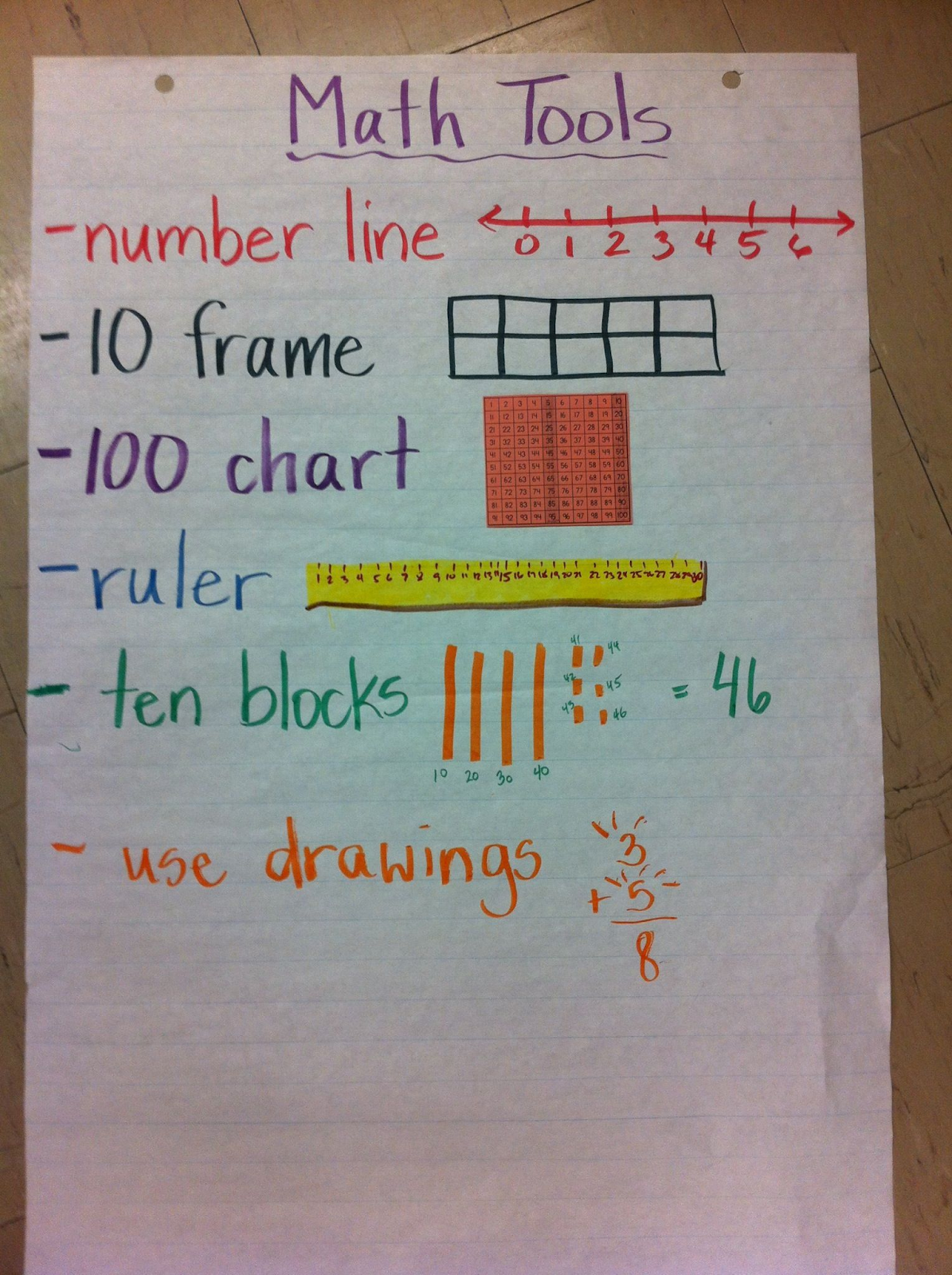

If digital tools are not available, have students practice creating their own.

Practice using pre-writing strategies they have been practicing.


Until next time, wishing you the best and may your students’ testing odds ever be in their favor…


Like what you read? Join me in upcoming blog posts where I continue to put these strategies into place and share resources!
Saturday, November 27, 2021

Common Core and Math: Running to the Win with RUNNS

 By Heather Pfrunder, M.A.Ed          SDC Teacher and Education Specialist

November 27, 2021


I can attribute my learned affection for math to the teaching formula of Eureka math: concrete objects, visual models, then representative diagrams.  Somehow in the vertical alignment of visual aids, math ceased to be a rote memorization of steps and procedures to fun puzzles to be solved.  However, I quickly found that beyond the steps of number sense for my students 100% of them stumbled to understand what to do once it came time to apply the concepts in real-world scenarios (i.e. word problems).  We would go confidently from adding using 1:1 correspondence and manipulatives, to count-on strategies, to simple algorithms, and then crash into a halted stop once it came time to apply them.  Logically, the Read, Draw, Write of what we had been doing all along should have worked - but it didn’t.  We would pull out the Eureka Math workbooks and would never get past guided practice: doe-eyed, my students would wait for me to explain the vocabulary, where to find it, and what to do with it.  I was waiting for the flicker of recognition, a spark of partial understanding that would never come - or at least never come until I adjusted my strategies. Thus it came to be, I, the lover of the written word, came to research and write my Master’s Thesis on my lesser love: Math.  


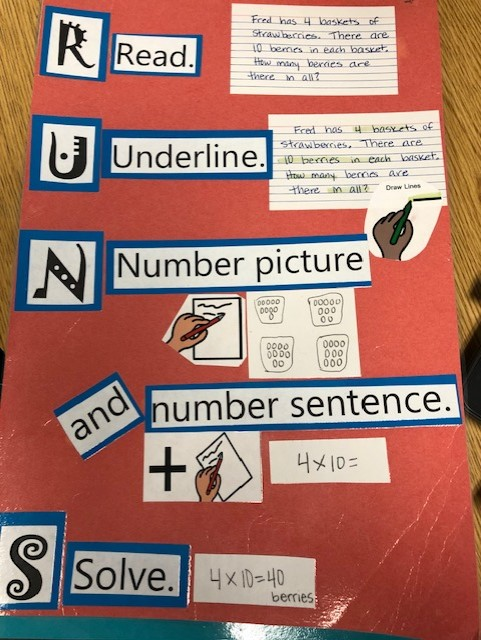
What I learned was a strategy to address the specific challenge of many of our students with language delays.  It is also the challenge that faces many of our English Language Learners.  The beautiful thing about this strategy is that it nestles quite nicely within the framework of Read, Draw, Write.  By using schema-based instruction (instruction to develop metacognition for the development of problem-solving skills through the use of mnemonics and/or visual aids/charts), my students were able to have real and lasting results.  Enter the development of my RUNNS strategy: Read, Underline, Number picture, Number sentence, Solve. While I can’t lay claim to the original idea by Rockwell, Griffin, and Jones (“RUNS… (1) Read the problem, (2) Use a diagram, (3) Number sentence, and (4) State the answer” (p. 90) , I can say that via formative assessments I found my adjustment to be far more effective with my students. 

Here is how:


 While the acronym may seem pretty self-explanatory,  

there are a few tricks to it that really make it work.


R - Read Read as in 1st read in its entirety and a 2nd read for specific chunking of info/close reading.


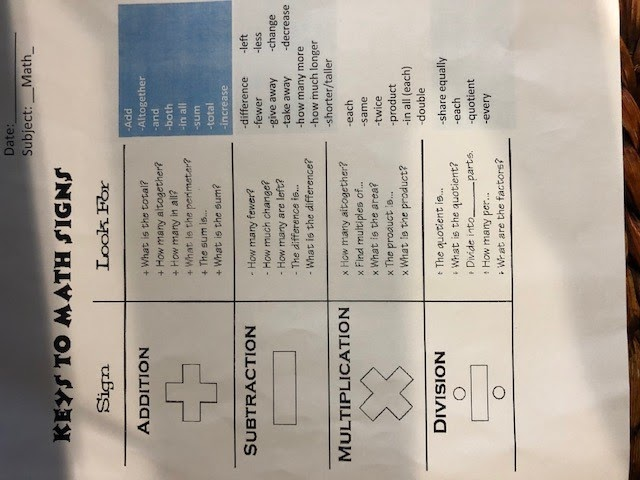
U - Underline.  Underline numbers and “special words” (i.e. "fewer, more than, each, groups, ect…") And most importantly, underline “the ASK.”  What is the question?  What are the key words there?  To know what to underline is the trick to this step.  For this I use AVID column notes for students to reference.  They find the “math words” then match them to their chart with a dry-erase marker.  By doing so, they are able to identify the function.  


While the original note/visual was shared with me from another teacher,

I found that I needed to add more to it to be reflective of

the Eureka Math questions - thus the unofficial 3rd column.


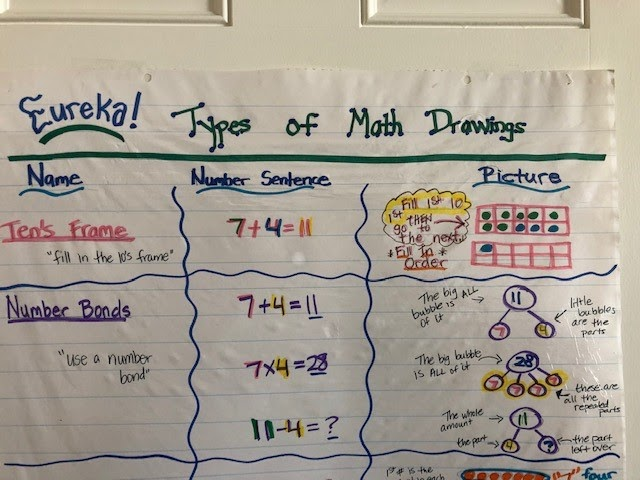
N - Number Picture.  For this I usually like to set up expectations.  It takes a while for my students to remember just what is a number bond, a tape diagram, or an array.  Knowing which picture to use can be even more challenging.  Typically, Eureka Math highlights a specific pictorial strategy in the lesson set.  Front loading students to understand the expectation is key in helping struggling and/or unique learners.


In this anchor chart I even gave examples of the Eureka Math verbiage for my 

students that require more direct examples.


N- Number Sentence.  Here we put it into place: what quantities (or use simplified verbiage to restate vocabulary “numbers”) what function do we put into place.  Tip: Vertically align the number sentence and label.  This makes the last step so much easier and keeps the train of thought connected to the word problem looking to be solved.


Numbers with their labels to make a vertical number sentence.


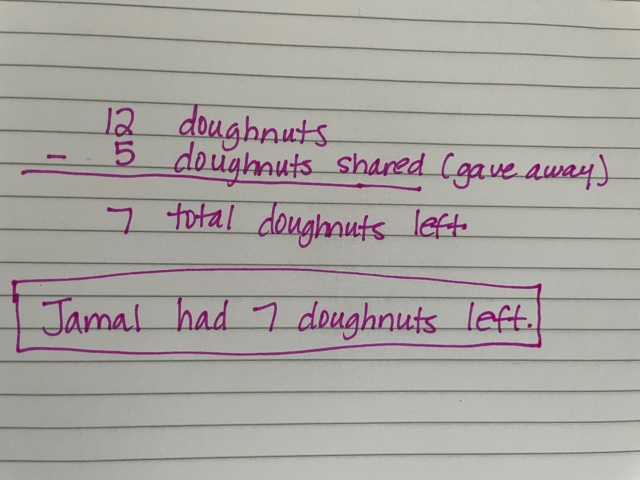
S - Solve. For this we double check, “Did we answer the ‘ASK’?”  This means making sure we have the written label.  I like to have students box their final answer - especially if there is a lot of work on the page.


And Solved it!  The answer is in a full sentence and boxed.


Whether you are struggling with a unique learner or trying to overcome sluggish student progress, this may be the solution.  Through the RUNNS strategy multiple challenges are addressed: breaking down of the “ASK” to solve, identifying key math vocabulary and their meaning, recognizing types of visuals, and putting it all together.  Like all good visual strategies, over time they needed to be faded back.  The beauty of this math strategy is that with repeated practice, students should be able to recall the specific strategy long after their graphic organizers are tucked away.  I’d love to hear if you are running to win with RUNNS!  


Common Core RUNNS Resource: Common Core Math Tools


Like what you read? Join me in upcoming blog posts where I continue to put these strategies into place and share resources!


Rockwell, S., Griffin, C., & Jones, H. (2001). Schema-based strategy instruction in mathematics and the word problem-solving performance of a student with autism. Focus on autism and other developmental disabilities. 26(2) 87-95. Doi: 10.1177/1088357611405039.

Most Viewed Posts