Showing posts with label novelty and variety. Show all posts

Tuesday, January 19, 2021

Forever in the Middle: Reading Novels Virtually


Reading Novels During Distance Learning


I love reading great novels with students and that is the biggest thing I miss from having students in the classroom. It also wasn't something I was willing to give up during distance learning. In the Spring, my classes were about 2/3 of the way through The Giver when schools shut down, and this school year, my classes have read one novel and started a second last week. Figuring out how best to do this has been a continuous challenge so here is a little insight into what did and didn't work for me.

A Shift in Focus

I use novels to reinforce and practice ELA standards in the classroom.  Since we are so much more limited on instructional minutes this school year, I have had to remind myself that if the students don't understand every single detail of the texts, it's okay as long as they can apply what skills they practiced to new texts or make connections to new material. 

The focus is not on the book itself, it is on the standards while using the book as a resource. 


What does this look like in my online environment? My seventh-grade class is using their novel as a supplement to the current unit where we look at the differences in the way people live in other parts of the world. My intervention class is using their novel as a way of identifying narrative techniques and practicing literature analysis as well as responses to literature: areas that they need extra practice with. Earlier this year, we focused on similar standards with the 8th grade ELA classes as we read The Outsiders.

Asynchronous Reading With EdPuzzle

My eighth-grade students read The Outsiders in the Fall and I was happy to find the chapters available on EdPuzzle. The benefit of using this was that I could see exactly who was completing the reading and I also was able to have them answer questions along the way and received instant feedback on their learning.  The challenge was that the students who really enjoyed reading did not enjoy having to listen to someone else read and the students who were not self-motivated did not complete the reading at all. However, I did like the idea of using EdPuzzle and the feedback I received from it. In the end, it was not the best choice for me.


Synchronous Reading During Zoom

My students last year finished The Giver over Zoom. Since we didn't have a set Zoom schedule like this school year, I scheduled "Reading time with Mrs. Valverde" for anyone who wanted to read the book along with me. Attendance was not mandatory and I had a group of around 10 very dedicated students attend each day. They even asked to extend the time past finishing the book to read the next novel in the series. 

This semester, I started reading Forged by Fire with my 8th-grade intervention students and The Bridge Home with my seventh grade Language Arts class. I am reading about 10 minutes at the beginning of the period with each of the classes and using the chat in Zoom to receive feedback. This has worked fairly well. Also, both of the texts are on Actively Learn, which allows me to assign chapters to students to read and even include questions for them to answer at the end of each chapter: another way to check for understanding and keep the students accountable to reading. I can start the day's reading with them and have them finish it asynchronously after our Zoom class is over. 

Virtual Literature Circles

In the Fall, my 8th Honors ELA class read through The Outsiders at a much faster pace than the other groups. This allowed us to run digital literature circles with the students. I had a shared document where they were responsible for specific roles as they would have in a traditional classroom. They then signed up as a group to meet with me over Zoom twice during the four-week session. During this reading club meeting, they were given time to discuss the book with each other in real-time. 

My only role in this was to provide them with the time over Zoom and to listen in on their conversation. I could easily tell who was reading the book by the connections they were making and discussions they had during this time. This worked for 7 of my 9 groups. Two of the groups struggled with members who didn't pull their weight but overall, it was a positive experience. 

Don't let reading a novel with your students virtually intimidate you. I do miss actually feeling their reactions to things that happen in the books we read, but reading something together with a class is too magical for me to give up, even if I miss out on some pieces of it. It all comes down to what you find the most value in for your students. Whatever you choose to do with your students over the next few months, don't feel limited by online learning, but instead view it as an opportunity to do things differently. Who knows? Maybe you'll end up finding a strategy you love and can continue doing when we return to school.


Keep the magic alive, 


Kandyce Valverde

Wiltsey Middle School
7th/8th Language Arts

Wednesday, March 21, 2018

Let's Talk About Math Intervention, Part 3

Let’s Talk About MATH INTERVENTION, Part 3!


Hi again, thanks for coming back to the final post in this 3-part series.  Over the last two posts, we’ve discussed WHY we need between-the-bells math intervention, and HOW we can structure our math block to deliver it.  Here let’s address WHAT materials we could use to best benefit our students. 


Finding what you’re going to use during intervention is actually the easiest part, and it’s probably in your classroom already!  As I said before, Math isn’t working for some of our students and that we need to mix it up and try something different, find a different way to teach what they need.


If I were a primary-grades teacher and wanting to implement this intervention style in my class, here is what I would do.  If our adopted materials have been used in both instruction and reteaching, and my students were still unsuccessful, I’d find another way to teach it- I’d go outside of the program.  This doesn’t mean go willy-nilly online purchasing items on Teachers Pay Teachers or at the local school supply store- I will not back you up on that and your administration probably won’t, either.  Let me be crystal clear- it requires very purposeful selection of materials based on the needs of your particular students. 

Maybe I have a game my students used to play from our previous adoption that did a great job at helping students understand this concept.  Perhaps someone on my team has a resource they used to use that was very successful.  I may go down a grade level or two in Eureka resources and use a strategy they missed or weren’t ready for when it was taught in that grade like fact families using number bonds or tape diagrams.  I might have them on the computer or iPad working on assigned content in Zearn, Khan Academy, iXL, or MobyMax.  If you have a parent helper you trust with a small group, put them to good use and have them work with that group!  Kindergarten, now that you’re full-day, you have helpers.  My fingers are crossed for you that they are AWESOME and you can have them pull a small group here!  Maybe they’re using Wikki-Stix to make numbers or create triangles.  Maybe they are making a collage to show the number 5. 

In the case of my upper-grade kiddos, they needed primary concepts.  Middle school teachers, you can probably relate to this as well.  For these guys, I gave a lot of thought to how I was going to reach big kid-learners with little-kid concepts without them feeling like little kids.  Would the teddy bear counters be too “babyish?”  Would kids feel like I was being condescending and not want to participate, even though they desperately needed it?  I knew I wasn’t going to go to an algorithm or shortcut, which would be the equivalent of putting a band-aid on a gunshot wound.  It may help for a little while, but it’s not a permanent fix.  I could go back in Eureka math and see how these concepts are taught now.  In the case of this year’s class, I decided that wasn’t going to be my best option so I chose to work with concrete items and other resources I know to be successful.  I pulled the Marcy Cook tiles and cards out and dusted them off.  I grabbed my Kim Sutton books and found opportunities for student learning.  I dug out the Greg Tang pack from the last math adoption and found great stuff that would help.  I pulled out my bins of base-ten blocks.  I looked through my John Van de Walle books for strategies to use in addition to the ones taught in Eureka.  I signed the students up in Khan Academy and found lessons each individual needed to work on.  And, I’m still adding to my repertoire in response to what my students are showing me they need.


All the while, my on-level and above-level students are having their needs met as well.   In their centers or on their must-do/may-do list, they may be working on problems from the problem set that are higher level DOK questions.  They’re playing a game that is extending their learning.  They’re in a media station on iXL practicing content.  They’re creating anchor charts or posters to show their understanding of the concept.  Perhaps instead of a must-do/may-do list, they have a menu for the week, incorporating choice and novelty into their math time.  They’re not doing more, they’re doing different.  Click HERE for a list of materials I've used. Please check with your administration to make sure they would support you in using these materials before starting out.


So, those are my thoughts about achieving a between-the-bells math intervention through small group instruction in the general-ed math classroom, for now.  I know I didn’t touch on everything, and this isn’t the end of this conversation, but it is the end of this trio of posts.  :)  I do believe this is a serious situation that needs to be addressed above and beyond the classroom level, but you starting it is a step in the right direction.  Is taking something like this on overwhelming?  Absolutely.  I’ve been planning on doing a version of Guided Math for awhile now.  My advice is to start slow!  One day a week or every two weeks.  But I implore you to consider it and start, and here’s my passionate plea in the name of equity.    
As a society, we value being able to read and write, hence the push for literacy.  We do RTI for reading, we have workshops for parents on how to help their children with reading, there are TV and radio commercials about the importance of reading with children.  At the same time though, not being a “math person” or not being good at math is acceptable in our society.  We aren’t okay with verbal illiteracy, but we are okay with math illiteracy?  By not offering an intervention in math during the school day, are we okay-ing failure in math?  Building in time for math intervention should be a priority in our schools to start eliminating this double standard.

If you try any of these ideas out, or come up with your own even cooler ones, I would seriously love to hear how it’s working out! The good, the bad, the ugly, I want to know.  Comment below and keep us in the loop!  Need help?  I’m here, my email is at the bottom.  Want to see my math block while guided math is happening?  Schedule a Spotlight visit, I’d love to meet you and be a part of your journey. 


Mathematically yours,
Sabrina Blake

sabrina.blake@omsd.net

Sabpic.jpg


Monday, November 13, 2017

Using Rotations with Eureka! by Kimberly Smith


Using Rotations with Eureka!
Imagine having the chance to meet with each of your students during small group time, an opportunity for all students to use technology, and some time for hands-on learning to take place.  If this seems like an impossible scenario during your math block, it’s not!


In my last blog post, I discussed using 10-minute warm-ups in order to bring in number talks, technology, spiral review, and fluency on different days of the week.  In this blog post, you’ll learn how to bring some of these options into one day of Eureka Math.  This option will not always work with your math block since some lessons take a lot longer than others, but the kids definitely enjoy rotations, and so do I!  What I like about this option is that you have the opportunity to really hone in on all of your students’ understanding of the current lesson.  This gives you the chance to talk out misconceptions and see who might need a little extra TLC.  Your students will also work on another activity that may be hands-on or something a little more exciting and fun.

As a math teacher, I understand how difficult it can be to teach a lesson a day.  We stress because we know that many of our students haven’t fully attained the concept in such a short amount of time.  With rotations, you’ll have some peace of mind because your kids will have four different stations to practice the concept at hand.  What’s nice is that as you meet with groups, you can hold back those students who are really stuck and keep them with you for the remainder of the rotation time if you deem it necessary.

“Never be afraid to try something new, because life gets boring when you stay within the limits of what you already know.” -Unknown

Before rotations begin each day, you’ll need to first teach the lesson.  This may mean shortening some of the fluency activities and teaching a little bit faster, but your students will revisit what they’ve missed during your rotations.  Here is what you can do in order to prepare for math rotations:


In order to get your rotations running smoothly, you’ll have to do a little bit of prep and planning beforehand.  First, you’ll want to figure out how many and what rotations you’ll offer.  I like to have four different rotations with students spending about 12 minutes in each station.  Click on the link below if you’d like to see some of my notes: My Math Rotation Notes & Ideas.  Here are my four stations:


  1. Meet with the Teacher/Teacher Time:  Students get small group instruction as we go over another example from our lesson or a Problem Set problem.  Here, each student gets a turn to explain a step or ask any questions they have.  You can also choose to use whiteboards, so you can quickly assess understanding.  This is also a great time to bring in your Eureka debrief!


  1. Independent/Partner Practice:  Kids work on the Problem Set problems either independently or with a partner from their rotation group.  This station is set up right next to where I teach small group, so if they’re stuck, they can listen in on what I’m teaching on the Smartboard.  I also like to check in on them to make sure they’re able to work independently.


  1. Hands On/Math Center Fun Activity/Math Games:  This gives kids a chance to try the math in a different way.  Sometimes, we find great activities online that we’d love our students to try but know there’s not enough time with Eureka to fit it in.  This is where you can bring these activities into play.  A hands-on activity would also be fun for kids because they can really see how the math can be used in the real world.  Math games are another engaging way for kids to attack the content or work on fluency skills.


  1. Tech Time:  If you have limited technology, this may be a way for you to bring in some more computer time into your math block.  I made my students tech cards with several websites and their login information, so they don’t have to waste time trying to remember how to log in.  Instructions are left at the tech station, so students know exactly what is expected of them.  Here I like to have my students work on assignments on tenmarks.com or zearn, practice fluency facts on xtramath.org, take quizzes on Kahoot or Formative, write a blog on Kidblog or Google Classroom, or even try some coding!  Videos from sites like embarc.online or Khan Academy can also be useful in order for kids to review the math lesson learned that day.

Please feel free to comment below should you have any questions, comments, or concerns.  I’d be happy to give you more information!

Educating together,
Kimberly Smith Loya


Monday, October 9, 2017

Mixing it up with Cooperative Learning!


Mixing it up with Cooperative Learning!
Cooperative Learning is a LOT more than simply telling your students to share with their partners or table groups.  Where this has its value, the students need to be provided with a multitude of different cooperative learning/grouping structures in order to keep them engaged and deepen their level of thinking and learning. Novelty and variety plays a HUGE part in student engagement and learning.  The Kagan Cooperative Learning strategies (alongside countless others) are a great way to maximize student learning within your classroom!


20170911_084844.jpg
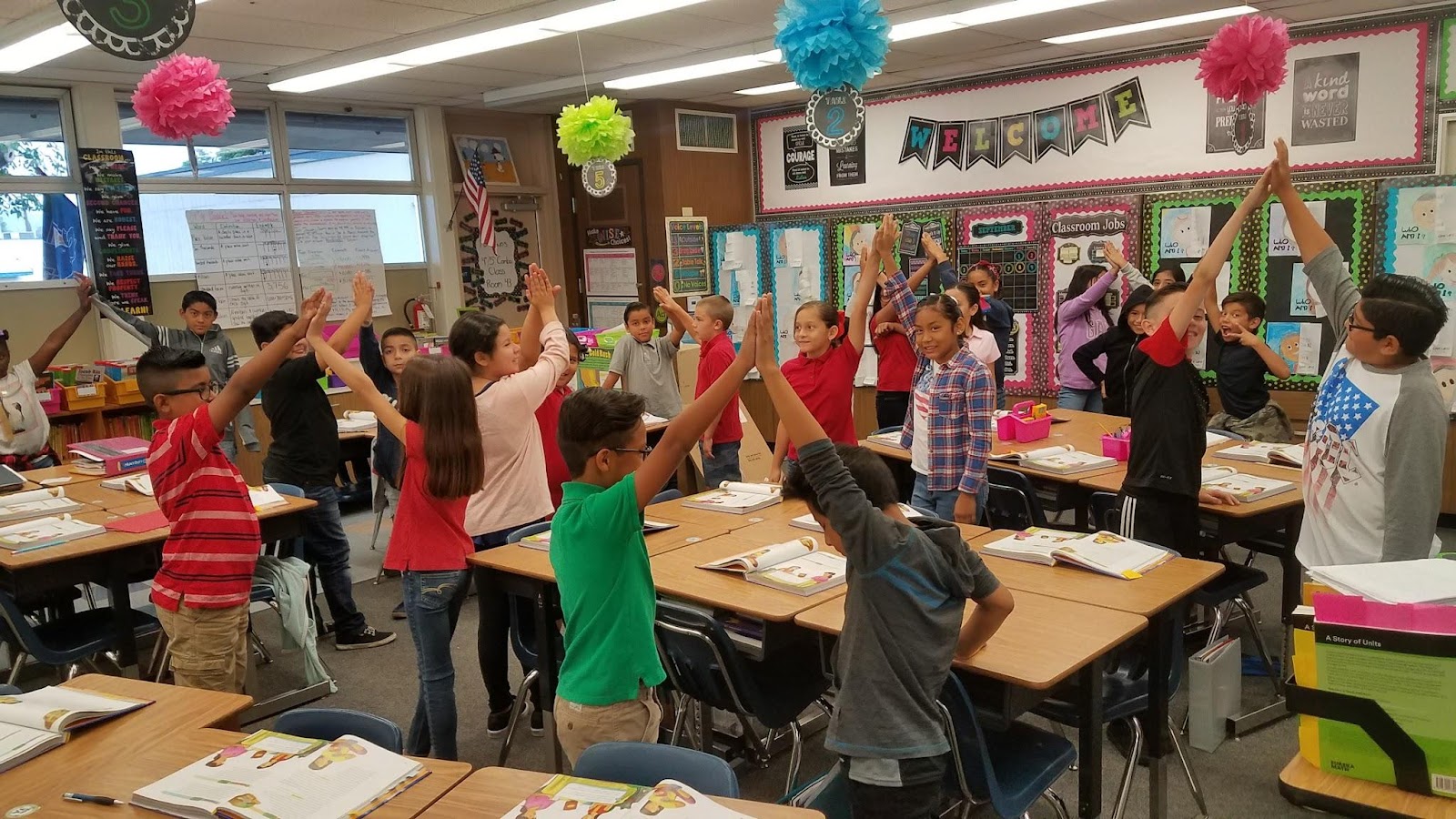
Students engaging in the “Stand Up Hand Up Pair Up” Kagan strategy (or Mix-Pair-Share) during a Wonders lesson.  Teacher poses a question, gives students think time (often times they will write a short answer), then teacher plays music set on a timer for 30 seconds while students wander around the room.  When the music stops, the students put their hand in the air and high five the closest person to them, thus forming their new TPS partner.  Teacher then has them discuss the question or idea that was originally proposed..  Shuffling students a few more times gives them more exposure to different levels of thinking.  Often times, I even build on the original question, and have the kids rethink before they shuffle to new partners.

This month’s blog is going to focus on student talk through a variety of Kagan/cooperative learning techniques.  As you read on, you will read about and see pictures and videos of my students successfully engaging in these different techniques and the level of learning that’s taking place.  Throughout this blog, I will show you examples of how easy it is to implement these structures into your daily routines with Wonders, Eureka Math, and any other subject for that matter!.  Once you see the power behind the kids’ learning and their level of engagement, you too will be convinced that student talk via cooperative learning structures is essential to help your students succeed!


Listening to the students insightful comments and conversations during collaborative conversations can be extremely heart-warming.  Once you have built that sense of security amongst your classroom climate, the students will share their thoughts, feelings, and emotions honestly as they make connections to the content being taught.  Its extremely powerful and endearing as a teacher to hear this in their conversations, and also powerful to know that they are learning from each other, connecting with each other, and thinking on a much higher/deeper level.
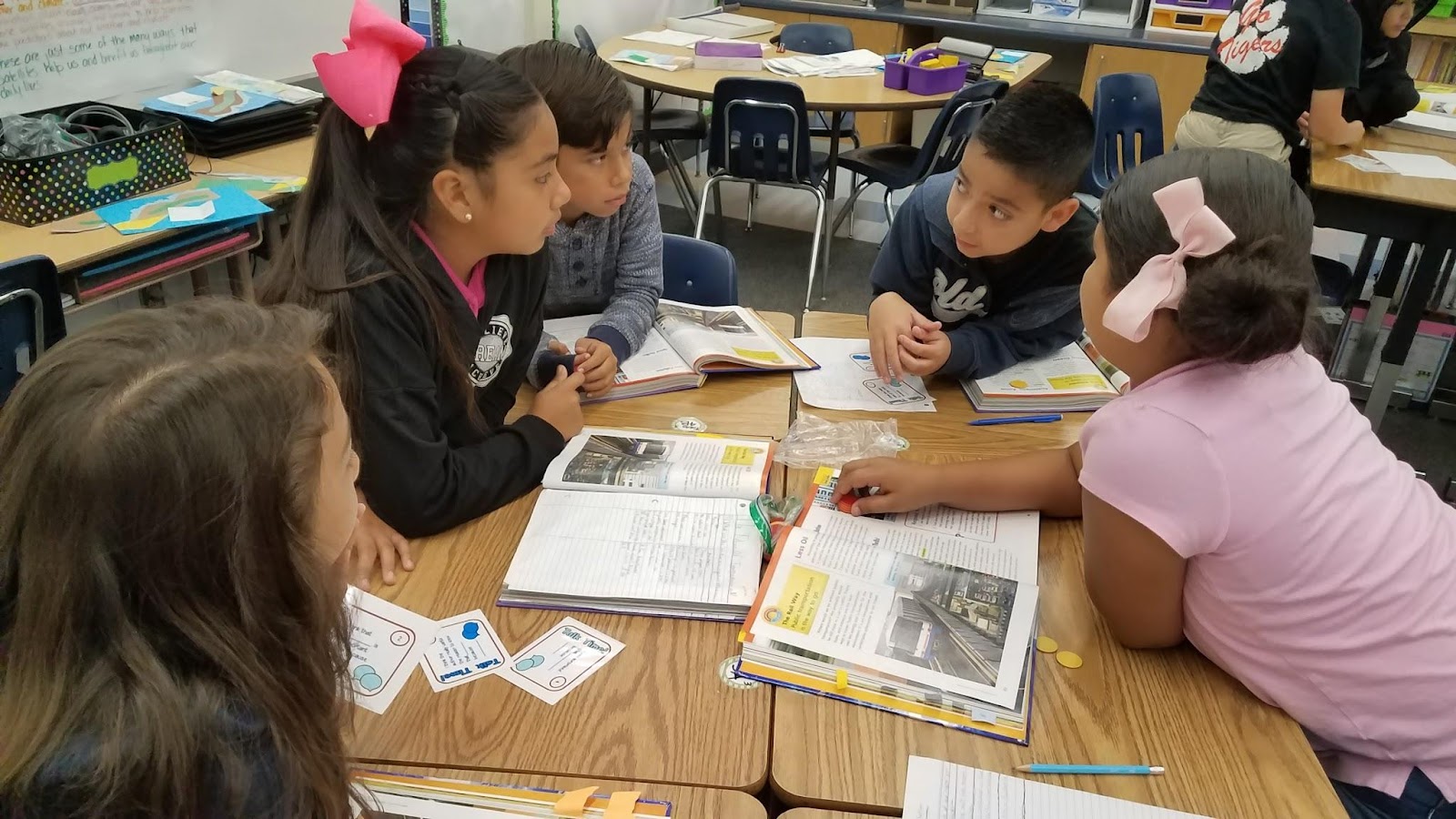
Here my students are participating in the Kagan “Talking Chips” strategy through the use of a collaborative conversation.  The students are given a bag of chips (counters) and each take one (or more).  After I have posed the questions, or ideas for discussion, and given them ample think time (and/or write time depending on the level of question and discussion) they take turns sharing their answers/ideas by placing their chip in the bag when they’d like to share.  This is what I use in the early stages of collaborative conversations to help teach them how to participate.  This strategy ensures that ALL students will have a chance to contribute their thoughts to the conversation.

20170915_092109.jpg

“Practice does not make perfect.  Only perfect practice makes perfect.” - Vince Lombardi

Here are some video clips of my kiddos participating in Collaborative Conversations with Talking Chips.  As the year progresses their conversations will grow and deepen, but they’re off to a great start!


Despite what some may fear, implementing cooperative learning structures does NOT require a ton of planning/prepping time on the teacher’s part.  In fact, most structures require minimal amount of teacher prep and the more you use them, you will LOVE them and your ideas of how/when to utilize them will start flowing freely!


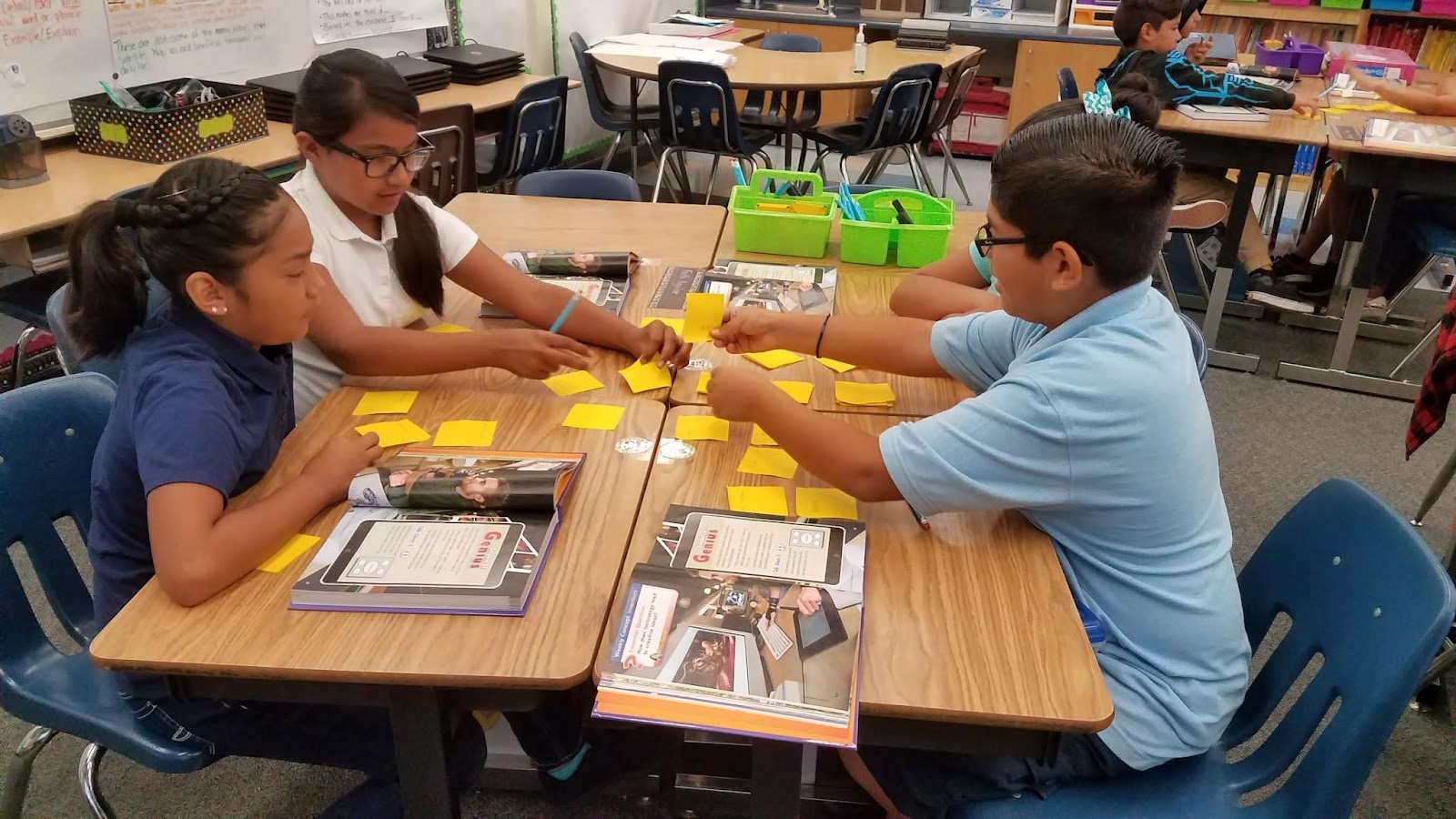
For instance with Wonders, I will look ahead at the lessons for the upcoming day/week and simply sticky- note in the TM where I want to incorporate certain Kagan/cooperative learning structures, and label which structure I want to use.  For example, on Day 1 of Wonders where you teach the “Introduce the Concept” lesson provides a GREAT opportunity to implement the Kagan “Jot Thoughts” strategy.  This is where students write as many different ideas/words/concepts etc on sticky notes until the teacher says time's up.  The table group has all their sticky notes in the center of the table and can then read and sort their ideas, group like ideas, and share out their thoughts.  Here is a picture of my kiddos utilizing this strategy last week!  


20170905_081854.jpgI constantly cycle through the different Kagan/cooperative learning structures throughout each week, so as to keep the kids engaged with novelty and variety as I mentioned above.  When teaching becomes monotonous and repetitive, the students tend to become less engaged and thus the level of learning is not a high as it should be.  Something to keep in mind!


Collaboratively Learning,
Megan Brown

pic- Megan Brown.jpg


OMSD.jpg

Most Viewed Posts