Showing posts with label 4th. Show all posts

Monday, May 11, 2020

End of the Year Activities

For me, this time of year is always bittersweet.  There is a sense of excitement in the classroom as students anxiously countdown the days until summer break mixed with knowing we will have to say our goodbyes.  The end of this school year looks different from any other year I have taught before, but some things are still the same.  Students, parents, and maybe teachers too, are getting restless and a little burnt out. Distance learning has been challenging for everyone.  As we come upon the last two weeks of our school year, I want to make learning exciting and engaging for everyone.  These are some of my ideas.

Flipgrid

Flipgrid is a website that lets students record videos of themselves in response to a question that you have posted. You can set the time limit for student videos which is an awesome feature. I like to keep student videos around 45 seconds or less depending on the questions.  Having a shorter time limit helps with students' anxiety of recording a video of themselves.  Some great end of the year questions you could ask could be:

  • What is your favorite book you have read this school year? Why?
  • What is your favorite memory from this year? Why?
  • Tell us three things you learned this week?
  • What does your "homeschool" space look like?
  • What are you going to miss the most about our class?
There is also a feature on Flipgrid that lets students respond to each other.  You could use this for a Socratic Seminar, or to increase student dialogue.  There are also tons of topic ideas already created in the Disco Library.  For example, Epic! has created topics that are connected to books in their digital library.  So you can assign the books in Epic! and then have students respond to the topic question on Flipgrid.

Padlet

This is a great time to have students share what they have learned this year.  Let them be the teacher.  Create a Padlet for students to work on collaboratively or better yet, have students create their own Padlets.  Originally, students in my classroom were supposed to share their independent study projects at our annual Gate Gala.  Due to school closure that didn't happen.  Students have been researching different countries for the past few months.  Since we couldn't hold our event at school, we decided to have a digital one using Padlet and Zoom.  Once students finish their Padlet then they are going to present with our class via Zoom.    

Google Slides

I love using google slides!  This has to be my go-to resource all school year long.  You can create student awards and have students vote on them using Google Forms. You could even have students create their own awards for others using Slides.   Another idea is to create a digital memory book for students to complete.  There are lots of resources out there already if you don't have time to make them yourself.  

Host an end of the Year party on Zoom  

I love the idea of spending the last day with my students on Zoom.  We are currently voting on a theme for our party.  I will have a few games for students to play (they love Kahoot) and also a time for sharing the end-of-the-year awards.  

I hope the next few days are filled with fun and excitement for you and your students.  


Learning and Teaching With Grace, Alina

Tuesday, March 10, 2020

PBIS Refresher


PBIS Refresher

Here we are already in the last trimester of the 2019-2020 school year.  I don’t know about you, but this school year has seemed to go faster than any of the ones before it.  One of my favorite things about being a teacher this time of the school year is reflecting back on how much my students have learned since August.  As I prepare students for these last few months it is inevitable that we will review what we have learned.  

One of the most important things that we have started to review is school and classroom expectations. It’s important to reteach behavior expectations throughout the school year, but as we get closer to Spring Break I have noticed my students forgetting some of our rules both in the classroom and out.  Last week, my whole school participated in a PBIS Refresher Week. This was perfect timing! As a grade level, we walked our school campus and discussed behavior expectations for each area of our school. In my class, I took the time to focus on a part of our PBIS matrix for the week. For the rest of the school year, we will continue to focus on a different part each week.  

Last week we focused on Line Basics (straight line, hands still, single file, with a smile).  I have a really sweet class that is full of joy, excitement, and lots of energy which is great.  We have wonderful classroom discussions but overall the class can get really chatting at times, especially when we are lining up.  I knew that this was the thing I wanted to focus on first. Even before I knew we had a PBIS Refresher Week on the calendar, I knew I wanted to review with my students.  Here are some things that helped me plan my PBIS refresher.

When should you review student expectations:
  • Whenever a student, a group of students, or the whole class isn’t following PBIS rules and expectations.  Sometimes we just stop what we are doing and review expectations.
  • At the beginning of the year.  My school takes the first two weeks in August to teach grade-level and school-wide rules and expectations.  We even have a PBIS kick-off rally. Usually, the first review for me starts after we have been in school for about a month.  Students are a little more comfortable with you and sometimes need a behavior reminder.  
  • After holidays, and long breaks, and in this case right before a holiday break.  I know my students are excited for Spring Break and even Summer Break, so I want to remind them of PBIS rules and expectations for the rest of our year together.  
  • Ongoing throughout the school year.  You could review a different PBIS rule or expectation every week like I am doing now.  
How to review student behavior expectations:
  • Be positive! 
  • Start by asking students what the expectations are.  The will gladly remind everyone.
  • Reward students, I always have little erasers and pencils that I had out.  We also use Tiger Pride Tickets school-wide. Students earn the tickets and can use them to buy a prize.  I hand these out throughout the day but I made sure to give out rewards for students following the behaviors we are focusing on.  
  • Use a calm voice, don’t raise it
This week we are focusing on transitions in the classroom.  I have continued to reward students for last week’s focus as well as this week’s.  I love how excited students are to follow the rules and expectations. As my students were coming back from P.E. today I opened the door to hear them reminding each other of line basics! 

Learning and Teaching with Grace,Alina

Friday, December 13, 2019

Building Math Fluency

Building Math Fluency

This is my 5th year teaching fourth grade.   By now I know most of the curriculum and standards like the back of my hand.   I know exactly where I need my kiddos to be by the end of the year, especially when it comes to math and I know how much work it is going to take to get there.  We teach 2-digit by 2-digit multiplication, division, and fractions in 4th grade!  It is not easy no matter how long you have been teaching it. All of those concepts require students to have fluency with addition/subtraction as well as multiplication facts.  It is important that I have time in my daily lessons to help students build their fluency. 

Eureka Math

The great part about using Eureka Math is that fluency is already built into each lesson.  This is almost always found at the beginning of lessons.  I know that sometimes as teachers we may feel tempted to skip that part for the sake of time, but I'm here to ask you not to skip over fluency.  It is so key to help spiral students' learning and set them up for the lesson you are about to teach. 

I recently went to a district training on math fluency and boy did I learn a lot.  I really had to take some time to think about how I was conducting fluency practice and how I could make it so much more meaningful for my students.

What I learned


  • Grades K - 5 are all about units! When practicing fluency it is important to remember the unit. Whether it is fractions, place value, or measurement always include the unit.
  • Signaling is so important.  This was totally new to me.  I thought that establishing a signal to use with Happy Counting would be easy.  Once I started practicing with my team I was so wrong.  If I wasn't clearly signaling for my colleague to understand, then how would my students be able to understand what I was asking of them?  I recommend practicing with a partner a few times before you try with students. You might also want to videotape yourself with your class to see how it went.  You can adjust your signaling after watching yourself.  One thing that I have struggled with in the past with students is when they start to count too fast.  Once I started using the signaling with fluency practice I notice that problem pretty much stopped altogether.  This helped me set a pace in the classroom that was perfect for everyone, not just the high achievers.  
  • Smile -  At first I was so focused on getting my signaling down, that I probably looked like I wasn't enjoying the lesson.   If you look like you are trying to rush through fluency or unhappy about including it in your lesson then students will pick up on it. Encourage students through your smile.  
  • Set a timer.  If you are struggling to fit math fluency in your lesson, then start with a minute or two. Fluency should not be the main part of your lesson.  The idea is not to drill and kill your students but to help them build their number sense and mental math skills.  

This training was such a game-changer for me.  I am sometimes guilty of falling into the same routine year after year.  I was so excited to see different strategies and teaching practices to make math fluency more accessible for my students. Have you been to this math training yet?  What were some of your takeaways? 


Learning and Teaching with Grace,
Alina


Teaching Through Inquiry

Teaching Through Inquiry

One of my favorite inquiry-based teaching strategies is a type of group investigation called a Puzzlement.  A puzzlement is an activity that starts with an observation of some kind, which leads to questioning, research, and synthesis of information.  If can be used for any topic or subject.  This is a great activity to use at the beginning of a unit of study.  However, it doesn't have to be confined to just at the beginning.

Getting Started


Start by showing students something (a picture, video, etc) that is both interesting and new to them about the topic you want them to learn about.  In the past, I have used a photo, illustration, video, excerpt of a text, and even a word problem during my puzzlement lessons.   The idea here is to get the students to think and wonder about the specific topic.  This helps students buy into their own learning.  Your goal is to get them to start thinking about questions they have about a topic.

After students have seen the puzzlement, ask them to come up with questions they have about what they have just seen.  As students are coming up with questions about the topic, list their questions on chart paper.  Next to each question, I like to put the names of the student that asked it.  This part of the lessons does take some time to complete.  I make sure to tell students to think about their questions and look at the list of questions before sharing their own.  This helps the process to go a little faster.  Before students share whole group, I have them do a think-pair-share first.  If there is a repeat question, then I will place a checkmark next to the question and write the new student's name as well.

Once the list of student questions is done, it is important to focus the inquiry on just a few questions.  Sometimes we analyze the questions together to decide which questions would be great research questions and other times I decide for the students.  In that case, I will place a star next to 3-5 questions that I think will guide students in the learning I want them to have.  Even though they will only work on answering the selected questions, I like to leave the entire list up for the class to see.  This is why I prefer chart paper to a whiteboard.  I want the questions viewable throughout the lesson.

Now that students have a set of questions to guide their learning the inquiry begins. Have students work in groups to respond to the focus questions you decided on. Remember students are not going to respond to all the questions on the list, just the selected ones.  How you chose to set up the inquiry groups is up to you.  Sometimes, I jigsaw the learning, giving each group different text sets.  Othertimes they all have the same text.  I usually place students in groups of 3-4, but I have also had students work with a partner as well.  As students are researching, I have them use the prompts of depth and complexity to guide them, I love using a frame with prompts to help them learn.

Finally, when students have finished their inquiry we come back to whole group to share our learning.  I will use a chart again to take notes on what each group learned.  Students always surprise me with what they have learned.  Their insights are amazing and this leads to such rich conversations about a topic.

Have you used a puzzlement in your classroom?  Leave a comment below to share how it went.


Learning and Teaching with Grace,
Alina


Sunday, August 25, 2019

So the writing journey begins...

The start of a new school year is always exciting.  Teachers return with a fresh mindset determined to
change or adjust instruction from last year....and....so the journey begins.  Last year, I focused my Spotlight blog entries in writing after participating at the Invitational Summer Institute sponsored through the Inland Writing Project.

As I implemented many new writing strategies into my classroom instruction, I felt that I needed to dig deeper in certain writing aspects and this is where a new year, a new journey, begins.  This year I will be focusing on explicitly teaching and practicing the 6 Traits of Writing more thoroughly.

The 6 Traits of Writing includes the following: ideas, organization, voice, word choice, sentence fluency, and conventions.  This month I am focusing on ideas.

Last week our class started a narrative story.  I had collected some super cool Writing Traits items like my Scholastic kit: The Trait Crate which includes mentor text to help frontload the six traits along with posters and a reference book.  I also had a Traits of Writing big book which someone had left in our community "grab-n-go" table of our staff lounge...(this was a treasure of a find!).

I explained to the class how writers sometimes struggle with not only coming up with ideas to write about but supporting details in order to expand on those ideas.  So here were two days worth of activities in a nutshell:

1.  Think of your comprehension skill of the week.  Ours was Problem/Solution.  Try to align this skill with a student-produced narrative essay.

2.  Provide students the "problem" of their narrative piece.  I gave my students the sentence "Suddenly, I heard the dark clouds roar like _____ and it began to rain cats and dogs!"  I left the line blank in order to review similes.  Students decide independently to write their own simile.  I also included an idiom as this was the vocabulary strategy of the week in our Wonders reading program.

3.  Students fold their graphic
organizer into six sections and draw borders using a sharpie.  They label the first two boxes "B," the next two "M," and the last two boxes "E."  These will be their beginning, middle, and end sections of their stories.

4.  I then proceeded to ask the class to think about something that may happen in real life that could be ruined by a sudden storm.  They came up with a lot of interesting ideas for their beginning event.  The problem would be the actual rain storm.  On the back of their graphic organizer, they selected their event and then proceeded to think about main characters, supporting characters and any details that they could possibly include in their stories.

5.  Next we proceeded to share these ideas for their stories with partners.  Students
gave each other feedback and encouragement to keep writing.

6.  I then allowed them two draw their panels with as much details as possible.  They could color their panels as well.

7.  They also received post-its and place the post-its on the panels in which they wanted dialogue.  They quickly "scripted" some dialogue on their post-its since this is part of the narrative writing standards for fourth graders.


8.  Now they are ready to write their first draft. After spending two days of sharing ideas, I feel they will have much more to write about during their first draft.

Happy Writing!
Gus Macuil


Wednesday, March 20, 2019

For the Love of Science by Alina

For the Love of Science

Two weeks ago, a group of about thirty-five 4th, 5th, and 6th graders from my school competed at the Inland Empire Science Olympiad Regional Tournament held at Ramona High School in Riverside.  According to their website, "Science Olympiad is a nationwide competition . . . designed to increase a student's interest in STEM fields and provide recognition for outstanding achievements in team events. As their head coach, I was so inspired by the students’ hard work and level of dedication. Since September, students met two to three times a month with a dedicated group of five exceptional teachers to help prepare them for the competition held on March 2nd. The Olympiads from my school were grouped into three different teams. Each of those teams competed for medals in events that tested their knowledge on topics like weather, fossils, ecosystems, circuits and energy, body systems, the solar system, and chemical reactions.  Other events required students to use engineering skills to build glider airplanes, Rube Goldberg like contraptions, rubber band launchers, and cars made out of pasta!

"The most important thing in the Olympic Games is not winning but taking part; the essential thing in life is not conquering but fighting well." -Pierre de Coubertin

Want to start your own Science Olympiad team? Here are a few tips to get you started. First, head over to Inland Empire Regional Science Olympiad website at https://statescioly.org/ierso to learn more about the program and how it works. Depending on the grade level of students on your team, they will compete in different divisions. Since I teach a group of elementary students, we compete in Division A. Once you know what division your students will be competing in, you will need to purchase a Competition Tournament Rules Manual. Inside you will find the official rules for all of the possible events that could be held at the yearly tournament. Registration for teams usually opens in the fall and a list of tournament events will also be posted on the website listed above around the same time so be sure to check back often for updated information.

Create a team of about 15 students. If you are having trouble finding students to sign up, consider holding a Science Fun Night at your school and try a few of the STEM challenges for the rules manual to generate a buzz. Once you have your team, you will want to divide students into smaller group to focus on particular events. Most events are designed for two students. I like to have the whole team to work on the build activities at the beginning of the year to see which students excel at which event.s You can then have students compete within the team for certain events; create an interest survey for students to fill out or you can just choose who gets to work on each event. A little tip I learned is that the schedule of events goes out later in the year, so I have students work on different events just in case there is a scheduling conflict on the day of the tournament. After students know which events they are competing in, they will need to either practice that event, study for the event or build something for the event. Give yourself plenty of time for students to build. It takes us most of the year to build and test our pasta cars.

Don't be afraid to ask for help. You will need a variety of materials to get started. I must have hundreds upon hundreds of straws in my room. Not to mention cardboard tubes, marbles, golf balls, wooden blocks, glue sticks, and uncooked pasta. I usually ask the kids to bring unwanted toys and other supplies that we might need for the events.

This is our 5th year participating in this tournament. When I started the process I really had no idea how or where to begin. Watching the Science Olympiad group grow has been an amazing experience. I am not a science expert by any means. Events vary from year to year, so I find myself doing a lot of reading on new content before I introduce it to students. This experience has allowed me to learn a lot along the way from my colleagues who fearlessly volunteered to join me in this adventure, from parents that cheerfully offer their help and support both after-school and on the day of the event, and, most importantly I have learned the most from my students who eagerly come to meetings excited to learn about science.

I hope that I have inspired you to think more about the impact of learning about science and maybe to even start a Science Olympiad Team of your own.

"I don't run away from a challenge because I am afraid.  Instead, I run toward it because the only way to escape fear is to trample it beneath your feet."  -Nadia Comaneci 


Learning and Teaching with Grace,

Alina

Tuesday, March 19, 2019

UA Treasure Box by Hilda


Universal Access Treasure Box


Have you ever wondered, “How can I prepare for a UA/RTI time where my student groups can be organized enough to work independently?” Get them the supplies necessary to lead group work without you! “But, how do I do this?!” you might ask, it’s time for Reading Treasure Boxes in your class!    


Okay, so they are not really a treasure box, but if you get kids to believe that the materials in the box will bring a wealth of knowledge, they will be thrilled to get this daily treasure. There are essential necessities to assist in reading growth…
According to the National Research Council, a group of experts convened to examine reading research and explored components in powerful instruction:
1.     Teach essential skills and strategies.
◊ Effective reading teachers teach skills, strategies, and concepts.
*After teaching/reteaching the Sound Spelling Cards, provide laminated copies in each box for students to begin their group review of sound patterns learned.
*After going over FRY’s words and testing your students, provide them a list (per week) to continue to study. My students keep their list in an envelope in the box to quiz each other as they wait for me or have finished their group work.
2.     Provide differentiated instruction based on assessment results and adapt instruction to meet students' needs.
◊ Effective teachers recognize that one size doesn't fit all and are ready to adapt instruction—both content and methods.
While your UA will be leveled instruction, remember that you still have different reading levels within the group. Provide each group with the Wonders Leveled Readers that are at their Lexile Level Range. I use the Leveled Readers to provide guided reading instruction, but after we read together students keep the books in the box to reread on their own/with a partner. 

3.     Provide explicit and systematic instruction with lots of practice—with and without teacher support and feedback, including cumulative practice over time.
◊ Students should not have to infer what they are supposed to learn.
*Allow teams come up with a team name for ownership and buy-in that teamwork makes the Dream Work! Purchase pocket sleeves to hold a team name/picture on one side and the other side will hold explicit directions of work for the day/week.
4.     Provide opportunities to apply skills and strategies in reading and writing meaningful text with teacher support.
◊ Students need to be taught what to do when they get to a "hard word."
*Provide Question Cards/Sentence Frame Cards to guide their independent reading, after they have read with the teacher. You can find a copy of the cards I use, linked to my profile.
*Provide passages (from Wonders) and sand timers for independent Fluency practice.

5.     Don't just "cover" critical content; be sure students learn it—monitor student progress regularly and reteach as necessary.
◊ Effective teachers adjust their teaching accordingly to try to accelerate student progress.
*Provide feedback (scoring, if necessary) on the independent writing or fluency practice for students to monitor progress.

You have read the experts’ suggestions and my classroom suggestions (by the asterisk in bold print). Please take these suggestions to make your reading instruction more powerful! Try something new, add your own touch, your “umph” and your students will TRIUMPH!! J

Live, Love, Teach!
Hilda Sanchez

Saturday, March 9, 2019

JUST WRITE! Reflect & Respond Journaling

Reflect & Respond Journaling
Here is a routine that I started implementing this year.  My class knows it as "reflect and respond" journaling.  The goal is to encourage students to JUST WRITE by offering a variety of writing stimulus - an interesting picture, an inspirational quote, a paragraph from a text or short video clips (Ted Talks for kids is an awesome resource on youtube).

STEPS:


1.  The item you choose should engage student THINKING.  Always start with reasons to write.  Just recently, my students watched this video:


2.  Allow about a minute for students to reflect silently (this is the REFLECT part of reflect & respond journaling).  I explicitly teach them that writers gather their thoughts before writing.  I encourage them to think about how the item made them feel.  Could they connect the ideas presented with something in their personal life or to something they've experienced in a text?

3. Students write for 15 minutes (this is the RESPOND part of reflect & respond journaling).  This step is important as ALL YEAR they will write for 15 minutes non-stop.  This builds stamina and writing fluency as well as volume.  Gentle, quiet reminders to keep writing can be given if you roam the room.  However, I encourage you, as the teacher and model, to also write along with them in your own journal.  Below you can see a short video of our class responding to the video above.  However, we only had ten minutes on this occasion because of parent conference week shortening our schedule - you can literally hear the lunch bell towards the end of the video! (I highly encourage the use of timers).


Author's Chair

4.  Once the timer is up, we move to Author's Chair.  Students volunteer to share their journaling with the audience.  You may choose as many volunteers to read depending on your time constraints.

5.  This part of reflect & respond journaling is crucial.  The teacher must listen carefully to responses and take notes as to specific ideas that come from one of your volunteers.  It could be a phrase or an interesting expression that comes from their responses.  I have started to encourage the audience (those listening) to try to state the main idea of each response.  For example, in a recent student response, one student wrote how "small kids can have big hearts."  This caught my attention and I asked the class to think about what those words mean.  I explicitly want them to build on one another's ideas in a meaningful and authentic way.  They had conversations about it right at that moment.  I encourage students to support their answers with examples in their own lives if they can.

6.  Select that ONE student journal that you think might stimulate more writing.  I have done this all year long and I can guarantee you that you will always find at least ONE response that stands out.

7. Make a copy of the selected journal entry and transcribe the journal on a word document.  Make double-sided copies (one side has the handwritten journal entry, the other side has the same text in typed format) for all students.  Each student will receive a copy of this entry to annotate.

Students should LOVE to write!
8.  Use that student's journal entry as the mentor text for the next day's reflect & respond journaling.  Think about the implications this has on your students - using THEIR writing as the text for reflecting and responding.  Even your most struggling student will have an opportunity to have the class respond to their writing because the focus is on IDEAS not grammar (yes, this will be difficult for those teachers who really want to correct every mistake but don't do it; celebrate ideas!).  Students will analyze that student's ideas and build upon them with examples and/or more thinking.

9.  There are SO MANY ways you can alter or change this routine to fit your needs.  It is very organic.  Don't be afraid to try it.  The more you implement this unique writing opportunity, the faster your students will become and you will also see their enthusiasm to write something OTHER than a prompt (we all know they get enough practice on those!).  If you have questions, please email me.  I am more than happy to assist or offer ideas!


1.  How long does this take?  30 minutes would be sufficient (4 to 5 minutes to present stimulus + 15 minutes to write + 8 to 10 minutes Author's Chair).
2.  How often do you do this?  Depends on the week.  I try to do this on Tuesdays, Wednesdays, and Thursdays.  However, it truly depends on your scheduling.  If you have a busy schedule, try once a week at least.
3.  Is this the only type of writing you do?  No.  I have a formal writing program where students will still continue to learn how to write constructed responses, essays, and other writing items.  It does NOT supplant my regular instructional program.
4.  Common Core standards addressed?  Here are the ones that float to the top (however there are many more if you really dive deep):

Writing Standards:
CCSS.ELA-LITERACY.W.4.10
Write routinely over extended time frames (time for research, reflection, and revision) and shorter time frames (a single sitting or a day or two) for a range of discipline-specific tasks, purposes, and audiences.
CCSS.ELA-LITERACY.W.4.9
Draw evidence from literary or informational texts to support analysis, reflection, and research
Listening and Speaking Standards:

CCSS.ELA-LITERACY.SL.4.1
Engage effectively in a range of collaborative discussions (one-on-one, in groups, and teacher-led) with diverse partners on grade 4 topics and texts, building on others' ideas and expressing their own clearly.


CCSS.ELA-LITERACY.SL.4.2
Paraphrase portions of a text read aloud or information presented in diverse media and formats, including visually, quantitatively, and orally.
CCSS.ELA-LITERACY.SL.4.1.D
Review the key ideas expressed and explain their own ideas and understanding in light of the discussion
CCSS.ELA-LITERACY.SL.4.3
Identify the reasons and evidence a speaker provides to support particular points.


There are two solid reasons why I love to implement this routine:

  • Students become writers NOT students of writing.  There is a difference.  They begin to see writing as a tool of expression.  They write because they want to write.  Offering them the reasons to write is the tricky part for the teacher, however, I assure you this will become habit after you feel comfortable with the routine.
  • RACE and SBAC - I have noticed that this routine sort of "frontloads" and then supports the "E" skill in RACE.  I understand that many teachers struggle with how to teach students to explain, elaborate, or extend during formal constructed response activities.  When our class begins a lesson of this nature, I remind students that the "E" in RACE is basically what they do during reflect & respond journaling - can you connect the text with something you've read before or a life experience example.  This can be very abstract especially for fourth graders and I have witnessed that our journal routine has enhanced responses since the beginning of the year.  It is not as difficult for them to wrap their heads around this.  Obviously, if students become more proficient in RACE, they will most likely meet the rigors of SBAC where a huge piece of assessment is the ability for students to find connection between ideas whether within one text or comparing two texts.
Would you like to learn how to strengthen your OWN writing abilities?  Why not apply for the Invitational Summer Institute?  Follow this link to my first blog of this school year for information on how to be part of this amazing opportunity:


Happy Writing!
Gustavo Macuil


Tuesday, October 9, 2018

Wordless Picture Book Poetry


When I taught Kindergarten years ago, I remember how much I loved reading picture books to my class.  There was always plenty to talk about as we closely observed the lush artwork splashed across the pages of whimsical text such as the books of Eric Carle.  During this time, I also discovered wordless books.  In the primary grades, wordless books lend themselves so well to oral narration or opportunities to write.  Sadly, as students move up the grades, they tend to see less and less picture or wordless books.  Has this happened to you?  Would you like to try a different approach to poetry?

If you read my last post, you know that I promised to share some new learnings from my ISI experience.  The ISI (Invitational Summer Institute) is a two-week summer writing program hosted by UCR for teachers to inspire writing in their classroom.  I would like to share how you can inspire poetry through wordless books.

1.  Briefly introduce the elements of poetry.

This is a wonderful title!
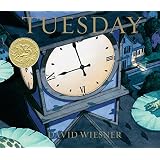
2.  Select wordless books that are whimsical, magical, and creative.  Books that lend themselves to the imagination.  Some of my favorites are SundayFlotsam, (both by David Wiesner), Wave by Suzy Lee, and Chalk by Bill Thompson.  You can find so many through Pinterest by typing "wordless books" in the search bar.  Once I select one, I see if I can find it on youtube to make it easier to monitor the activity while it plays.

3.  Each student gets one long post-it (4 x 6) and a sharpie.  Mention to students that they will view the story twice.  The first viewing is for them to experience the story line.  On the second viewing, they are instructed to write ONE word that they can think of as they watch.  Encourage creativity.  The word can be a noun, adjective, or verb.  Here are the rules:  as they write the word, they must hurry and place it on a word collector wall (chart paper, whiteboard or easel).  If that word is already on the word collector wall, they must return to their seats and think of another word.
Tuesday

4. I chose Sunday by David Wiesner.  The class was highly engaged and challenged to think of unique words.  It was a great way to informally assess student vocabulary banks as well as "thinking" fluency as they hurried to think of words to place on the word collector.


5.  After typing all the words onto a simple table, I printed and they glued the word table onto their writing journals on one of the pages of a two-page spread.  On the other page, they were to write a poem using only the words from the table PLUS five additional words they may need in order to complete their poems.  They asked many interesting questions such as: Can we use words twice?  Can we change the tenses (past/future)?  Can we use the bonus words twice?  Could we use the root word of one of the words? Could we use a synonym of a word since it means the same thing?  These questions were a pleasant and unexpected surprise as it offered me to do some mini-lessons on grammar at the moment.


5.  Once they finished their poems, they typed them onto a Google doc.  I was able to use this part of the activity as a technology opportunity as I taught them how to center text, manipulate fonts to make the poem more whimsical and how to choose an appropriate font size.  After they printed their poem, they glued the paper onto a construction paper and drew some frogs to decorate the blank space (frogs are a major character in Tuesday).


6.  Laminate the poems and decorate a bulletin board.

7.  Make poetry fun!!
Happy Writing!
Gus Macuil

Wednesday, April 18, 2018

Conferencing with Students = Communicating with Parents (part 2)

Conferencing With Students =
Communicating with Parents (part 2)


     What is more exciting than conferencing with a struggling reader or perhaps an English Learner and witnessing their continuous effort to become fluent readers?!  In this month’s post, I want to continue talking about how to conference with students using authentic and meaningful data in order for them to articulate this data with their parents!  

Conferencing with students should be meaningful for both teacher and student.  It is an important opportunity to create, strengthen and continue the teacher-student bond that can last for years to come!

I have made an extra effort to use the technology that our district provides such as Renaissance Learning products (Accelerated Reader) in order to meet with students about their reading habits/progress as well as convert these into an opportunity to communicate with their parents.  AR offers lots of reports and I would like to share how I use the word count report with students.  At our school, our Principal has created a “challenge” to all students.  Each grade is challenged to gain a certain amount of AR points within a six-week period.  If students achieve these points, they receive an extra recess as well as a brag tag.  The brag tags have been a great incentive this year as most students really want to collect all six Principal’s Challenge tags for the year!

Each time a student passes an AR quiz, the program adds the total word count of that particular book into the student’s record.  AR allows teachers to run reports within certain time periods to report a particular word count for that time period.  What I like to do is use an informational chart that our principal provided us a few months ago about the impact that reading has on academics.  I decided to create a worksheet (embedding this chart) in order to allow my students to reflect on how they did during the principal’s challenge and what this tells them about their reading habits.  In the video below, you can see how I conferenced with one particular student to help her reflect on her reading.  I also encouraged her to make personal goals for the next challenge.  In the end, she made certain that she would be able to share this information with her mom at home. 

Items to remember during student conferencing:

1.   Keep it simple - try to make data “kid-friendly” but don’t be afraid to use academic vocabulary when reviewing reports.  Kids get it!

2.           Keep it positive - students tend to gravitate towards the “mistakes” so become their cheerleader and their coach by celebrating their progress.

3.           Keep it brief- remember that you have a lot of students and not enough time.  Allocate just a few minutes for each conference...I usually try to keep them under 10 minutes...less is more!  

4.           Keep it reflective - it is more important to me my students understand HOW they learn instead of what they’ve learned.   Questions I try to use over and over: What does this tell you about yourself as a learner?  What goals can you set? Why?

5.           DON’T keep it to yourself - have students share their data home to share with parents.  Parents often mention to me how impressed they are to hear their child articulate details about their performance or progress.  It is exciting to receive this feedback during parent conferences or unexpected emails.


Learning and growing along with my students!
Gus Macuil

Most Viewed Posts