Showing posts with label goal setting. Show all posts

Wednesday, September 7, 2022

Huddle Time - Making DATA relevant to students


Welcome to my first 'Huddle Time' - the purpose of this time is to provide a short video that offers student centered ideas to consider for your classroom.


HUDDLE TIME VIDEO


Today's Huddle Time focuses on 

    -  Color coding my seating chart to indicate student CAASPP levels at a glance

    -  Digital SMART Goal Template - LINK  (thank you Ms. Khan - 'Literacy in Focus')

    -  Weekly digital tracker - LINK


Remember to believe in yourself, believe that you matter, and believe that you can make a difference.


Teaching and still loving it,      

Kevin Stott                               

De Anza Middle School           

Wednesday, December 29, 2021

New Year! Set Goals!


As teachers, we have goals for almost everything.  
Students should be reading ___ words per minute. 
Students should know ___ letters and sounds by ___.  
Students should know addition and subtraction facts 10, 20 ... by ____.  
The list goes on... These goals may be helpful to us as teachers, but do they mean anything to students?
The answer is often a resounding no.  If students aren't part of the goal-making process, they won't be invested in their learning.   


Students work harder towards the goals they set!

There are many benefits of student goal-setting: students setting their own goals can be mighty and valuable, encouraging them to work harder, learn about themselves, and learn life skills. When students are part of setting their goals for learning, they are motivated to accomplish these goals.

1. Students are enthusiastic about working towards their goals. What better motivation than getting a choice as to which areas to want to improve on? 


2. Sets a focal point. Students need to funnel down a significant goal into smaller attainable goals. For example, reading can be overwhelming because it involves so many facets- decoding, fluency, comprehension, etc. Having students focus on precise goals makes this duty easier to approach.


3. Increase confidence. Instead of sharing a common goal as everyone else and feeling defeated if they fail, students can make individual goals they can meet.  


4. They learn about themselves as a learner. Setting goals can help students learn which habits will make them successful. Students get a chance to find out which practices work best for them and which they feel unsuccessful with as a learner.  


5. You can hold them accountable. If a student isn't working hard, you can remind them of the goal they set for themselves and ask them if what they're doing will help them achieve it.  


6. They learn life skills. Goal setting, planning, reflecting, and problem-solving are all parts of everyday life, and learning to do these effectively will benefit students throughout their lives.  


Students can set their own goals!


It may seem intimidating to think of kindergartners and first graders setting their own goals, but IT IS POSSIBLE with some guidance. It's essential to guide students to set realistic goals. Students also must have a plan to reflect and revise as they learn. To help students understand, I like to use a video game analogy. You wouldn't expect to beat all levels of a video game the first time you play it. But you also wouldn't give up right away, so remember that if you don't have success the first time, think about what needs to change next time. Goal setting looks different depending on grade level and subject area. Goal trackers are a concrete tool to help kids keep track of their progress. They also serve as motivation to keep working hard. They provide a great visual to let kids see how they progress and come close to their goals. Here are some ideas:


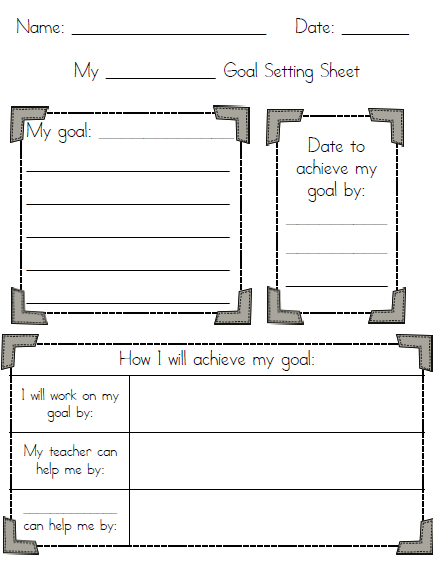
  • Goal-setting sheet: Students write out a goal, as well as how they'll take to get there. This will also include the goal date.
  • Post-its: Create an anchor chart for a subject area- reading, for example: Discuss possible areas of improvement and ask questions about which area they can focus on. Students can write their goals on post-it notes and add them to the chart (you can also write for developing writers). It's vital to refer back to this chart to check student growth. You may want to give them a goal sheet to keep as a reminder. This chart can group students by goals and collaborate on ideas to meet their goals.  
  • Goal Slips: I use these goal slips to help my students set goals to learn High-Frequency words. They choose how many words they will know by a specific date. We brainstorm some ideas of how they can get there: study their word rings for 5 minutes a day, work in a small group with me to practice, read their word list nighly at home.


Celebrate! When students have achieved their goals, they need to celebrate and be rewarded. Students earn a certificate of recognition, a prize, and a class cheer. Then they can set a new goal.  


Data- Also, it's important to remember to keep track of all data to help students reflect.


There are so many things students can set goals for-
      • Sight words, letters/sounds...
      • Fluency scores
      • Writing- more details, proper punctuation, adding feeling...
      • Reading more books
      • Doing their homework every night
      • Daily routines
      • Math Facts
      • Behavior management

      As you can see, you can have students set all kinds of goals! Start with one area you want to see student improvement in and work on that first. Don't try to have students set goals for every area. After all small steps are part of goal-setting.  


      Positively Teaching,

      Randi Muehlen

      @positively_teaching

      Sunday, October 27, 2019

      Worry is Just Wasted Energy

      How can we help students cope with stress when they have to take a district benchmark?  Recently, my students had to take our Reading Inventory assessment which is a reading comprehension diagnostic tool.  My fourth graders understand how this test works and that will measure their current Lexile level used to determine reading proficiency.  Of course, students can do well, struggle, or even score lower than the last time they took it. 

      As any concerned teacher, I continuously try to find new ways to encourage my students to relax as much as possible and to do their best.  I came across a new strategy at a recent conference I attended and wanted to try it out.  It is quite simple to implement:

      1.  Talk to students about what stress is and how it affects us during performance-type assessments.  Let them vocalize their concerns first. I described worry as just wasted energy.  If you allow it to take over, you won't get far in whatever task you have in front of you.

      2.  Hand out a half-sheet of lined paper.  Give students 3 or 4 minutes to write down what worries them about the assessment they are about to take.

      3.  While they are writing, place two trash cans at opposite ends of the classroom.  As soon as the timer is up, ask students to read what they wrote to themselves one more time.  At a determined signal, have students roll up their paper into a ball and toss it into a basket.

      4.  When my students threw their "worry balls" into the baskets, I could feel the tension released.  There were a few cheers as well.  Do NOT pick up the rolled up worry balls.  Leave them right where they landed.  I told my students that if they begin to stress out they could simply look towards everyone's concerns on the floor or in the basket to remind them that the act of worry is just wasted energy. 

      5.  Needless to say, reading gains were MUCH more than I had expected.  Of course, these gains are not exclusively because of this strategy but I hope it relaxed them enough to get through it with confidence!


      Happy Writing!
      Gustavo Macuil

      Wednesday, April 11, 2018

      Goal Setting For the Win!


      Goal Setting For the Win!
      Goal setting is a very powerful teaching tool that should be used in every classroom across grade levels! Creating small, attainable goals helps students to achieve success and boost their self-confidence. Setting academic goals also helps students to know what to focus on, and motivates them to do so. Not all learners are intrinsically motivated, so doing goal setting with your students helps to instill that motivation and drive for success within themselves.


      Goal setting can yield powerful results and success in the classroom- both for the students AND the teacher!


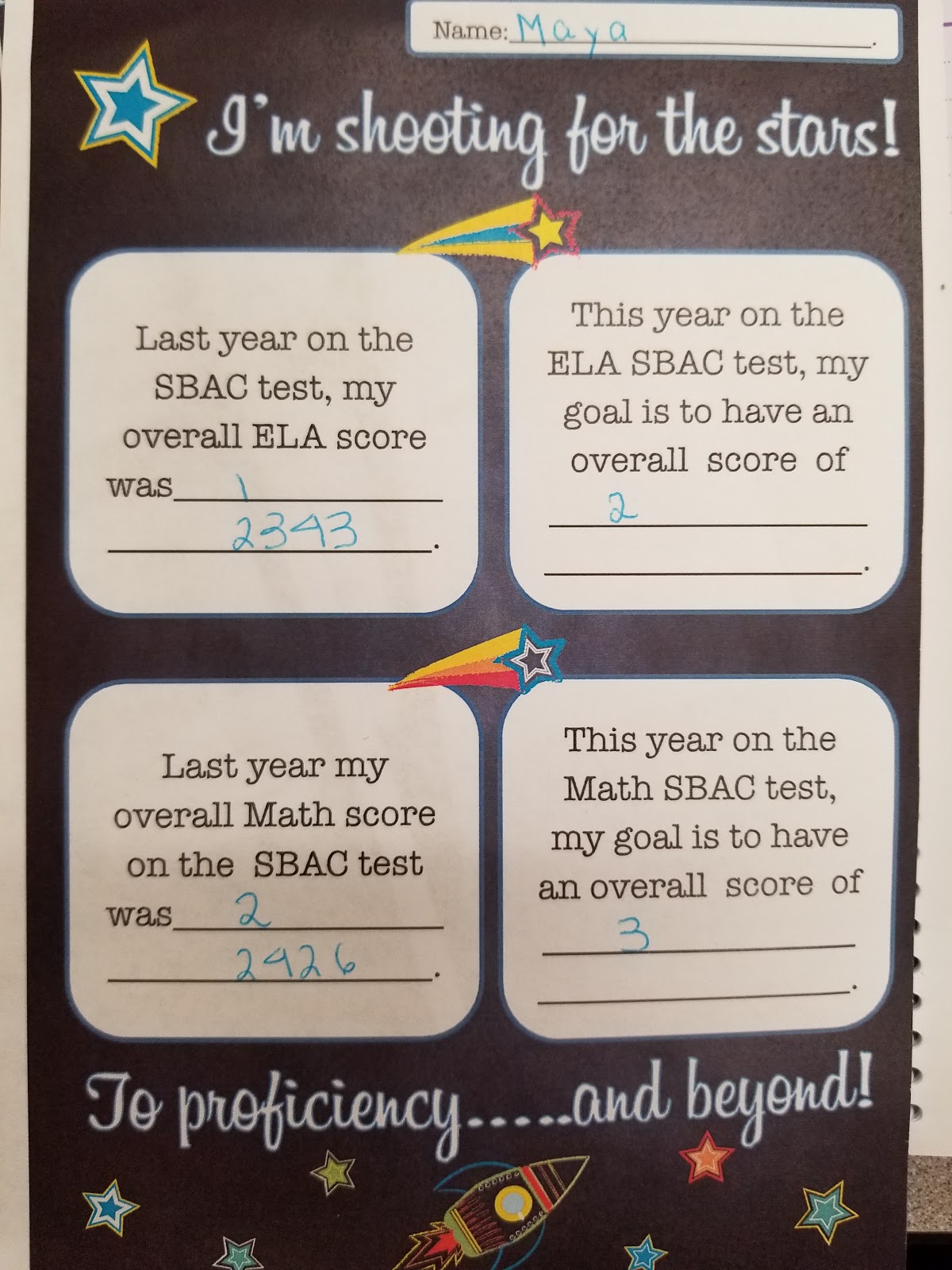
      It’s extremely heartwarming to see the look on the kids faces and hear their excited conversations when they find out they have achieved a goal they set! In my classroom, I goal set with the kids prior to each SRI assessment, and prior to the district Math and ELA benchmarks.  It really is a powerful tool to help students focus on a specific skill, motivate them to learn, and helps them to feel accomplished when meeting their goals.  Those who don’t achieve their goals are generally further motivated to  work harder until they accomplish what they’d like to.  My school site additionally does goal setting with each student in grades 3-6 prior to SBAC testing as well (you can see an example of this below). It really does serve as a motivational tool and helps give them a purpose and something to really strive for. 


      So how exactly can you implement goal setting? It’s easy! Here’s how you can get started:


      1) Have frequent Growth Mindset conversations with your class.  Let me know that they CAN accomplish ANYTHING they set their mind to.  Let them know that you believe in them, and that you are here to help them accomplish their goals.  

      2) Meet one-on-one with students prior to a test you would like to goal set for.  Show them their score on the last (similar) test, and then help them pick an attainable goal for the upcoming test.  Discuss specifically what they will need to do to achieve their goal, and what they might need from you to accomplish this goal.

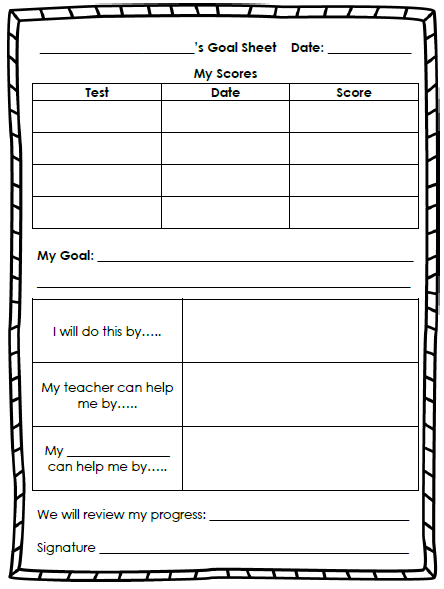
      3) Provide them with some sort of paper that records their previous score (see examples above), and then add their current goal as you are discussing with them.  This can simply be done on a sticky note that they can just stick right on their desk and have as a constant reminder.  Or you can have them complete a more in-depth template where they might record their thoughts, ideas, etc. as in the examples above.  Either way is equally as powerful as long as the right conversations are being had!  

      Collaboratively Learning,
      Megan Brown

      Copy of pic- Megan Brown.jpg
      OMSD.jpg


      Most Viewed Posts