Showing posts with label Communication. Show all posts

Thursday, August 22, 2019

Building Relationships With Students

Classbuilding and Teambuilding

Why do teachers who do more Teambuilding and Classbuilding obtain higher academic scores? Teambuilding and Classbuillding  create relaxed alertness, the ideal state for learning. When students meet their needs for security and belonging, they are free to engage in higher-level learning. Disruptions and discipline problems decrease, speeding up student learning. When students feel safe, known, respected, and appreciated they enjoy school more, like their teacher more, and are more prepared to learn and work hard."  -Dr. Kagan

Starting off the year on the right foot by building relationships with your students will help your entire school year to run smoothly and successfully. I can personally attest to this, as I have had a number of students over the past few years, who I saw HUGE amounts of growth in their academics, once I had built relationships and made connections with them.  Once they knew that I was truly rooting for them and cared about them and their well-being, it gave them an extra motivation to work hard. I had a student last year who came into my class struggling, he was a bit of a disaster, struggled with behavior and academics.  After spending a great deal of time connecting with him and building relationships class-wide, by the end of the year he was one my best and MOST FAVORITE students! He excelled with growth both academically and behaviorally and said to me one day, "Miss Brown do you know why I always try my hardest now? because I know you really care about us and you really want what's best for us." It was VERY eye-opening and warmed my heart.  It's a very rewarding feeling.  Building relationships with your students truly benefits both the students and YOU as the teacher!

"When teachers are able to take the time to build a stronger relationship with their students, it's possible to create a stronger understanding of what individual students need to achieve higher levels of growth. By doing this, teachers can adapt their classroom activities to better meet the needs of students"  -Kirby Hall

Building relationships with students is a very simple way to implement behavior management in your classroom.  The closer of a bond you build with your students, the less likely they are to have behavior disruptions within your classroom. ADDITIONALLY, this also leads to students academic success.  It's  win-win!

Here's how you can get started:
 1) Start by utilizing team building structures on a daily basis the first few weeks of school.  Kagan defines these as a non-academic activity that promotes positive social interaction between small groups (table groups) in effort to get students to learn about and feel comfortable with one another. Here are some great Kagan structures that I used to support team building the first few weeks of school:

  • Me Bag- Students are given a paper lunch bag and asked to take it home, fill it with a designated number of items that represent them, and bring it back to  share with their teams.
  • Team Word Finder- Similar to the game Boggle, teams are given one paper that has a square grid of letters on it, they have to work together as a team to create words.  The longer the word the more points that word gets.  You can do team celebrations once the activity is finished.
  • Sentence Builder- Very similar to the activity above except in this  one, students are provided with pre-cut words and have to work together as a team to build as many sentences as they can.
  • Would you Rather... Kids love this! They're given a list of 2 scenarios (both kind of silly) students take turns going around the table (Round Robin) stating which they would rather do and why.     
  • Team Cheers-  Have teams/table groups create a team cheer once they've had an ample amount of time to get to know each other and feel comfortable.                        

2)Classbuilding: Kagan defines Classbuilding as a structure that provides mutual support among all of the students in a class, and creates a positive context for learning.  It is important that students see themselves as part of a larger group- the class- and not just as members of one small team.  A couple of ways that I have done this within the first few weeks of school:

  • Find a Friend Scavenger Hunt: A sheet is provided to each student that has a number of categories (ie favorite sport, favorite food, etc).  Students fill in their own answers and then mix around the room until they have found a friend who shares their same answers.
  • Mix-Pair-Share: This structure can be used with ANY "getting to know you" type of question, have students mix around the room, pair up with a partner whose not from their table, and share their answer to the question you provided them. They can Mix and share multiples times for the same question thus, allowing them to converse with many different partners in the room.
  • "Taco Bout it" Cards- Students are provided with cards to ask questions they have about the teacher, their classmates, their classroom, and the school year- they then put each question card in the corresponding bag and the teacher will pull them out one at a time, read and answer the questions, inciting discussion as it pertains.
  • Community Circles: In short, this is a structure which helps teach students to communicate and share feelings in a classroom setting.  Students are to stand or sit in a whole group circle.  The teacher gives them a prompt or sentence starter where students then go around the circle (passing an object to signify their turn) and share their thoughts/feelings.  This is only done successfully when you have instilled that sense of community and safety to share among others. You want to start out with fun or simple prompts- perhaps they are only sharing a one-word answer, and then can slowly move into more complex topics.
 

Just remember that both Classbuilding and Teambuilding activites are to be non-academic and promote positive social interactions between the teacher and students.  It's NEVER too late to get started!!!

Collaboratively Learning,

Megan Brown
Copy of pic- Megan Brown.jpg


Wednesday, April 18, 2018

Learn, Create, Share


Learn, Create, Share


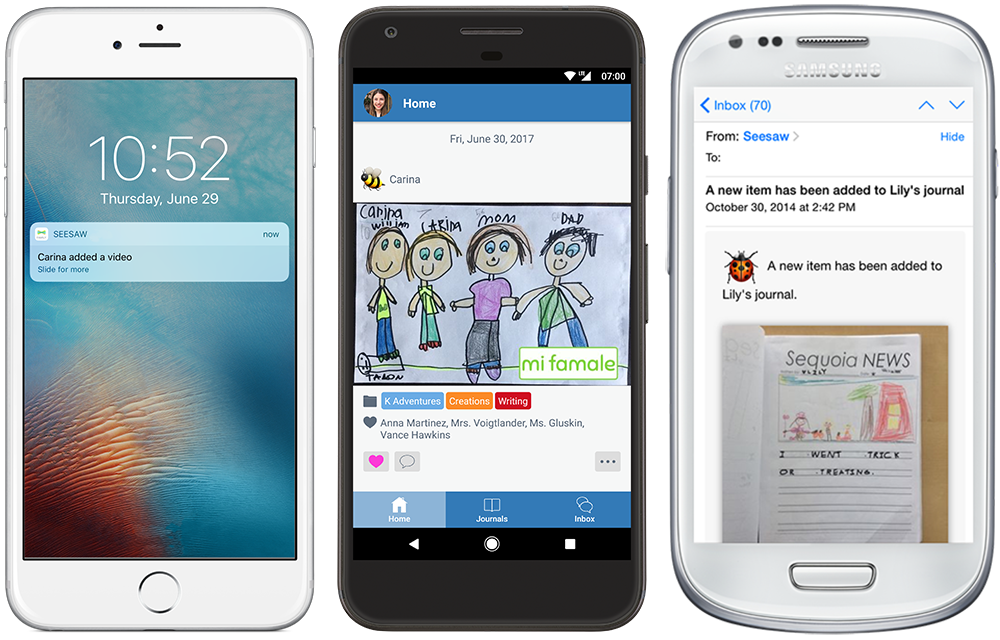
As mentioned in my last blog the Seesaw app is a learning and communication tool. Not only does it enhance learning but it also boosts communication between teachers, students, and parents. Did you get the opportunity to create an account for your class?

“Can you say phenomenal?” - Online Teacher Review

Wouldn’t it be phenomenal if your students’ parents could have a daily glimpse of how their child is doing in math? What if I told you it's possible? Through this tool student’s are able to show their parents a glimpse of how they are doing in math on any given day.

We have recently introduced multiplication to 2nd graders. They love it! But imagine how much more engaged in math they could be when integrating technology!


Last week there was a math lesson with an Application Problem that read:


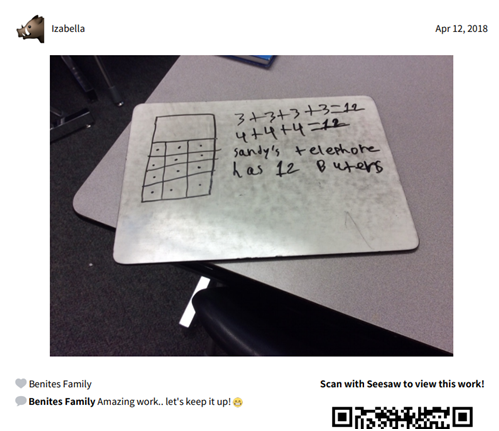
Sandy's toy telephone has buttons arranged in 3 columns and 4 rows. 

a. Draw a picture of Sandy's telephone. 
b. Write a repeated addition equation to show the total number of buttons on Sandy's telephone. 
c. Answer the question in a written sentence. 

So how did I integrate Seesaw with this application problem? I added it to Seesaw as an “Activity.” After discussing the application problem students solved the problem on their whiteboards, took a picture of it, and uploaded it to their Seesaw account. Once uploaded, their parent gets an alert and they can see it on their phone! If you allow for it, they can even comment! Check out one student’s result:


As you can see, Izabella, solved this problem correctly. Her family was able to see her work and just a few minutes later comment on her work: “Amazing work. Let’s keep it up.” Students love to make their parents proud!

Watch what happens when students solve an answer incorrectly. This next problem was part of an application problem that required students to add up to 3 different addends.

Wow! This student’s parent quickly reminded her son to make sure to check his work. I find this to be quite powerful! Now they are accountable to show not just their teacher, but their parents too!
This tool can also be used as proof during conferences. Instead of going through a pile of papers, go straight to this students’ profile. There it is! A digital portfolio of work throughout the year.

“Parents love that they get a glimpse of a typical day in their child's classroom. I can also capture many items and observations for students' individual portfolios. Super easy to set up, share and use daily.” Online Teacher Review

Aren’t you excited to start using this tool? Check out the following tutorial on how to Create a Seesaw Activity . Now you can easily create and share activities for your students to complete in Seesaw. I’d love to hear what activities you come up with!

Inspiring Minds,
Melissa Hernandez


Conferencing with Students = Communicating with Parents (part 2)

Conferencing With Students =
Communicating with Parents (part 2)


     What is more exciting than conferencing with a struggling reader or perhaps an English Learner and witnessing their continuous effort to become fluent readers?!  In this month’s post, I want to continue talking about how to conference with students using authentic and meaningful data in order for them to articulate this data with their parents!  

Conferencing with students should be meaningful for both teacher and student.  It is an important opportunity to create, strengthen and continue the teacher-student bond that can last for years to come!

I have made an extra effort to use the technology that our district provides such as Renaissance Learning products (Accelerated Reader) in order to meet with students about their reading habits/progress as well as convert these into an opportunity to communicate with their parents.  AR offers lots of reports and I would like to share how I use the word count report with students.  At our school, our Principal has created a “challenge” to all students.  Each grade is challenged to gain a certain amount of AR points within a six-week period.  If students achieve these points, they receive an extra recess as well as a brag tag.  The brag tags have been a great incentive this year as most students really want to collect all six Principal’s Challenge tags for the year!

Each time a student passes an AR quiz, the program adds the total word count of that particular book into the student’s record.  AR allows teachers to run reports within certain time periods to report a particular word count for that time period.  What I like to do is use an informational chart that our principal provided us a few months ago about the impact that reading has on academics.  I decided to create a worksheet (embedding this chart) in order to allow my students to reflect on how they did during the principal’s challenge and what this tells them about their reading habits.  In the video below, you can see how I conferenced with one particular student to help her reflect on her reading.  I also encouraged her to make personal goals for the next challenge.  In the end, she made certain that she would be able to share this information with her mom at home. 

Items to remember during student conferencing:

1.   Keep it simple - try to make data “kid-friendly” but don’t be afraid to use academic vocabulary when reviewing reports.  Kids get it!

2.           Keep it positive - students tend to gravitate towards the “mistakes” so become their cheerleader and their coach by celebrating their progress.

3.           Keep it brief- remember that you have a lot of students and not enough time.  Allocate just a few minutes for each conference...I usually try to keep them under 10 minutes...less is more!  

4.           Keep it reflective - it is more important to me my students understand HOW they learn instead of what they’ve learned.   Questions I try to use over and over: What does this tell you about yourself as a learner?  What goals can you set? Why?

5.           DON’T keep it to yourself - have students share their data home to share with parents.  Parents often mention to me how impressed they are to hear their child articulate details about their performance or progress.  It is exciting to receive this feedback during parent conferences or unexpected emails.


Learning and growing along with my students!
Gus Macuil

Most Viewed Posts