Friday, February 16, 2024
Gradually Learning to Let Go, Part 3
Wednesday, February 7, 2024
HOT Questions (Higher Order Thinking) - "The New Classroom Instruction That Works"
Welcome to 'Huddle Time' - the purpose of this time is to provide a short video that offers student centered ideas to consider for your classroom.
HUDDLE TIME VIDEO #11
Today's Huddle Time focuses on
- A new book I am reading "The New Classroom Instruction That Works" by Bryan Goodwin and Kristin Rouleau, 2023.
The book examines six phases of learning and 14 teaching strategies that support them. The 105 research studies referenced in the book encompass all grade levels and subject areas - which means there is something for everyone in this book.
The book has reinforced several strategies I currently employ in my classroom. At the same time I am challenged to close learning gaps and support the success for each of my students through the use of researched based teaching practices identified in the book.
As I start my journey, I am challenged with the strategy of 'High Level Questions'. The strategy is embedded in the phase of learning where students are trying to make sense of their learning. In an effort to be more strategic in my questions, I am asking students to consider 3 questions during the lesson - a comprehension question, a strategy question, and a connection question. The purpose of the three questions is for students to think about their learning.
This week's questions - Math 8 - Resource Link
This week's questions - Integrated Math I - Resource Link
I will give an update next month on my progress with this strategy and where I am headed with other strategies from this book.
Remember to believe in yourself, believe that you matter, and believe that you make a difference in students' lives every time that you interact with them.
Teaching and still loving it,
Kevin Stott
De Anza Middle School
Thursday, January 25, 2024
UDL Notebook: It’s Casual
My previous blog post discussed the importance of classroom environment when it comes to engaging and supporting students in UDL. I provided a multitude of examples of how I have tried to enhance the vibes in my classroom this year so that it could help, “minimize threats and distractions, foster collaboration and community, and facilitate personal coping skills and strategies,” for my students. In this post, I will discuss one of my favorite new strategies for making use of this space and helping students learn the crucial communication skills they need to be successful UDL participants. I call this strategy “Casual Conversation,” which is a very literal, unimaginative name for it.
Readers of my two previous UDL blog posts are likely tired of me citing entire paragraphs from the Engagement portion of the UDL Progression Rubric in order to support my assertions, so I am going to try to refrain from doing that wherever possible. I will leave it to you to decide if you would like to review it before proceeding, but I can tell you that there are many instances throughout the rubric in which students are expected to confidently and respectfully express themselves to both their peers and their teacher. As I discussed in my previous post, I feel that a first step to properly behaving and communicating in a classroom environment is to practice doing these things in less formal settings. If a student is incapable of holding a polite, casual conversation with a friend or classmate, what hope do they have of participating in something as formal, structured, and academic as a Socratic Seminar or Literature Circle?
As parents, my wife and I are able to ensure that our children are given ample opportunities to participate in conversations with a wide variety of interlocutors around the dinner table, on car rides, at family get-togethers, and during play dates. Frequently, we either participate in these conversations directly or surreptitiously eavesdrop on them (Don’t pretend you’ve never done this, my fellow parents!). Either way, we use these opportunities to provide our kids with feedback about the strengths and weaknesses of their respective conversation skills. Intentionally or otherwise, we also model what polite conversations look like on a regular basis (I mean, I hope we do…usually). All of these considerations led me to an obvious question: How could I curate similar experiences for my students in class? Here are some things that occurred to me as I began to formulate an answer to this:
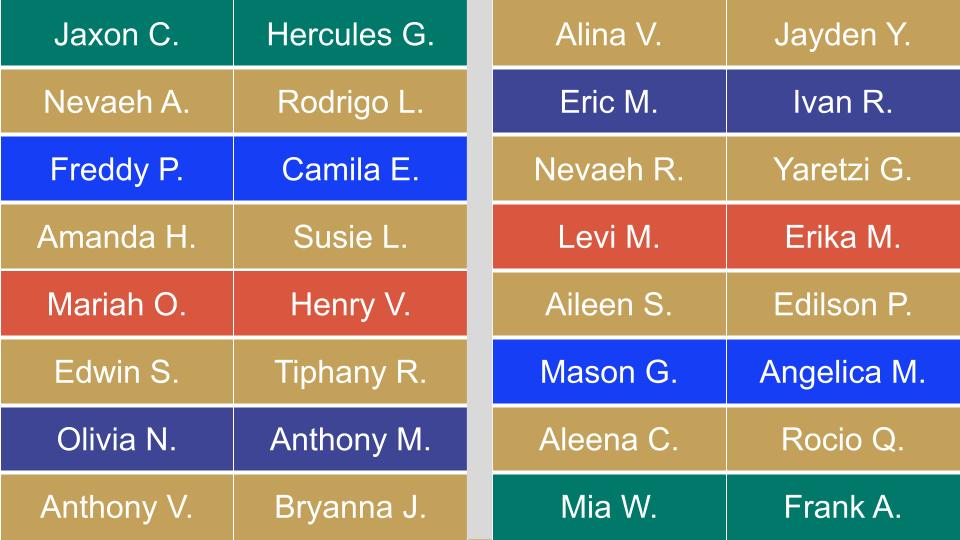
I would want my students to practice their conversation skills with a wide variety of peers (By the way, this is actually an advantage that all teachers have over parents: the potential partner combinations are seemingly endless!). I could have each student spend a solid week partnering with every other student in the class. This would mean that, eventually, every student would have spent quality time getting to know every one of their classmates. This would certainly foster a more positive, friendly, and safe classroom environment in which kids would be comfortable working with just about anyone in their class.
Display of weekly partners from a Google Slide presentation
I would want there to be a focus on learning to sustain friendly conversations with peers with whom students would not usually choose to converse regularly. A big emphasis should be put on having a positive attitude when discovering who they are being partnered with and finding ways to be empathetic and kind towards even their least favorite fellow students. I would also like them to learn to find at least one connection to each of their classmates.
I would like to teach conversation skills explicitly but in a low-stakes environment. A quick mini-lesson (perhaps in the form of a video) on a specific skill before the casual conversations begin should do the trick. I could cycle through the same 10-15 skills every 2 or 3 weeks, and the students should be allowed to decide whether they would like to deliberately focus on the daily skill (perhaps it’s already a strength of theirs and they’d prefer to focus on something else).
Skills can include things like: taking turns speaking, active listening, reading facial expressions, keeping personal space, staying on topic, asking questions, and making comments.
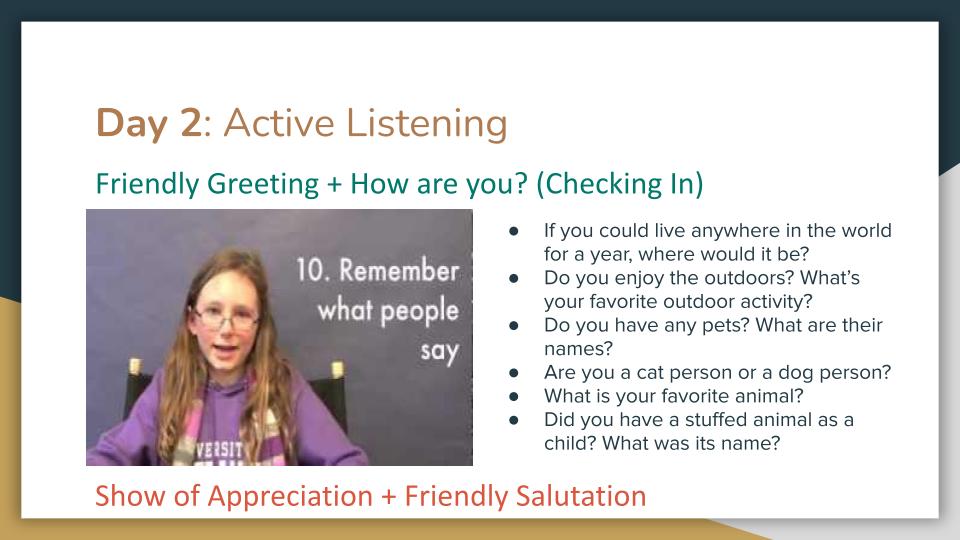
I have found some wonderful YouTube videos on conversation skills, including this one on Active Listening.
Partners should be allowed to sit together wherever they want; this is an opportunity for them to use the cushions, blankets, and other alternative seating discussed in my previous blog post.
Some chill music should play quietly in the background (like in a café!).
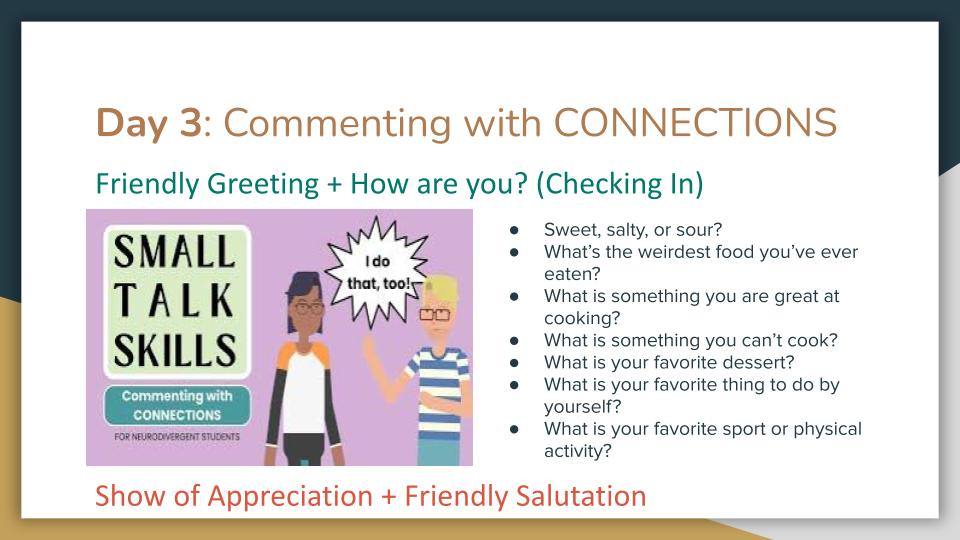
A daily Google Slide with the skill lesson and other suggestions can be displayed on the Smartboard while the kids chat. A reminder can be posted on the slide to start their Casual Conversations with a friendly greeting and a quick SEL-style check-in to see how their partners are feeling. A list of suggested icebreakers can also be posted, but kids should understand that the icebreakers are only there to support them if they are struggling to generate their own topics of conversation. Additionally, prompts for the kids to show appreciation to their partners and end the conversation with a friendly salutation can be included.
Prompts remind students to greet each other, check in, show appreciation, and end the conversation with a friendly salutation. There are also some Ice Breakers borrowed from our district’s SEL Toolkit.
As you can see, a strategy that seemed almost comically simple when I first conceived of it ended up being far more complex and nuanced than I could have imagined, but it is not an exaggeration to say that it was an obvious success from the moment we first tried it. I was shocked at how quickly my kids embraced Casual Conversation, and their feedback was immediately positive. They now get quite frustrated with me when I do not manage to fit it into our schedule, and this is probably the most meaningful way in which it contributes to the larger goal of improved engagement: It is something my kids look forward to every day, and we all need more of that in our lives!
Writing Every Day,
Eric Lovein
Thursday, January 18, 2024
UDL Notebook: Café Vibes
My previous blog post provided a brief overview of UDL and discussed why Engagement is the logical first step in developing a UDL classroom. Using the UDL Progression Rubric, I described the characteristics of a successful UDL student, and I briefly mentioned the fact that I have tried to make my classroom a more enjoyable, relaxing place to learn. In this post, I will elaborate on how I have done that and what I still hope to improve about my students’ learning environment in the near future.
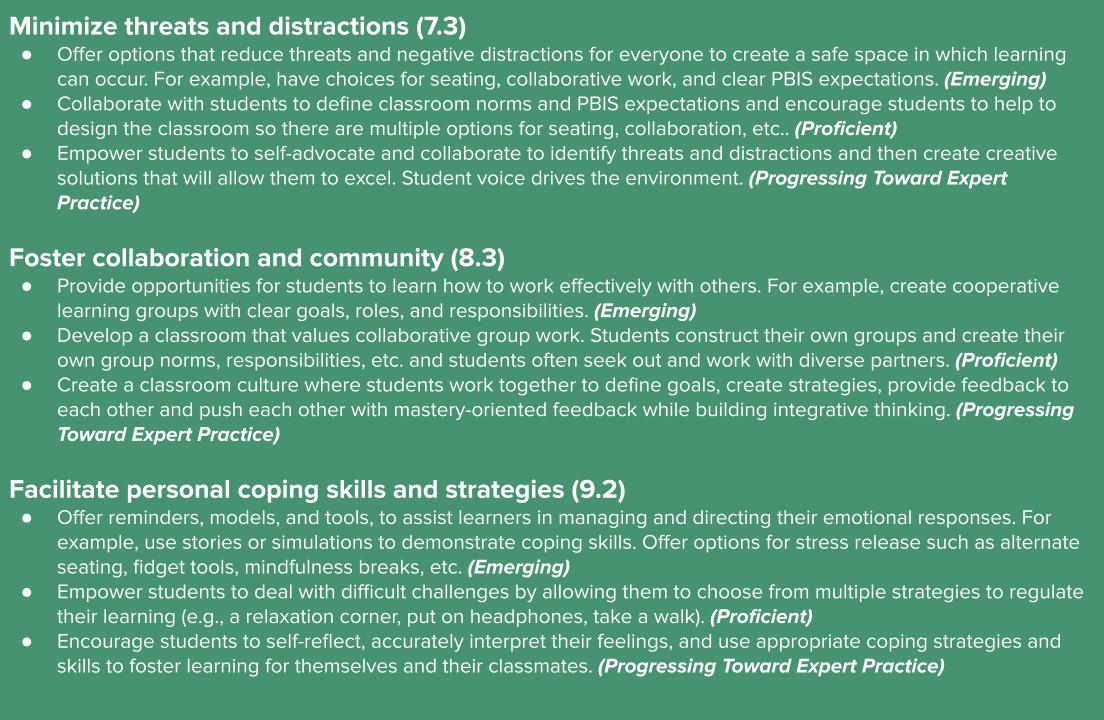
The first thing you should know is that, before this school year, my classroom was an incredibly underwhelming place to visit. I’ve always been a, “It’s not about where we are learning but what we are learning,” kind of guy. If I’m honest with myself, I simply didn’t have a lot of confidence in my decorating skills, nor was I overly-motivated to improve them. After reading through the Progression Rubric’s descriptions and examples of what it means for a student to be truly engaged in the UDL sense, I realized that my classroom needed a major facelift. Using several of the Engagement standards as a guide, I tried to envision what a classroom that could minimize threats and distractions (7.3), foster collaboration and community (8.3), and facilitate personal coping skills and strategies (9.2) would look like. The below graphic shows the Emerging, Proficient, and Progressing Toward Expert Practice levels of each of the three standards I have deemed most relevant to my classroom environment. Unlike with some rubrics, each of these levels is worth a gander. Even the Emerging level descriptions have some great suggestions for getting started.
After absorbing the information in these standards, I settled on the idea of creating a café vibe. The rabbit-hole thinking that led me to this decision went something like this:
I eventually want my students to become self-knowing, self-sufficient, self-disciplined, self-guided, and self-motivated learners. This seems like a pretty ambitious goal.
To the extent that my own children at home possess these capacities, I feel like they developed a lot of them outside of the classroom. Visits to parks, gardens, museums, beaches, restaurants, libraries, forests, and theaters have provided my wife and me with ample opportunities to teach our kids to explore their curiosities and interests, advocate for themselves and take chances, and learn to act responsibly in a variety of social contexts.
While I cannot take my 30 students to these sorts of places on a regular basis, perhaps I can, to some extent, replicate the most important aspects of these experiences for them while they are at school.
By “the most important aspects,” I mean the parts where they are: directly taught how to get the most out of each experience while allowing others to do the same, being given ample opportunities to practice these skills, and consistently reflecting on their successes and failures.
Building on the theme of social contexts, here are some of my initial ideas:
I could have a recurring activity called “In the Restaurant” in which I teach a mini-lesson on restaurant etiquette, table manners, or appropriate topics for discussion while eating. The kids could then eat lunch in my classroom at tables done up to look like restaurant tables. Students could then be instructed to practice any skills that have been taught in said mini-lessons, perhaps with parent volunteers acting as hosts/hostesses and waiters/waitresses.
Similarly we could have an SEL-related activity called “In the Café.” Kids could sit in comfortable spaces around the room, sipping beverages (perhaps served up by parent volunteers), and having casual conversations with predesignated partners after a mini-lesson on conversation skills. Note: A version of this idea has evolved into an activity called “Casual Conversations”—much more on this later (mostly in my next blog post).
The thinking behind UDL originated in architecture—the idea being that the built environment should work for everyone. Therefore, it is incumbent upon me to make my classroom as comfortable and functional as possible. This should include flexible seating and spaces to accommodate a wide range of activities, discussions, and projects. I am picturing something like the shared work area of a hipster tech company designed to allow people and ideas to flow freely while some cool music plays quietly in the background. Words like “cozy,” “chill,” “warm,” “welcoming,” “fun,” and “stimulating” all spring to mind.
I want my kids talking to each other (and me!) constantly in a wide variety of structures and contexts. These should include, but not be limited to: Kagan structures, Literature Circles, Philosophical Chairs, Socratic Seminars, Casual Conversations, group projects, and student/teacher conferences. Some of these structures will require tables (Kagan team activities and group projects), while many others will require open floor space and cushions, pillows, blankets and other flexible seating options. This will be particularly important if I expect my students to, “construct their own groups and create their own group norms, responsibilities, etc. and students often seek out and work with diverse partners.”
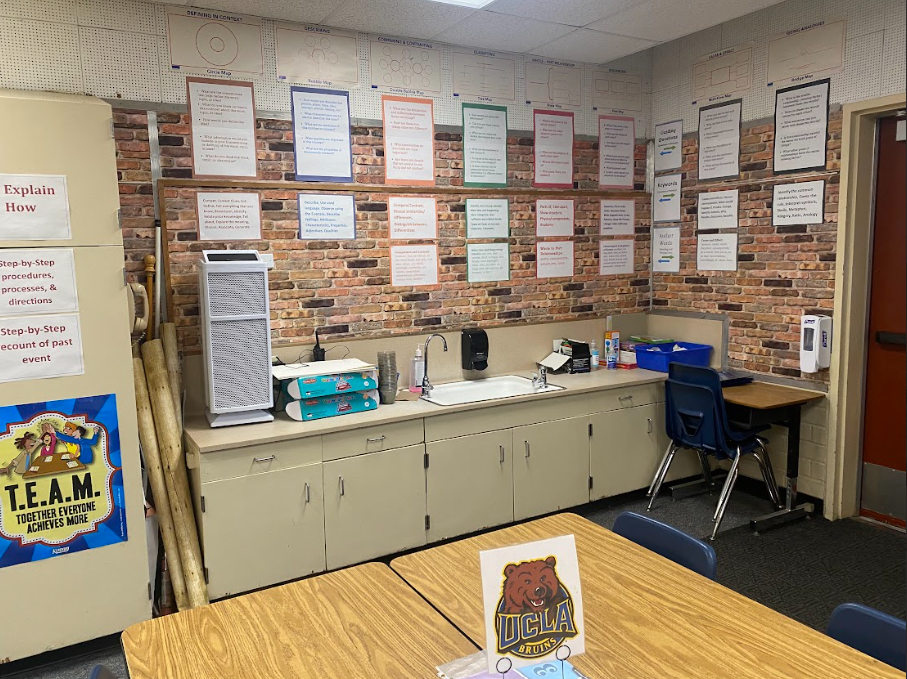
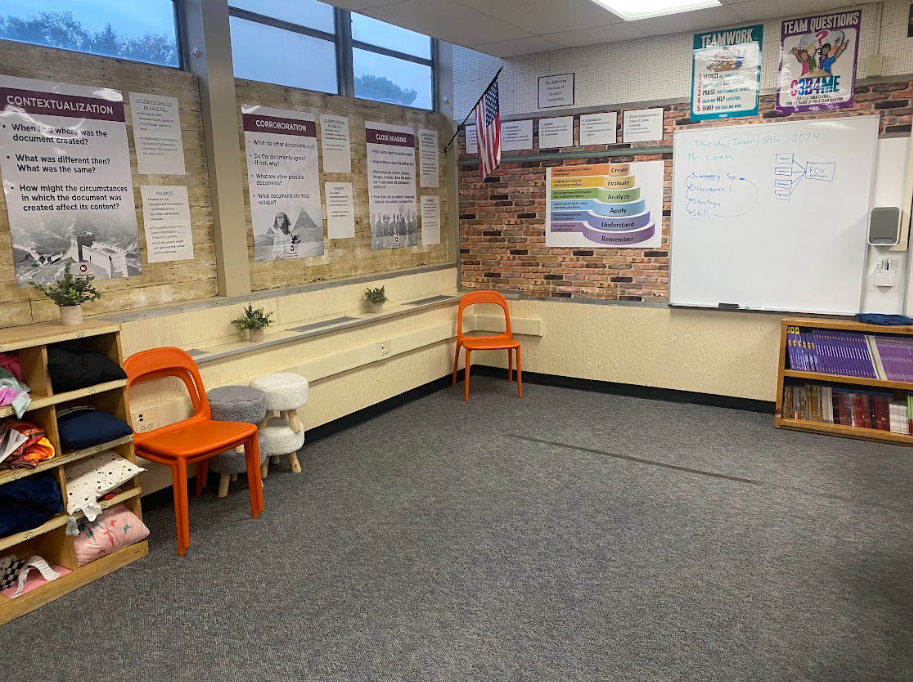
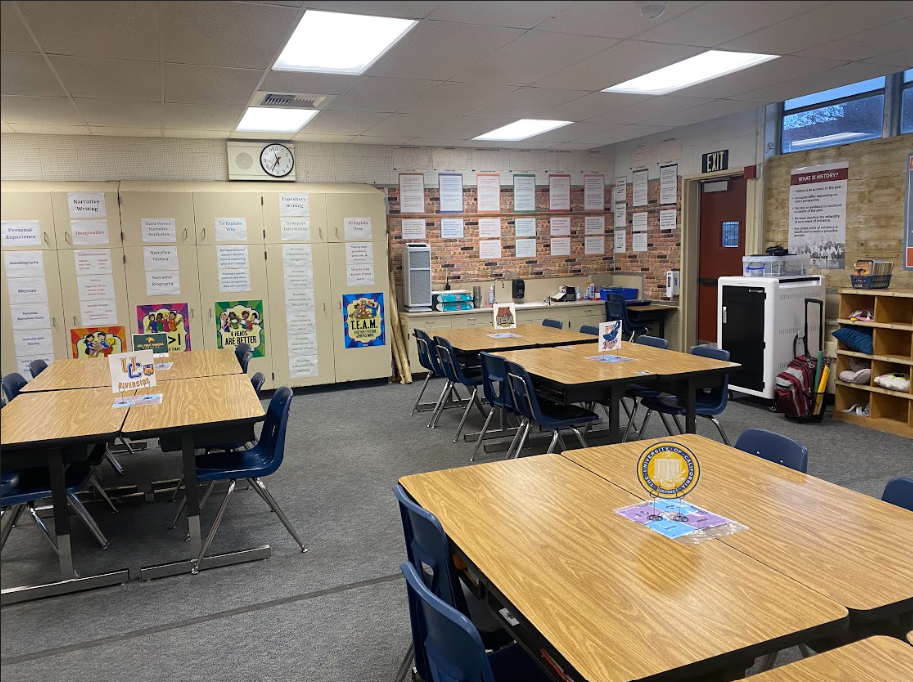
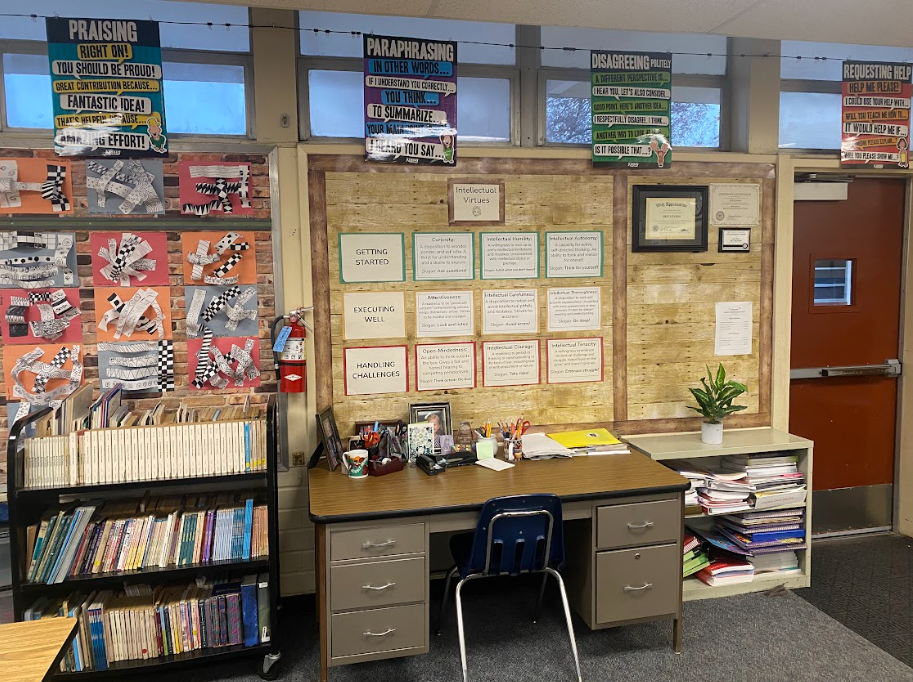
I am still a bit self-conscious about my room’s appearance, mostly because I have no confidence in my design sense, but there is no denying that it looks a heck of a lot better than it has at any time in the last dozen years (not a high bar to clear). Here are some of the positive changes I have made on a budget (See the accompanying photos for visual proof):
I ripped down my decades-old “fadeless” paper and replaced it with spanking new brick and wood designs that evoke a reclaimed space in DTLA.
I bought fake plants of various shapes and sizes and used them to green up my classroom environment.
I repurposed my cubby holes to serve as yoga studio-style storage spaces for my kids’ cushions and blankets—used for sitting comfortably on the floor during old-school read alouds, Casual Conversations, and collaborative learning.
I bought/requisitioned a variety of chairs and stools that kids can use in the aforementioned contexts.
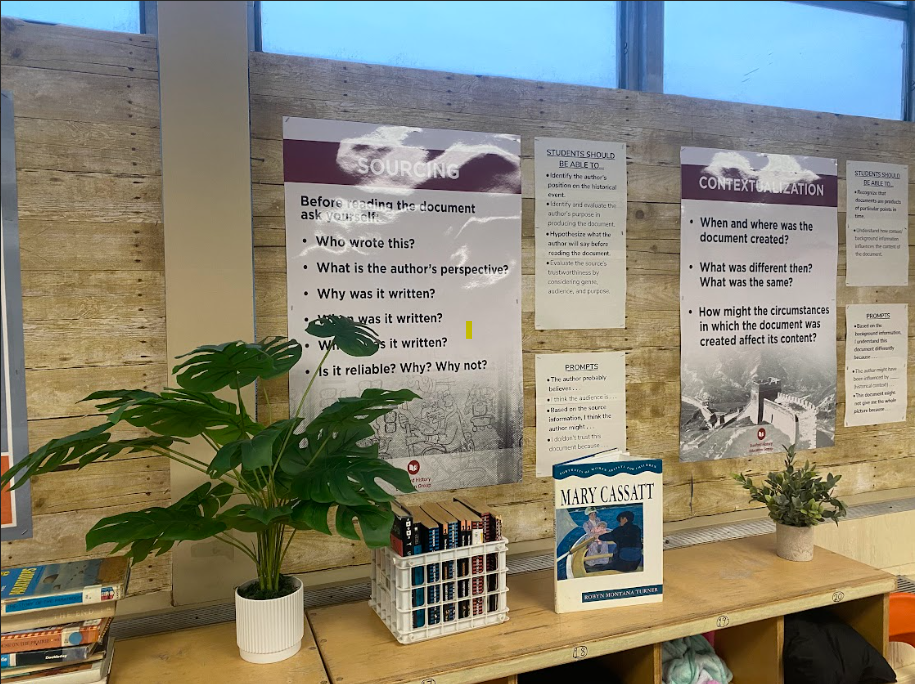
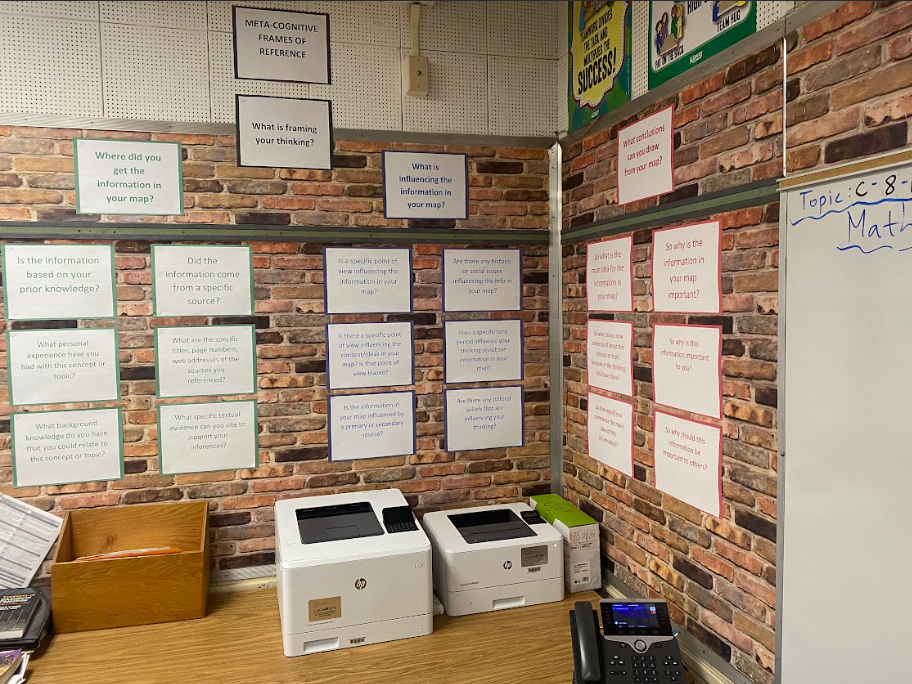
I replaced my old, faded, sad-looking informational posters with fresh ones. I have always prioritized information when it comes to wall decor, and I think UDL makes this more important than ever; if I want my kids working independently or on group projects based on personal interests, I still need them to work within the meta-cognitive guidelines I have set forth. For instance, If I am teaching you how to Report Information by Comparing and Contrasting in Social Studies by writing about a self-selected topic, I am still going to expect you to use the resources around my classroom on things like Double Bubble Maps, Sourcing, Contextualization, and Corroboration (See below photos for examples).
Fresh paper, college signs and Kagan mats, fresh informational posters
Large open space for bringing kids to carpet or allowing them to stretch out while having Casual Conversations or participating in Kagan structures, cubbies with cushions and blankets, plants for touches of green
Here are some further ideas for my classroom upgrade that I hope to incorporate in the near future:
- Continue to add more cozy seating options, including a sofa if possible. Coffee and side tables would also be cool.
- Add a rack or shelving in my sink area where each student can keep a mug for beverages.
The UDL Progression Rubric has certainly convinced me that enhancing my classroom environment is a key to improving student engagement. In my next post, I will discuss one of my early engagement successes: Casual Conversation.
Writing Every Day,
Eric Lovein
Monday, January 8, 2024
Gradually Learning to Let Go, Part 2
My journey into the complexities of the gradual release framework continues. I specifically chose to use the term "complexities" because it is defined as "a factor involved in a complicated process or situation." This perfectly captures the complex process we educators undergo as we plan how and when to let students begin assuming control of their own learning.
We want to empower and challenge our students with rigorous and meaningful work, yet at the same time, we have to be careful not to frustrate them by releasing too much too soon. It's a fine balance that brings to mind Lev Vygotsky's Zone of Proximal Development, which is defined as "the space between what a learner can do without assistance and what a learner can do with adult guidance or in collaboration with more capable peers."
The key is to have a deep knowledge of where our students are academically. There are several ways to ascertain that information, such as anecdotal notes taken during instruction, formative assessment results, and exit tickets, to name just a few. In our district, we are fortunate to have iReady to help us track students' progress (i.e. lessons passed) and needs on a monthly, weekly, and even daily basis. These are but a few of the ways we can collect information about our student's academic needs, which can range anywhere from filling in academic gaps to challenging students. The information we gain will enable us to determine at what point students are ready to be more independent.
As I mentioned in my previous blog, I read Better Learning Through Structured Teaching by Douglas Fisher and Nancy Frey to build my knowledge of gradual release. My logical next step was to try out my newly acquired knowledge with my own students. I began the process yesterday during my students' writing block. To be honest, it wasn't comfortable. I expected and even embraced those uncomfortable feelings. I was challenged, but not frustrated. (I explained to my students that it's common to experience a range of emotions when learning new material.) There was a palpable tension in the air as I was gradually letting go and encouraging students to work more independently. Note that I said, "more independently." You can't just throw students into the cold, deep water; you need to ensure that students know how to swim.
I was pleasantly surprised to see students willingly grapple through the writing process. They reached out to one another for support as they struggled to craft sentences and spell words correctly. They read their writing to one another to obtain a second opinion. A handful of students even asked if they could start over because it wasn't their best work. I'm learning a lot. I'm learning how to gradually let go.
Still Loving Every Minute,
Lola E. Jollie
Friday, December 1, 2023
Lets Go To Video Review! - A new strategy for me
Welcome to 'Huddle Time' - the purpose of this time is to provide a short video that offers student centered ideas to consider for your classroom.
HUDDLE TIME VIDEO #10
Today's Huddle Time focuses on
- Student Feedback through video review
Sample Videos from my Quiz #12 (Math 8) - I try to keep the videos short for the students. I also tell myself to do each problem one time and not to make multiple videos to honor my time and not caught up in being absolutely perfect.
Quiz #12 - Problem #1 - Video LINK
Quiz #12 - Problem #2 - Video LINK
Quiz #12 - Problem #3 - Video LINK
Quiz #12 - Problem #4 - Video LINK
Quiz #12 - Problem #5 - Video LINK
Quiz #12 - Problem #6 - Video LINK
Quiz #12 - Problem #7 - Video LINK
Quiz #12 - Problem #8 - Video LINK
Student Reflection Google Slide - LINK
Remember to believe in yourself, believe that you matter, and believe that you make a difference in students' lives every time that you interact with them.
Teaching and still loving it,
Kevin Stott
De Anza Middle School
Friday, November 17, 2023
UDL Notebook: Engagement First
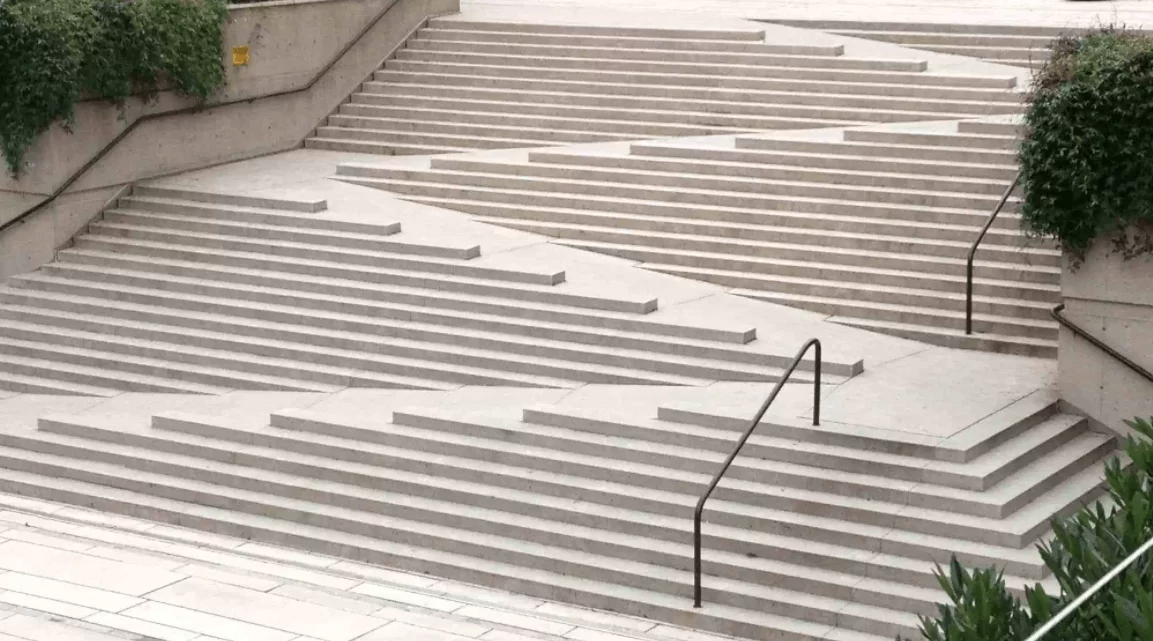
Last year, I was fortunate enough to attend a two-day district training on Universal Design for Learning (UDL) presented by the wonderful Nicole Tucker-Smith. I came away convinced that I needed to immediately begin implementing UDL in my classroom. If you are not familiar with UDL, its basic premise is that all students can learn and be successful if classrooms and lessons are designed to meet their individual needs. The principles of UDL originated in architecture. The staircase/ramp pictured below is a perfect example; anyone, regardless of their preference or ability, can use it to reach the top.
You can think of UDL as comprehensive differentiation that meets the needs of all students in three core areas: Engagement, Representation, and Action & Expression. As you can see in the graphic below, Engagement is the “Why?” of student learning; here we are concerned with motivation, affect, agency, interest and SEL skills. Representation involves what methods and materials are being used for and by the student to learn the required content; if the objective is for the student to learn how to add mixed numbers using the standard algorithm, the means (or path) to this objective can be varied (realia, videos, white boards, etc.). Finally, Action & Expression concerns the assessment of the student’s learning. If the objective is for the student to demonstrate knowledge of the causes of the American Revolution, the way they demonstrate this knowledge (the product) can be varied (presentation, video, essay, skit, test, news article, etc.).
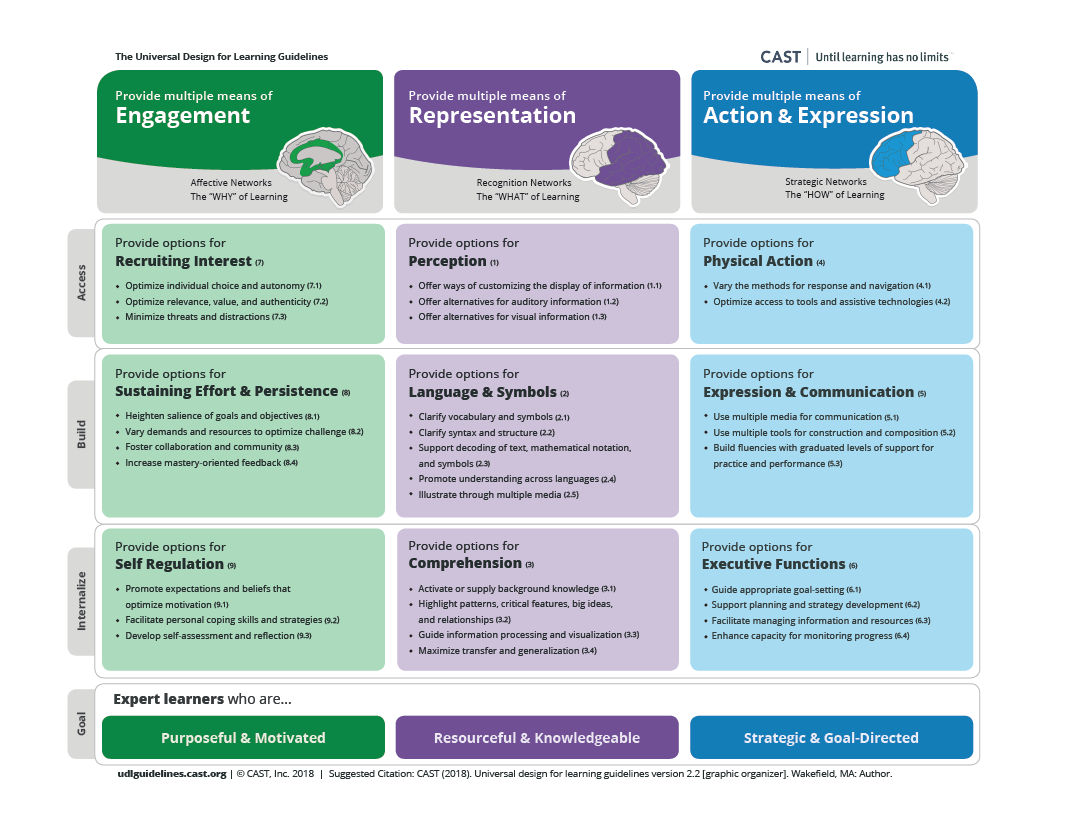
Obviously, designing your classroom learning environment and lessons to accommodate the unique needs of each student sounds like a daunting task, and I will not try to make an argument to the contrary. I will, however, propose a method for slowly rolling out UDL in your classroom over a series of years, which I hope you will find logical and reasonable. For a variety of reasons, I feel it makes sense to, initially, only tackle one of the aforementioned core areas each year, beginning with engagement in year one.
This UDL Progression Rubric is designed to help teachers monitor their own progress towards “Expert Practice” and is a great way to get a clear picture of what a well-designed UDL classroom could look like. My fear is that a skeptical teacher could read through the various descriptions of how students would operate in such a classroom and determine that “we just don’t have the kinds of kids who can do these things.” Initially, I shared this concern, but I soon realized that, if our kids lack the skills and competencies to be UDL students, then teaching them these skills and competencies should be job one. I began referring to the prerequisites they would need as a “meta-curriculum.” In other words, to as great an extent as possible, I should try to weave them into everything I do all day.
It is clear that the architects of UDL view Engagement as the first, crucial step towards UDL success. This makes perfect sense, given that students who feel they are in a safe, welcoming environment in which their own interests and abilities are taken into consideration are much more likely to be ready and motivated to learn. In my view, a teacher who is reaching “Expert Practice” levels in Engagement has already gone a long way towards preparing students to be successful in the areas of Representation and Action & Expression. In the rest of this post, I will describe what I perceive to be the ideal UDL student and classroom environment and lay out some strategies I have begun to use with my own students to set them up for success. Future blog posts will explore these strategies in deeper detail.
In the “Recruiting Interest” section of the Engagement progression rubric, you will see terms like “make choices or suggest alternatives,” “authentic,” “self-monitor and reflect,” and “self-advocate.” All of these terms paint a picture of a student who is confident, assertive, motivated, and self-aware in terms of both their personal interests and social-emotional needs. One of Dr. Hammond’s goals involves increasing students’ self-efficacy, which dovetails perfectly with the above description. Of course, a student who is designing their own projects and assignments and monitoring their learning environment for distractions and threats is taking a great deal of ownership of their learning and likely experiencing a strong sense of agency.
The “Sustaining Effort and Persistence” section talks about students creating their own personal goals, selecting their own content and assessments, and collaborating “to add to the multiple options offered to challenge themselves and identify appropriate resources that connect to their interests and passions.” These goals imply a similar need for the skills and competencies mentioned above. Additionally, the teacher is expected to, “Create a classroom culture where students work together to define goals, create strategies, provide feedback to each other and push each other with mastery-oriented feedback while building integrative thinking,” and empower students, “to use mastery-oriented feedback independently to self-reflect, self-direct, and pursue personal growth in areas of challenge.” When I first read these descriptions (along with those in the Recruiting Interest section), I realized that all five of the SEL competencies (Self-Awareness, Self-Management, Social-Awareness, Relationship Skills, and Responsible Decision-Making) were going to be crucial to cultivating such classroom cultures and students.
Speaking of SEL skills, the third and final section of the area of Engagement is called “Self-Regulation,” which is just another term for self-management, but this area requires even more than that. Here, students are expected to be willing and able to support their, “own self-talk and support one another's positive attitudes toward learning.” These goals require both self-efficacy and relationship skills. Further, students should, “self-reflect, accurately interpret their feelings, and use appropriate coping strategies and skills to foster learning for themselves and their classmates.” SEL, SEL, SEL.
It is an oversimplification to say that the Engagement portion of the UDL is simply SEL by another name. While SEL skills clearly play a major role, there is also a strong academic bent to this area which includes a student’s ability to identify their own preferred learning styles, settings, strengths, weaknesses, and interests. In addition, the student should be able to create their own learning plans, self-assessments, rubrics, and projects. There is also a collaborative aspect to Engagement, which clearly benefits from social awareness and relationship skills but also requires the ability to have academic discussions.
This year, I have tasked myself with experimenting with various ideas for improving my classroom Engagement. So far, these ideas have included making my classroom a more relaxing and enjoyable place to learn and teaching my students to engage in casual conversations. I have also tied Engagement to my ELA instruction by giving my kids regular opportunities to reflect on their SEL competencies and academic skills through journaling and Kagan structures, reading novels and Wonders stories that address SEL skills, and writing personal narratives that involve their experiences with the aforementioned competencies and skills. Over the course of the next few months, I will delve deeper into each of these areas and report on any future ideas with which I begin experimenting.
Writing Every Day,
Eric Lovein
Friday, November 3, 2023
Next Gen Math - Dabble & Start Small
Welcome to my 'Huddle Time' - the purpose of this time is to provide a short video that offers student centered ideas to consider for your classroom.
HUDDLE TIME VIDEO #9
Today's Huddle Time focuses on
- Next Gen Math computer application
Resources:
- Warm-ups (Math 8 - 2023) - Link
Remember to believe in yourself, believe that you matter, and believe that you make a difference in students' lives every time that you interact with them.
Teaching and still loving it,
Kevin Stott
De Anza Middle School
Tuesday, October 17, 2023
Gradually Learning to Let Go
This year, our whole staff is reading a book titled, Better Learning Through Structured Teaching by Douglas Fisher and Nancy Frey. According to Euclid's MTSS Team:
🍎First BEST Instruction is key. Meaning, deliberately planning and preparing for the Skill/Strategy being taught for the content areas. Our MTSS team last year chose to select Gradual Release as our Instructional structure for delivering lessons. Our book, Better Learning Through Structured Teaching, highlights the importance of Gradual Release of Responsibility and how to best support students.
Since this happens to also be my evaluation year, I decided that I would focus my chosen form of evaluation, an action research project, on mastering the gradual release approach expounded by authors, Fisher and Frey. I am cordially inviting you, my blog readers, to join me on what I anticipate will be a roller coaster of a learning journey. In fact, the longer I'm in the classroom, the more I realize that there is so much more for me to learn!
Just as it's essential to plan for an actual excursion, it's equally important to plan for a learning journey. So, here's my "To-Do" List:
1) Read the book. Check 👍.
2) Set aside an area to display my focus areas (as described in the book). 👍 ![]()
3) Begin incorporating new learnings. I have made a deliberate decision to proceed slowly as I institute this new framework into my classroom. 👍
As I mentioned in my September post, this year my class's G.A.T.E. Universal Theme focus is CHANGE. Item numbers 1, 6, and 7 from this handout that I shared with my students really resonated with me. They highlight where I'm at in this journey.
I am going to hold myself to the high expectations that I hold my students to. High expectations are vital, but so is embracing a growth mindset. I am going to make mistakes. That's natural and expected when learning something new. I am going to try new things and try again when things go awry. But I'll get there eventually and you can keep me company along the way.
Still learning and growing,
Lola E. Jollie
Tuesday, October 10, 2023
Universal Theme: Change
Years ago, I attended a G.A.T.E. training that challenged me to think deeply about universal themes. According to the site Envision Gifted, "A universal theme is an organizing concept that transcends time and place, and brings focus to learning across subject areas." I had never heard the term "universal theme," uttered in any academic setting, and, to be perfectly honest, I struggled to understand what the presenter was discussing. Sure, I nodded confidently as she delved deeper into the concept, but the truth was that I needed to let the concept simmer on low for a while in my mental crockpot.
Lately, after listening to multiple learning podcasts by Justin Sung ("...a former medical doctor, full-time learning coach, and consultant...), I've come to realize what my experience as a learner and teacher has already revealed to me: learning is messy and not necessarily linear. Every year I understand the concept of universal themes just a tad more than the year before and am better able to integrate facets of them into my instructional planning.
Using universal themes enables me to unify instruction across content areas. Here are examples of questions that spark conversations about the universal theme of change:
- Math: How do numbers change when we add to them or subtract from them?
- Science: What is the process by which a caterpillar changes into a butterfly?
- Social Studies: What changes occur in cities when the population increases or decreases?
- Reading: Would using another word in place of _____________ change the author's intent?
- Writing: How would your writing change if you used a more powerful term instead of ________ to indicate how you are feeling?
- Word Study: How does the meaning of ______________ change if we add a prefix or a suffix?
Friday, September 29, 2023
Wrapping Paper Matters! (Superheroes, Harry Potter, Anime, Sponge Bob - Students love them)
Welcome to my 'Huddle Time' - the purpose of this time is to provide a short video that offers student centered ideas to consider for your classroom.
HUDDLE TIME VIDEO #8
Today's Huddle Time focuses on
- Student Engagement Activity - Reviewing a topic of study
Resources:
Remember to believe in yourself, believe that you matter, and believe that you make a difference in students' lives every time that you interact with them.
Teaching and still loving it,
Kevin Stott
De Anza Middle School
Wednesday, August 30, 2023
Interim Assessments (IABs) - Never to early to start
Welcome to my 'Huddle Time' - the purpose of this time is to provide a short video that offers student centered ideas to consider for your classroom.
HUDDLE TIME VIDEO #7
Today's Huddle Time focuses on
- Interim Assessments (CAASPP website)
CAASPP website: https://www.caaspp.org/
Our site's current data gathering document: Link
Our Team is giving our first IAB on August 31 with the goal that students experience an IAB on a consistent basis from the beginning of the year all the way up to CAASPP testing.
Follow up to original post (September 3): Student feedback is important. To accomplish this, I highlight in green each student's correct responses and then provide focused feedback on certain questions. This feedback is different for each student depending on their understanding of the material - so some students get feedback on the Level 1 questions and other students get feedback on high level thinking questions.
Remember to believe in yourself, believe that you matter, and believe that you make a difference in students' lives every time that you interact with them.
Teaching and still loving it,
Kevin Stott
De Anza Middle School
Thursday, April 13, 2023
April Showers Bring May Flowers
In elementary school, I remember one of my teachers saying that April showers bring May flowers. That saying resonated with me because I never enjoyed rainy days (or Mondays--as the song by the popular brother/sister duo, the Carpenters, accurately expressed in their 1970's hit song). My teacher's words gave me hope that the rain would not last forever. And it gives me hope now.
As we near the April 24th date for the start of CAASP testing, I feel a change in the atmosphere--just like you do when your senses tell you it's about to start raining. This year after Spring Break, the school atmosphere at my site changed drastically. Our focus is now on preparing students for the state test. Don't get me wrong. We are not teaching to the test; rather, we are ensuring that our students are prepared to "show what they know" on the assessment.
In the same way that I made certain I was ready for the rainy season, I am also making sure that my students are as prepared as possible for testing season. Every day of instruction matters. In my ELA instruction over the next two weeks, I will be reviewing:
- the RACE Strategy for answering constructed-response questions. I've linked an example of a worksheet I created for Wonders Unit 3, Week 5.
- how to determine the meaning of unknown words by using context clues.
- how to use my "Plug It In" strategy. If students see a blank line or an empty box, they need to "plug in" the choices. Here is an example.
In my math instruction over the next two weeks, I will be reviewing:
- the importance of working out each problem on scratch paper.
- math terms and phrases such as perimeter, area, and equivalent fractions. I've linked a helpful handout.
Most Viewed Posts
-
In my previous post, I discussed how incorporating Kagan engagement structures into your classroom can help not only increase the engagem...
-
Fluency: Sprints in Eureka Math What is "fluency" in terms of mathematics? And what is the purpose? Eureka Math explains fluenc...
-
If you're familiar with Kagan, then the "Rally Coach" structure is not a stranger. However, you may have forgotten about thi...